


The Chinese Communist Party (CCP) inherited from the Soviet Union a tradition of treating the health of top leaders as a matter of state security. A leader’s illness was not viewed simply as a medical issue, but as a potential threat to political stability, succession, and control of the party, military, and propaganda apparatus. As a result, authorities often tightly restricted information about a leader’s health.
The late Soviet era provided some of the clearest examples. Leonid Brezhnev’s health had deteriorated significantly by the late 1970s, with his slurred speech, slow movements, and declining public appearances becoming increasingly difficult to conceal. Despite this, Soviet authorities continued to project an image of stable leadership until his death on Nov. 10, 1982.
Similar secrecy surrounded his successors. Yuri Andropov suffered serious health problems soon after taking office and disappeared from major public events, while officials offered only vague explanations. Konstantin Chernenko was also in poor health during his brief tenure.
The deaths of Brezhnev, Andropov, and Chernenko in rapid succession reinforced an image of an aging Soviet leadership operating behind a highly secretive political system.
Concealing everything becomes a political habit
After this logic was passed on to the CCP, it became even more institutionalized. The CCP’s concealment of its leaders’ health has become a longstanding political practice. Its real purpose is not to protect personal privacy, but to protect the mythology of power.
For the best of our weekly content!
You are now signed up for our newsletter
Check your email to complete sign up
When the supreme leader must be portrayed as eternally correct, eternally stable, and eternally in command, his physical condition cannot easily be allowed to reveal aging, loss of control, or vulnerability.
Within the CCP’s political system, information about health carries political significance. If the health of the top leader were made public, outsiders would not merely ask whether he was capable of continuing to work. They would also ask who was making decisions in his place, who controlled the military, who was influencing personnel appointments, and whether succession procedures existed.
Once such questions are raised, they can weaken the supreme leader’s authoritative image and expose the system’s excessive dependence on personal power. As a result, concealing health information gradually becomes a means of “maintaining stability.”

Mao Zedong: The politicization of medical care
Mao Zedong’s final years are often regarded as an early example of the CCP leadership’s medical black box. Mao suffered from numerous illnesses in his later years, and his physical condition steadily deteriorated, but information about his health was never handled in an open and transparent manner.
Externally, the authorities sought to preserve his image as the supreme leader. Internally, a highly secretive system developed around medical treatment, political decision-making, and struggles for power.
Mao’s personal physician, Li Zhisui, wrote in his memoir, The Private Life of Chairman Mao: The Memoirs of Mao’s Personal Physician (Random House, 1994), that he was responsible for Mao’s medical care for many years, from 1954 until Mao’s death in 1976. He described Mao’s deteriorating health in his later years and the political pressure under which his medical team worked, providing an important perspective on the politicization of Mao’s medical treatment.
According to relevant accounts, Mao suffered from chronic respiratory illnesses in his later years and developed more serious physical problems by the mid-1970s. At the time, the outside world had great difficulty obtaining reliable information and could only speculate about his condition based on details such as whether he met foreign guests, appeared in public, or spoke during meetings.
Mao’s illness became incorporated into the regime’s power structure. The professional judgment of his medical team could also be constrained by political considerations, the need to maintain the leader’s image, and internal power struggles.

Deng Xiaoping: The hidden power of health
The Mao era left behind the CCP’s tradition of opaque politics. By Deng Xiaoping’s later years, political power did not necessarily require a leader to remain publicly visible in order for him to exercise decisive influence at critical moments.
Deng gradually relinquished his formal positions during the 1980s, and after 1989 he no longer appeared publicly as the country’s formal leader. Nevertheless, he continued to be regarded as China’s “paramount leader,” or its ultimate political arbiter. Precisely because of this, his physical condition and public appearances became closely tied to outside assessments of “who was really in charge.”
When authorities announced Deng’s death in 1997, they explicitly stated that he had died from complications of Parkinson’s disease and a lung infection. Before that, however, the outside world had spent years judging his health and political influence by whether he appeared publicly, met foreign guests, or expressed opinions on major policies.

Jiang Zemin: Image management
By the Jiang Zemin era, the leadership health black box had increasingly evolved into a form of image management suited to the media age. Unlike the extreme secrecy surrounding Mao’s final years, Jiang operated in an era of television, internet news, and increasingly active international media.
Authorities did not necessarily have to disclose details about a leader’s health. Instead, they could use photographs, video footage, public appearances, and memorial ceremonies to shape perceptions of the political standing of former or retired leaders.
Jiang’s public appearances after retirement continued to carry political significance. Whether he attended major Party anniversaries, National Day celebrations, or memorial services for former leaders was frequently interpreted by outsiders as an indication of whether he retained political influence.
Around 2011, Jiang’s absence from celebrations marking the CCP’s 90th anniversary sparked rumors that he was seriously ill or had died. Authorities initially provided no detailed explanation, while Xinhua later denied related reports.
Jiang died on Nov. 30, 2022. Xinhua announced that the cause of death was leukemia and multiple organ failure. State media adopted black-and-white webpages and standardized mourning coverage.
Hu Jintao: A strange scene
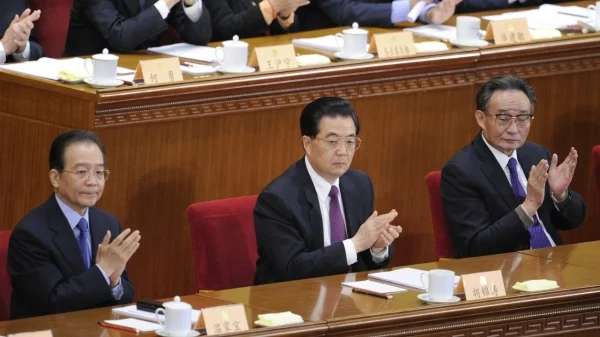
Compared with Mao, Deng, and Jiang, health issues surrounding Hu Jintao were less dramatic. The era in which Hu governed appeared more institutionalized. Term limits, succession, “collective leadership,” and retirement practices differed considerably from the Mao era.
Yet this institutionalization remained largely superficial, while top-level political information continued to lack transparency. When Hu appeared publicly, when he disappeared from view, and the manner in which he appeared remained tightly controlled.
The scene at the closing ceremony of the CCP’s 20th National Congress in 2022, when Hu Jintao was escorted out by staff members, exposed the fragility of this control over visibility.
According to Reuters’ reporting from the scene, Hu was escorted from the main stage by two staff members after journalists had entered the hall, and the footage quickly generated intense international media discussion. Xinhua later stated through its English-language social media account that Hu had not been feeling well during the session and had gone to a room beside the meeting venue to rest, adding that his condition had improved.

The black box under Xi Jinping
Under Xi Jinping, this historical trajectory has moved toward an even deeper black box.
If the Mao era established a model in which medical treatment and political power became intertwined; the Deng era demonstrated how an informal supreme leader could direct affairs from behind the scenes; the Jiang era transformed appearances by retired leaders into a form of political image management; and the Hu era exposed the fragility of controlling leaders’ public visibility under supposedly institutionalized politics, then under Xi Jinping, the concentration of supreme power in one individual has further magnified the connection between health, travel schedules, public appearances, and political signaling.
Whenever Xi fails to appear frequently for a period of time, or when the rhythm of his public activities changes, various political rumors tend to emerge. Speculation about his health, serious illness, or even possible succession can appear.
These rumors repeatedly gain traction precisely because the system itself has long lacked transparency. When information is scarce, speculation fills the vacuum. When the authorities say nothing, the outside world magnifies and interprets every detail.
It can therefore be seen that when power is excessively concentrated in one person, and there are no open, predictable, and verifiable succession mechanisms, the health of top leaders inevitably becomes a barometer of political stability.
A canceled event can be interpreted as evidence of a power struggle. A change in a leader’s itinerary can likewise be interpreted as evidence of political upheaval.
In an authoritarian system, health problems can easily be regarded as the beginning of a struggle for power. The more such information is suppressed and concealed, the more likely it is to trigger turmoil at critical moments.
Original article
Comments