


President Donald Trump said the Israeli prime minister would not be arrested on U.S. soil after New York City Mayor Zohran Mamdani discussed whether the International Criminal Court’s warrant could be enforced during the United Nations General Assembly.
By yourNEWS Media Newsroom.
President Donald Trump declared Monday that Israeli Prime Minister Benjamin Netanyahu would not be detained during an anticipated September visit to New York City, directly rejecting Mayor Zohran Mamdani’s effort to examine whether local authorities could act on an International Criminal Court arrest warrant.
Mamdani said his administration was exploring the legal possibility of arresting Netanyahu when the Israeli leader travels to the city for the United Nations General Assembly.
Trump responded in a Truth Social post, presenting Netanyahu as an ally fighting Iran and insisting that no arrest would occur while the prime minister is in the United States.
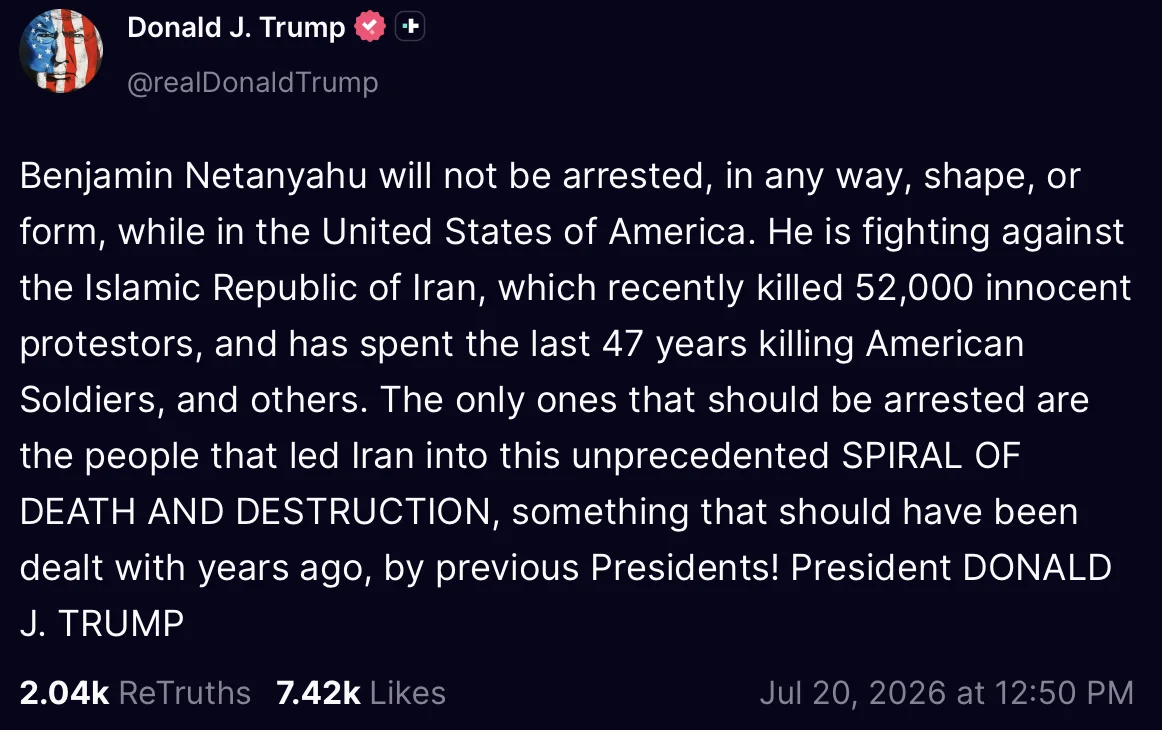
“Benjamin Netanyahu will not be arrested, in any way, shape, or form, while in the United States of America,” Trump wrote. “He is fighting against the Islamic Republic of Iran, which recently killed 52,000 innocent protestors, and has spent the last 47 years killing American Soldiers, and others.”
“The only ones that should be arrested are the people that led Iran into this unprecedented SPIRAL OF DEATH AND DESTRUCTION, something that should have been dealt with years ago, by previous Presidents! President DONALD J. TRUMP,” he added.
The dispute centers on arrest warrants the International Criminal Court issued in 2024 for Netanyahu and former Israeli Defense Minister Yoav Gallant.
The court announced the warrants, alleging criminal responsibility for war crimes and crimes against humanity arising from Israel’s military campaign following the Oct. 7, 2023, Hamas attack.
“The Chamber issued warrants of arrest for two individuals, Mr Benjamin Netanyahu and Mr Yoav Gallant, for crimes against humanity and war crimes committed from at least 8 October 2023 until at least 20 May 2024, the day the Prosecution filed the applications for warrants of arrest,” the ICC stated.
The court said the warrants were classified as secret to protect witnesses and preserve the investigation but released information about them because the alleged conduct appeared to be continuing.
“The arrest warrants are classified as ‘secret’, in order to protect witnesses and to safeguard the conduct of the investigations,” the ICC said. “However, the Chamber decided to release the information below since conduct similar to that addressed in the warrant of arrest appears to be ongoing. Moreover, the Chamber considers it to be in the interest of victims and their families that they are made aware of the warrants’ existence.”
The court also addressed Israel’s challenge to its authority over the case.
“At the outset, the Chamber considered that the alleged conduct of Mr Netanyahu and Mr Gallant falls within the jurisdiction of the Court,” the ICC stated. “The Chamber recalled that, in a previous composition, it already decided that the Court’s jurisdiction in the situation extended to Gaza and the West Bank, including East Jerusalem.”
“Furthermore, the Chamber declined to use its discretionary proprio motu powers to determine the admissibility of the two cases at this stage,” the court continued. “This is without prejudice to any determination as to the jurisdiction and admissibility of the cases at a later stage.”
The ICC said judges found reasonable grounds to believe Netanyahu and Gallant shared criminal responsibility for several alleged offenses.
“With regard to the crimes, the Chamber found reasonable grounds to believe that Mr Netanyahu, born on 21 October 1949, Prime Minister of Israel at the time of the relevant conduct, and Mr Gallant, born on 8 November 1958, Minister of Defence of Israel at the time of the alleged conduct, each bear criminal responsibility for the following crimes as co-perpetrators for committing the acts jointly with others: the war crime of starvation as a method of warfare; and the crimes against humanity of murder, persecution, and other inhumane acts,” the court stated.
“The Chamber also found reasonable grounds to believe that Mr Netanyahu and Mr Gallant each bear criminal responsibility as civilian superiors for the war crime of intentionally directing an attack against the civilian population,” it added.
Netanyahu has rejected the court’s allegations, and Israel disputes the ICC’s jurisdiction.
The prospective confrontation in New York is complicated by the legal and diplomatic status of both the United States and the United Nations.
Netanyahu would be traveling to attend a U.N. gathering, while the ICC’s institutional development is closely connected to the history of international cooperation through the United Nations.
The ICC is legally separate from the United Nations, but the two institutions maintain a formal relationship and frequently cooperate. The court’s role, authority and relationship with international institutions have remained subjects of dispute among governments that object to its jurisdiction.
The United States is not a party to the Rome Statute, the treaty that created the ICC, and the Trump administration has strongly opposed efforts by the court to exercise authority over American officials, service members or allied leaders.
The administration is now advocating for the institution to be dismantled, arguing that it threatens national sovereignty by claiming authority over people from countries that never accepted its jurisdiction.
“Now the ICC and its allies seek a standing world tribunal with near-unlimited reach, empowered to override the courts and constitutions of the U.S. and other sovereign states—and to prosecute and arrest our citizens,” Secretary of State Marco Rubio wrote Tuesday.
“Americans never agreed to any of this,” Rubio continued. “Both of our major political parties opposed the prospect of handing a distant global court the power to prosecute and jail our own citizens.”
Rubio cited former President Bill Clinton’s decision not to send the Rome Statute to the Senate for ratification.
President Clinton refused to seek ratification because of what he described as “concerns about significant flaws in the Treaty,” Rubio wrote.
“Two years later, a bipartisan Senate supermajority passed the American Servicemembers’ Protection Act, authorizing the president ‘to use all means necessary’—including military force—to prevent the ICC from detaining or arresting Americans,” Rubio added.
Mamdani’s proposal therefore places New York City at the center of a broader dispute involving municipal authority, federal foreign policy, diplomatic protections and the enforceability of an international arrest warrant in a country that does not recognize the ICC’s jurisdiction over its citizens.
Trump’s statement made the administration’s position unequivocal: Netanyahu will be protected from arrest while visiting the United States.
Whether New York officials possess any independent legal authority to act on the warrant remains unresolved, but any attempt to detain a sitting foreign leader attending the General Assembly would likely provoke an immediate confrontation with the federal government.
Original article
Comments