


President Donald Trump said the United States risks decline if it accepts large numbers of migrants from poorer countries, prompting renewed debate over immigration, economic outcomes and national identity.
By yourNEWS Media Newsroom
President Donald Trump renewed his criticism of mass immigration Monday, arguing that large-scale migration from poorer countries can undermine national stability and transform the character of wealthier nations.
In a Truth Social post, Trump said the United States must avoid policies that, in his view, import the problems of less-developed countries into America.
“Sadly, if you import people from Third World Countries, you quickly become a Third World Country — And there’s not a thing you can do about it. MAKE AMERICA GREAT AGAIN! President DONALD J. TRUMP,” Trump wrote.
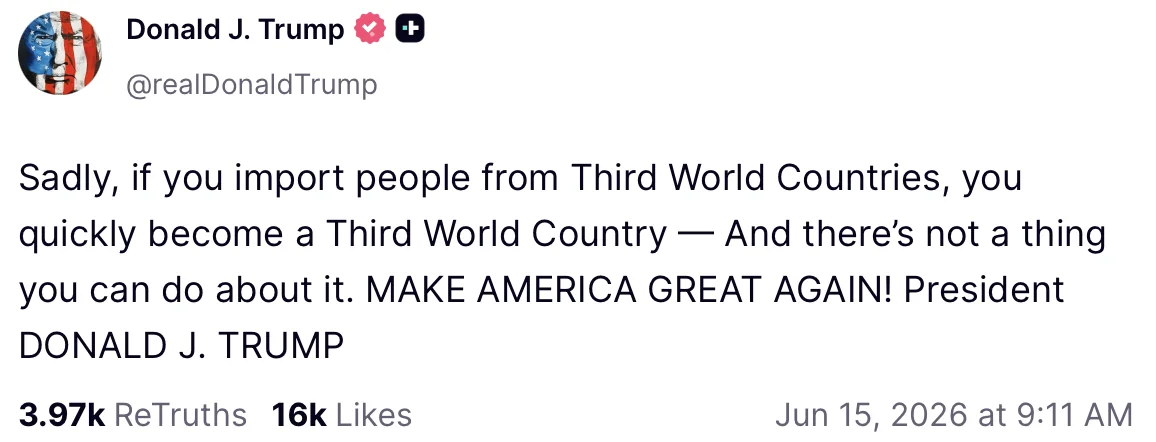
The statement drew attention from supporters who argue that immigration policy should be evaluated through its effects on public order, public services, wages, welfare systems, cultural cohesion and national security. Critics of mass migration have long argued that governments cannot separate immigration levels from the social and economic conditions that follow.
Trump’s comments also revived discussion over whether national outcomes are shaped primarily by institutions, culture, political leadership, geography, economics or the composition and values of a population.
Some commentators have pointed to South Africa as an example of a country whose political and social trajectory changed after the end of minority rule, citing the country’s transition during decolonization. Others argue that Western Europe has faced rising tensions after decades of high migration, pointing to the United Nations’ Replacement Migration report as part of a broader debate over aging populations, labor supply and demographic change.
Supporters of Trump’s position argue that geography and climate alone do not determine whether a country becomes prosperous or unstable. They have compared places with similar climates but sharply different political and economic systems, including Pyongyang, North Korea, and Des Moines, Iowa, which have been described in a Reddit discussion as having similar climates.
The debate has also included discussion of economic contributions by migrants from different regions. In May, Trump posted a list based on an IZA study from the Netherlands that ranked lifetime fiscal contributions by nationality. A related article argued that some immigrant groups provide net economic benefits while others impose net costs on public systems, according to the summary cited in the source material.
Media commentator Paul Joseph Watson also addressed cultural differences in a 2016 video that has received more than 1.2 million views, arguing that cultures should not be treated as interchangeable when assessing immigration and assimilation.
Trump has previously made comments about criminal behavior, migration and inherited traits. In a March interview with Fox News Radio’s Brian Kilmeade, Trump discussed violent attacks and said some offenders should not have been allowed into the country.
“They’re sick people, and a lot of them were let in here. They shouldn’t have been let in. Others are just bad. They go bad. Something wrong — there’s something wrong there. The genetics are not exactly, they’re not exactly your genetic,” Trump told Kilmeade. “It’s one of those problems, Brian. It’s a, it’s a terrible thing, and it happens.”
The remarks have fueled renewed political debate over how far immigration restrictions should go and what standards should guide admissions. Trump’s supporters say the president is raising concerns about national survival, public safety and the long-term consequences of migration policy. Opponents say such rhetoric risks overgeneralizing large populations and escalating social division.
The latest post comes as immigration remains one of the central issues in Trump’s second term. His administration has emphasized deportations, tighter border control and a broader effort to reverse policies that it says allowed too many migrants to enter the United States without sufficient vetting or regard for long-term costs.
The debate is expected to continue as the administration presses its immigration agenda and as supporters and critics argue over whether migration should be judged primarily by humanitarian commitments, labor-market needs, fiscal impact, cultural assimilation, public safety or national sovereignty.
Original article
Comments