


When you look up at the night sky, it appears unchanging. But if you look deep enough, you will find that the sky is, in fact, constantly shifting. Satellites, asteroids, and interstellar objects pass by. Stars not only shine brightly, but they can also suddenly burst with energy or explode in bright supernovae.
There is a plethora of explosive and cataclysmic phenomena waiting to be witnessed. For physicists, this is an opportunity to study our universe and physics that we can’t reproduce on Earth.
A whole new era of discovery is opening with the NSF-DOE Vera C. Rubin Observatory. For the next ten years, Rubin will create a high-definition video of the southern sky, revealing our universe in an unprecedented way. Many of the objects it finds will have never before been seen by human eyes.
More than 20 years in the making
This moment has been more than 20 years in the making, from the concept to the completion of the Rubin Observatory.
Located on a dark sky mountaintop in Chile, the observatory represents a generational leap in astronomy with its ultra-wide, deep, and high-resolution imaging capabilities.
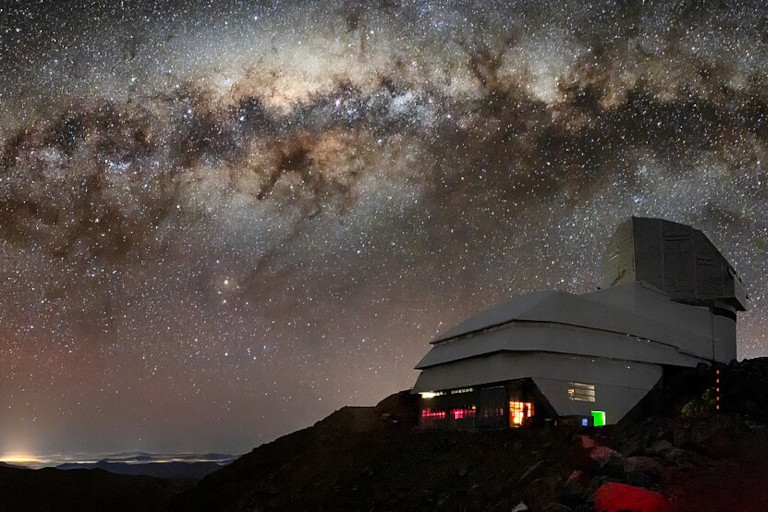
The Rubin Observatory represents a generational leap in astronomy with its ultra-wide, deep, and high-resolution imaging capabilities. (Image: via NSF-DOE Vera C. Rubin Observatory / NOIRLab / SLAC / AURA/B. Quint)
Rubin has the largest camera ever built, with 3,200 megapixels. Each image scans an area equivalent to 40 full moons. The resolution of the images is so high that if we pointed the camera toward a lime located 24 kilometers away, it would be able to resolve exactly what type of fruit it is.
Last year, Rubin amazed us with its first test images. These images revealed a swarm of new asteroids never before detected, stars varying in our Milky Way, and beautiful deep images of galaxies. This is just a taster of what is to come; Rubin started publicly sharing hundreds of thousands of changing sky objects per night.
The telescope will be uniquely used for the Legacy Survey of Space and Time. This 10-year-long survey aims to solve the biggest mysteries of the universe — and the nature of the physics out there.
20 billion galaxies
…
Read the full article on Nspirement
Comments