


Some of the universe’s most extreme explosions leave behind almost no trace. The original explosion is unseen, but our observations can capture the long-lived echo it leaves behind as the shock front plows into its surrounding environment.
In new research accepted for publication in The Astrophysical Journal, we have discovered what may be the clearest example yet of one of these hidden explosions: the radio afterglow of a powerful gamma-ray burst whose initial blast went unnoticed.
The only other viable explanation for what we see is an extraordinarily rare event in which a star is torn apart by an intermediate-mass black hole: a long-hypothesized, elusive class of black holes that has proven difficult to detect.
Either way, we’re watching the slow-motion aftermath of one of the most extreme, rare events the cosmos can produce.
The explosions we usually miss
Gamma-ray bursts are brief but powerful jets of high-energy radiation. Within seconds, they release as much energy as the Sun will emit over its entire lifetime. They are caused when massive stars die and form black holes.
While these jets are launched in all directions, we only observe the small fraction whose emission is directed towards us. When it is directed away from us, the initial flash goes unseen, and all we can observe is the slowly fading afterglow.
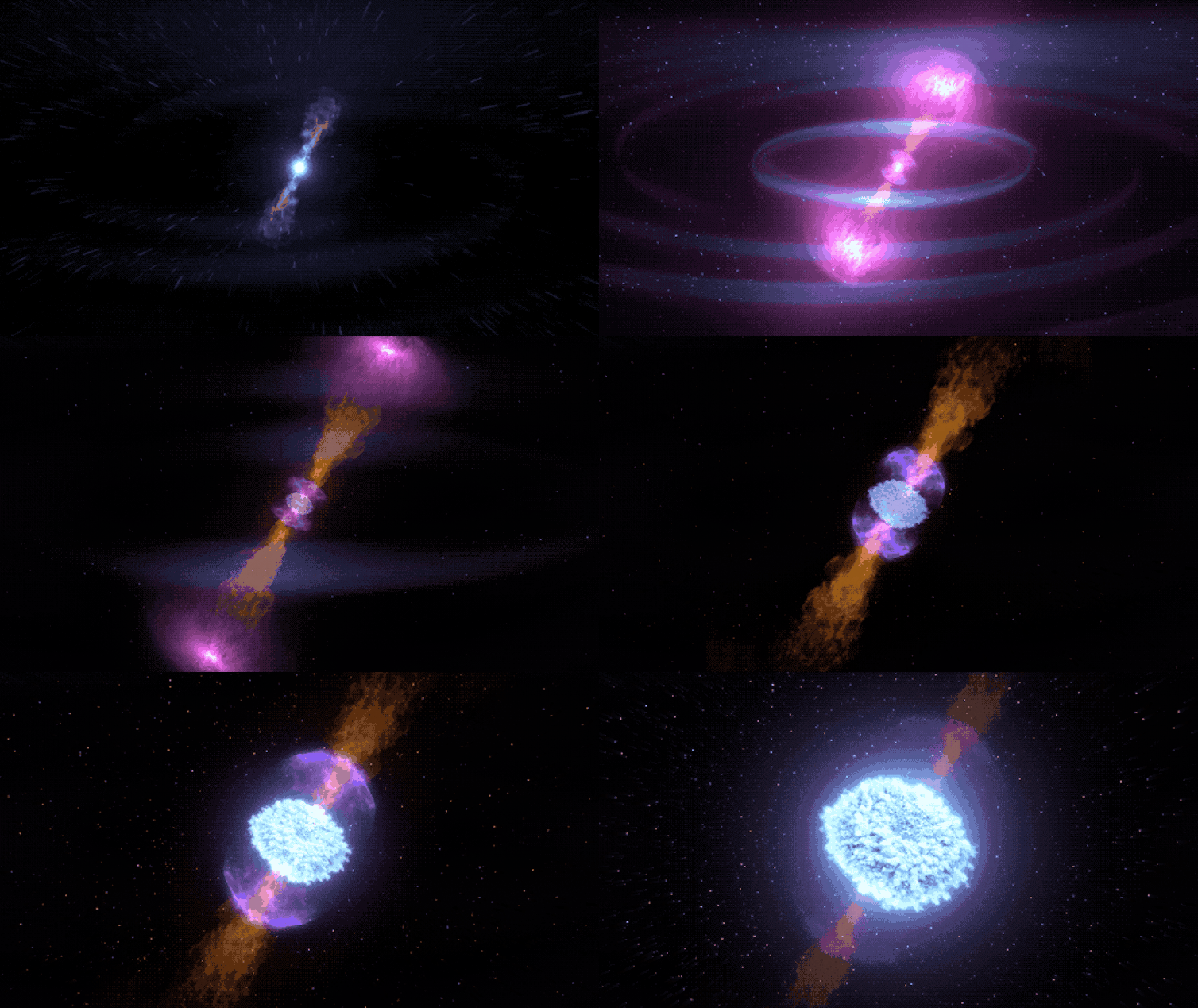
Animation of a gamma-ray burst showing the narrow, high-energy jets. (Image: via NASA)
…
Read the full article on
Comments