

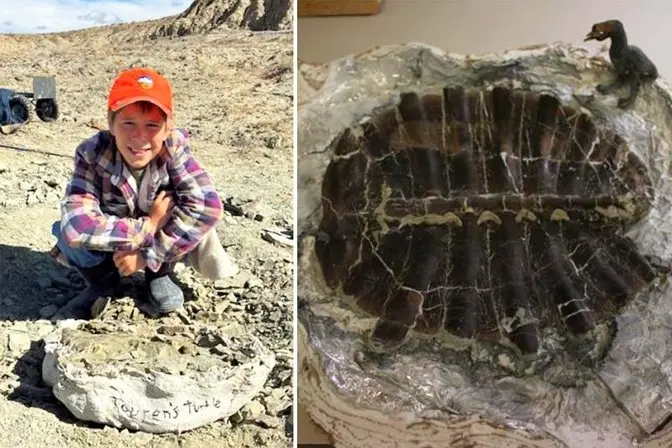
A routine family outing in the Wyoming badlands recently transformed into a "mind-blowing" brush with prehistory when 11-year-old Touren Pope stumbled upon a remarkably preserved fossil. What began as a simple day of rockhounding with his grandparents, Patti and Tom Patterson, ended with the discovery of a nearly 48-million-year-old softshell turtle shell that is now captivating the scientific community.
"It blew all of our minds. We're like, 'What is this?'" said Touren’s mother, amateur geologist Tessa Patterson, per Wyoming Public Media.
A Stroke of Luck and Keen Eyes
The discovery began with the family searching for rocks and finding white, clam-like shells that were very fragile. Touren recalled the moment his focus shifted: "We went searching for rocks and found a white, clam-like shells ... and like they were broken, some were not...very fragile and then I just got bored and it started doing weird stuff and I found it," Touren said, as reported by Wyoming News Now.

Patti and Tom immediately knew their grandson had found something special and texted a photo of the "weird rock" to Tessa. Recognizing the significance of the find, the family followed federal guidelines and reported it to the Bureau of Land Management (BLM). "Within a few minutes, we could tell it was a pretty complete turtle shell and worth collecting," museum specialist J.P. Cavigelli told Wyoming Public Media (WPM). Officials with the BLM confirmed the fossil was “nearly complete and remarkably well preserved."

A Race Against the "Turtle Splat"
Per a press release, the BLM stated that the prehistoric animal has stayed put in what used to be Lake Gosiute for nearly 48 million years. During that era, the Greater Green River Basin was a tropical floodplain filled with rivers, crocodiles and even monkeys in the trees.

However, the fossil faced a modern threat once it reached the surface. Craig Thomas, a paleontology field coordinator for the BLM, explained that water can trickle into a shell, causing minerals to expand and the fossil to shatter. Thomas referred to this rapid degradation as a "turtle splat" and noted that Touren found the specimen just in time.
Stepping Back in Time with "Little Timmy"
The fossil belongs to the trionychid family, a softshell variety that would look surprisingly familiar to modern observers. "Let's say you were experienced in looking at softshell turtles in Florida or Louisiana, and you came out here, time traveled, went back 50 million years — you would be able to say, 'That is a softshell turtle,'" Cavigelli explained.

As a reward for "doing the right thing," Touren was invited to participate in the excavation process in Sept. 2025. He was even given the honor of naming the turtle, choosing the name "Little Timmy."

A Legacy of Stewardship
"Little Timmy" has now found a permanent home at the Tate Geological Museum in Casper, Wyo., for all to see. For Touren, an avid science lover who handcrafts his own dinosaur books, the find has made him "more visible" in the paleontological community.

The story serves as a powerful reminder of the impact one person can have on history. The BLM stated that Touren's discovery "not only helped preserve an important piece of Wyoming’s paleontological history but also highlighted the role the public plays in protecting and responsibly reporting scientific resources found on public lands."
"These fossils on public land, they ultimately belong to the American people," Thomas said. Through Touren's keen observation and responsible reporting, a piece of Wyoming’s ancient past has been saved for future generations to appreciate.
Subscribe to The Bright Story and step into a world of hope, wonder, and humanity at its best. With unlimited access, discover powerful personal journeys, heartwarming family and animal stories, incredible discoveries, and the everyday kindness that makes life brighter.
Comments