


Charlemagne: The Unifier of Europe
Charlemagne, also known as Charles the Great, stands as one of the most influential rulers in European history. His reign from 768 to 814 marked a pivotal moment in the shaping of medieval Europe. Charlemagne's legacy as a unifier of Europe is evident in the vast empire he forged, his promotion of Christianity, and his support for cultural and intellectual revival. Through his military conquests, strategic alliances, and a vision for a united Christian empire, Charlemagne not only transformed the political landscape but also laid the foundations for the future of Western Europe.

(Charlemagne (747–814), (or “Charles the Great”) king of the Franks, the Lombards, and emperor of the Romans)
The Early Years: Charlemagne's Rise to Power
Charlemagne was born around 747 to Pepin the Short, King of the Franks, and Bertrada of Laon. His lineage belonged to the Carolingian dynasty, a family that had risen to power in the Frankish realm after the fall of the Merovingian dynasty. Upon the death of his father in 768, Charlemagne and his brother Carloman I inherited the Frankish kingdom, which was divided between them. The kingdom was vast, stretching from the North Sea to the Pyrenees, and it was home to a diverse array of people and cultures.
While Carloman and Charlemagne initially co-reigned, the two brothers had a strained relationship, largely due to power struggles and differing political views. Carloman died in 771, leaving Charlemagne as the sole ruler of the Frankish kingdom. This marked the beginning of Charlemagne's consolidation of power, which would eventually lead to the creation of the Carolingian Empire.
Charlemagne quickly set about solidifying his rule. He took on military campaigns to quell rebellions within the kingdom and expanded his territories through a series of conquests. His most notable campaigns included the annexation of Saxony, the defeat of the Lombards in Italy, and the subjugation of various other tribes and regions. Each of these conquests not only extended Charlemagne's control but also played a key role in his long-term goal of unifying Europe under a single Christian monarchy.
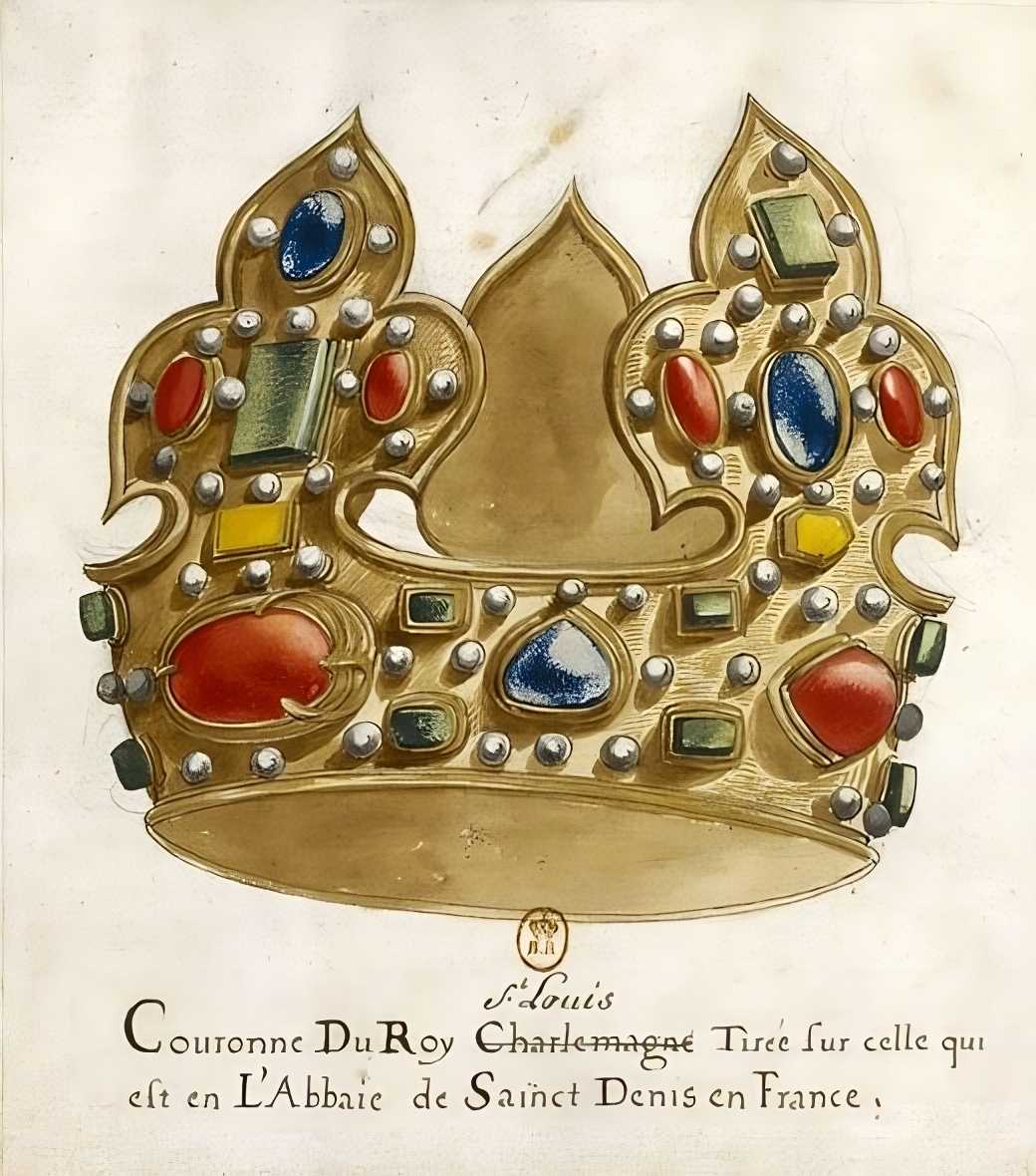
(The Crown of Charlemagne, also known as the Crown of Saint Louis. A painting by Dom Michel Félibien)
The Military Campaigns: Unifying the Territories
Charlemagne’s military campaigns were the primary tool through which he expanded his realm and brought Europe under his control. These campaigns were driven by both religious zeal and political ambition. He sought to extend the influence of Christianity across Europe and create a realm that could act as a bulwark against the expansion of Islamic forces from the south.
The Saxon Wars
One of Charlemagne's most prolonged and challenging military endeavors was the Saxon Wars, which lasted from 772 to 804. The Saxons, a pagan tribe living in what is now modern-day Germany, had long resisted Frankish domination. Charlemagne sought to bring them into his empire, not only for territorial expansion but also to convert them to Christianity.
The first phase of the Saxon Wars began in 772, when Charlemagne launched a campaign to subdue the Saxons and forced their conversion. Charlemagne's strategy was two-fold: he wanted to expand his empire and spread Christianity. In 772, he destroyed the Saxon sacred site of Irminsul, a symbol of their pagan religion, which intensified the conflict.
The Saxons resisted fiercely, and it took Charlemagne over three decades to bring them fully under control. His strategy involved a mix of military pressure, religious conversion, and diplomacy. Charlemagne established a network of Christian missions in Saxony, and over time, the Saxons were integrated into the Frankish kingdom. This victory laid the groundwork for the Christianization of northern Europe.
The Lombard Campaign
In 773, Charlemagne turned his attention to Italy. The Lombards, a Germanic people who had settled in northern Italy, had long been a thorn in the side of the Papacy. The Lombard King, Desiderius, had taken control of the Papal territories in central Italy, threatening the independence of the Pope. In response to the Pope's plea for help, Charlemagne marched into Italy with an army to confront the Lombards.
Charlemagne defeated King Desiderius in 774 and took control of the Lombard Kingdom. As a result, Charlemagne became the King of the Lombards and was recognized as the protector of the Papacy. This victory was crucial for several reasons. First, it solidified Charlemagne's authority in Italy and allowed him to control important strategic territories. Second, it strengthened his relationship with the Pope and reinforced his role as the defender of Christianity in Europe.
The Spanish March and the Reconquista
Charlemagne's military campaigns also extended into Spain, where the Muslim forces of the Umayyad Caliphate controlled much of the Iberian Peninsula. Charlemagne's forces engaged in several campaigns along the borders of the Christian kingdoms in northern Spain, known as the "Spanish March." Although Charlemagne was not able to expel the Muslims from Spain, his efforts were crucial in preventing further Muslim expansion into Europe.
The most famous episode in this context was the Battle of Roncevaux Pass in 778, where Charlemagne's rearguard was ambushed by Basque forces while returning from a campaign. Though Charlemagne's forces were ultimately unsuccessful in pushing the Muslims further south, his campaigns laid the groundwork for the future Christian Reconquista of Spain, which would unfold over several centuries.
The Carolingian Empire: A New European Order
Charlemagne's military successes were followed by a series of political and administrative reforms that helped him consolidate his power and create a unified empire. The most significant of these reforms was his effort to create a system of governance that combined both secular and religious authority.
The Role of the Pope
One of the most important factors in Charlemagne's unification of Europe was his relationship with the Pope. The Christian Church was a powerful institution in medieval Europe, and the Pope wielded considerable influence. Charlemagne understood the importance of this relationship and worked closely with the Church to legitimize his rule and promote his vision of a united Christian Europe.
In 800, Charlemagne's status was elevated to a new level when Pope Leo III crowned him Emperor of the Romans on Christmas Day. This event symbolized the revival of the Western Roman Empire and marked the beginning of the Holy Roman Empire, which would endure for centuries. By receiving the imperial crown from the Pope, Charlemagne not only secured religious legitimacy for his reign but also solidified his role as the defender of Christianity in Europe.
Administrative Reforms
Charlemagne implemented a series of administrative reforms to better govern his vast empire. One of his key strategies was the establishment of a system of local rulers known as "counts," who were responsible for maintaining order and administering justice in their regions. These counts were chosen by Charlemagne and were expected to enforce the law, collect taxes, and ensure the protection of Christian institutions.
Charlemagne also created a system of royal inspectors known as "missi dominici" who were sent to the various regions of his empire to ensure that his policies were being followed and that his local officials were not abusing their power. These inspectors played a crucial role in maintaining the cohesion of the empire and ensuring that Charlemagne's authority was respected throughout the realm.
The Carolingian Renaissance
(The Carolingian Dynasty and the Holy Roman Empire)
In addition to his military and political reforms, Charlemagne is also credited with promoting a cultural revival known as the Carolingian Renaissance. During his reign, Charlemagne sought to revive the intellectual and cultural achievements of the classical world. He established a network of schools and encouraged the study of Latin, classical literature, and Christian theology.
Charlemagne’s court became a center of learning, and he attracted scholars from across Europe to his palace. Among the most notable of these scholars was Alcuin of York, who played a key role in the Carolingian Renaissance by promoting education and the preservation of ancient texts. Charlemagne’s support for learning and the arts helped to lay the foundation for the intellectual revival that would take place during the High Middle Ages.
Charlemagne's Legacy: The Impact on Europe
Charlemagne's reign had a profound and lasting impact on Europe. His efforts to unify the continent through military conquest, religious conversion, and political reform helped to create a more cohesive Europe that would endure for centuries. Charlemagne's empire served as a model for future European rulers, and his efforts to promote Christianity and learning laid the foundation for the development of Western European civilization.
One of Charlemagne's most lasting legacies was the establishment of the Holy Roman Empire. Although the empire would eventually fragment and face numerous challenges, it remained a dominant political force in Europe for over a thousand years. The idea of a united Christian empire, as embodied by Charlemagne, continued to inspire European rulers throughout the medieval period.
Charlemagne's commitment to Christianity also played a central role in the spread of the religion across Europe. His support for the Church and his efforts to Christianize the pagan tribes of Europe helped to solidify the role of Christianity as a unifying force in the continent. The Christianization of Europe would continue over the next several centuries, and it became a cornerstone of European identity.
Conclusion
Charlemagne's reign was one of the most significant periods in European history. His ability to unify the continent through military conquest, religious conversion, and political reform made him a central figure in the formation of medieval Europe. Charlemagne's legacy as a unifier of Europe is seen not only in the empire he created but also in the cultural, intellectual, and religious foundations he laid for future generations. His reign marked the beginning of a new era in European history, one that would shape the continent for centuries to come.