


From Wikipedia, the free encyclopediaThis article is about the biblical figure. For other uses, see Mary Magdalene (disambiguation).
| SaintMary Magdalene | |
|---|---|
| Mary Magdalene (c. 1598) by Domenico Tintoretto, depicting her as a penitent | |
| Apostle to the Apostles | |
| Born | Possibly Magdala , Roman Judea |
| Venerated in | Catholic ChurchEastern Catholic ChurchesEastern Orthodox ChurchesOriental Orthodox ChurchesAnglican CommunionLutheranismother Protestant churchesBaháʼí Faith |
| Canonized | Pre-Congregation |
| Feast | July 22 |
| Attributes | Western: alabaster box of ointmentEastern: container of ointment (as a myrrhbearer), or holding a red egg (symbol of the resurrection); embracing the feet of Christ after the Resurrection |
| Patronage | ApothecariesArahal, SpainAtrani, ItalyCasamicciola Terme, Ischiacontemplative lifeconvertsDiocese of Salt Lake CityglovershairdressersKawit, CaviteAmadeo, CaviteMagdalena, LagunaSanta Magdalena, SorsogonOrder of Preachersperfumeriespeople ridiculed for their pietypharmacistsPililla, RizalProvencepenitent sinnerstannerssexual temptationwomen |
Mary Magdalene[a] (sometimes called Mary of Magdala, or simply the Magdalene, Magdalena or the Madeleine) was a woman who, according to the four canonical gospels, traveled with Jesus as one of his followers and was a witness to his crucifixion and resurrection.[1] She is mentioned by name twelve times in the canonical gospels, more than most of the apostles and more than any other woman in the gospels, other than Jesus's family. Mary's epithet Magdalene may be a toponymic surname, meaning that she came from the town of Magdala, a fishing town on the western shore of the Sea of Galilee in Roman Judea.
The Gospel of Luke chapter 8 lists Mary Magdalene as one of the women who traveled with Jesus and helped support his ministry "out of their resources", indicating that she was probably wealthy. The same passage also states that seven demons had been driven out of her, a statement which is repeated from Mark 16. In all four canonical gospels, Mary Magdalene is a witness to the crucifixion of Jesus and, in the Synoptic Gospels, she is also present at his burial. All four gospels identify her, either alone or as a member of a larger group of women which includes Jesus's mother, as the first to witness the empty tomb,[1] and, either alone or as a member of a group, as the first to witness Jesus's resurrection.[2]
Mary Magdalene is considered to be a saint by the Catholic, Eastern Orthodox, Anglican, and Lutheran denominations. In 2016, Pope Francis raised the level of liturgical memory on July 22 from memorial to feast, and for her to be referred to as the "Apostle of the apostles".[3] Other Protestant churches honor her as a heroine of the faith. The Eastern Orthodox churches also commemorate her on the Sunday of the Myrrhbearers, the Orthodox equivalent of one of the Western Three Marys traditions.
Erroneous portrayal of Mary Magdalene as a prostitute[edit]
The portrayal of Mary Magdalene as a prostitute began in 591, when Pope Gregory I conflated Mary Magdalene, who was introduced in Luke 8:2, with Mary of Bethany (Luke 10:39) and the unnamed "sinful woman" who anointed Jesus's feet in Luke 7:36–50. Pope Gregory's Easter sermon resulted in a widespread belief that Mary Magdalene was a repentant prostitute or promiscuous woman.[1][4] Elaborate medieval legends from Western Europe then emerged, which told exaggerated tales of Mary Magdalene's wealth and beauty, as well as of her alleged journey to southern Gaul (modern-day France). The identification of Mary Magdalene with Mary of Bethany and the unnamed "sinful woman" was still a major controversy in the years leading up to the Reformation, and some Protestant leaders rejected it. During the Counter-Reformation, the Catholic Church emphasized Mary Magdalene as a symbol of penance. In 1969, Pope Paul VI removed the identification of Mary Magdalene with Mary of Bethany and the "sinful woman" from the General Roman Calendar, but the view of her as a former prostitute has persisted in popular culture.
Mary Magdalene's portrayal in Gnostic writings[edit]
Because she was the first to witness Jesus's resurrection, Mary Magdalene is known in some Christian traditions as the "apostle to the apostles". She is a central figure in later Gnostic Christian writings, including the Dialogue of the Savior, the Pistis Sophia, the Gospel of Thomas, the Gospel of Philip, and the Gospel of Mary. These texts portray her as an apostle, as Jesus's closest and most beloved disciple and the only one who truly understood his teachings. In the Gnostic texts, or Gnostic gospels, Mary's closeness to Jesus results in tension with another disciple, Peter, due to her sex and Peter's envy of the special teachings given to her. In the Gospel of Philip's text she is described as Jesus's companion, as the disciple Jesus loved the most and the one Jesus kissed on the mouth,[5] which has led some people to conclude that she and Jesus were in a relationship. Some fiction portrays her as the wife of Jesus.
Life[edit]
It is widely accepted among secular historians that, like Jesus, Mary Magdalene was a real historical figure.[6][7][8] Nonetheless, very little is known about her life.[9] Unlike Paul the Apostle, Mary Magdalene left behind no known writings of her own.[10] She was never mentioned in any of the Pauline epistles or in any of the general epistles.[11][12] The earliest and most reliable sources about her life are the three Synoptic Gospels of Mark, Matthew, and Luke, which were all written during the first century AD.[13][14][15]
During Jesus's ministry[edit]

Photograph taken c. 1900 of al-Majdal, a village standing among the ruins of Magdala, Mary Magdalene's hometown[16][17][18]
Mary Magdalene's epithet Magdalene (ἡ Μαγδαληνή; literally "the Magdalene") most likely means that she came from Magdala,[16][17][b] a village on the western shore of the Sea of Galilee that was primarily known in antiquity as a fishing town.[16][19][20] Mary was, by far, the most common Jewish given name for girls and women during the first century,[16][c][21] so it was necessary for the authors of the gospels to call her Magdalene in order to distinguish her from the other women named Mary who followed Jesus.[16] Although the Gospel of Mark, reputed by scholars to be the earliest surviving gospel, does not mention Mary Magdalene until Jesus's crucifixion,[22] the Gospel of Luke 8:2–3[23] provides a brief summary of her role during his ministry:[24]
Soon afterwards he went on through cities and villages, proclaiming and bringing the good news of the kingdom of God. The twelve were with him, as well as some women who had been cured of evil spirits and infirmities: Mary, called Magdalene, from whom seven demons had gone out, and Joanna, the wife of Herod's steward Chuza, and Susanna, and many others, who provided for them out of their resources.— Luke 8:1–3[25]
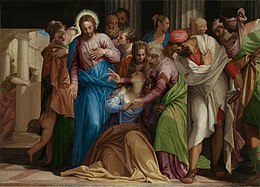
The Conversion of Mary Magdalene (c. 1548) by Paolo Veronese
According to the Gospel of Luke,[26] Jesus exorcised "seven demons" from Mary Magdalene.[27][28][29] That seven demons had possessed Mary is repeated in Mark 16:9,[30][31] part of the "longer ending" of that gospel – this is not found in the earliest manuscripts and is possibly a second-century addition to the original text, possibly based on the Gospel of Luke.[31][32] In the first century, demons were believed widely to cause physical and psychological illness.[33][27][28] Bruce Chilton, a scholar of early Christianity, states that the reference to the number of demons being "seven" may mean that Mary had to undergo seven exorcisms, probably over a long period of time, due to the first six being partially or wholly unsuccessful.[29]
Bart D. Ehrman, a New Testament scholar and historian of early Christianity, contends that the number seven may be merely symbolic,[28] since, in Jewish tradition, seven was the number of completion,[28] so that Mary was possessed by seven demons may simply mean she was completely overwhelmed by their power.[28] In either case, Mary must have suffered from severe emotional or psychological trauma for an exorcism of this kind to have been perceived as necessary.[27][28] Consequently, her devotion to Jesus resulting from this healing must have been very strong.[16][34][35] The Gospels' writers normally relish giving dramatic descriptions of Jesus's public exorcisms, with the possessed person wailing, thrashing, and tearing his or her clothes in front of a crowd.[36] By contrast, that Mary's exorcism receives little attention may indicate that either Jesus performed it privately or that the recorders did not perceive it as particularly dramatic.[36]
Since Mary is listed as one of the women who supported Jesus's ministry financially, she must have been relatively wealthy.[16][37] The places where she and the other women are mentioned throughout the gospels indicate strongly that they were vital to Jesus's ministry[38][39][40][41] and that Mary Magdalene always appears first, whenever she is listed in the Synoptic Gospels as a member of a group of women, indicates that she was seen as the most important out of all of them.[42][43][44] Carla Ricci notes that, in lists of the disciples, Mary Magdalene occupies a similar position among Jesus's female followers as Simon Peter does among the male apostles.[44]
That women played such an active and important role in Jesus's ministry was not entirely radical or even unique;[39][41] inscriptions from a synagogue in Aphrodisias in Asia Minor from around the same time period reveal that many of the major donors to the synagogue were women.[39] Jesus's ministry did bring women greater liberation than they would typically have held in mainstream Jewish society.[45][41]
Witness to Jesus's crucifixion and burial[edit]

Detail of Mary Magdalene weeping at the crucifixion of Jesus, as portrayed in The Descent from the Cross (c. 1435) by the Flemish artist Rogier van der Weyden[46]
All four canonical gospels agree that several other women watched Jesus's crucifixion from a distance, with three explicitly naming Mary Magdalene as present.[47] Mark 15:40 lists the names of these women as Mary Magdalene; Mary, mother of James; and Salome.[47] Matthew 27:55–56 lists Mary Magdalene, Mary mother of James and Joseph, and the unnamed mother of the sons of Zebedee (who may be the same person Mark calls Salome).[47] Luke 23:49 mentioned a group of women watching the crucifixion, but did not give any of their names.[47] John 19:25 lists Mary, mother of Jesus, her sister, Mary, wife of Clopas, and Mary Magdalene as witnesses to the crucifixion.[47]
Virtually all reputable historians agree that Jesus was crucified by the Romans under the orders of Pontius Pilate.[48][49][50][51] James Dunn states of baptism and crucifixion that these "two facts in the life of Jesus command almost universal assent".[52] Nonetheless, the gospels' accounts of Jesus's crucifixion differ considerably[53] and most secular historians agree that some of the details in the accounts have been altered to fit their authors' theological agendas.[53] Ehrman states that the presence of Mary Magdalene and the other women at the cross is probably historical because Christians would have been unlikely to make up that the main witnesses to the crucifixion were women[54] and also because their presence is attested in both the Synoptic Gospels and in the Gospel of John independently.[55] Maurice Casey concurs that the presence of Mary Magdalene and the other women at the crucifixion of Jesus may be recorded as an historical fact.[6] According to E. P. Sanders, the reason why the women watched the crucifixion even after the male disciples had fled may have been because they were less likely to be arrested, they were braver than the men, or some combination thereof.[56]
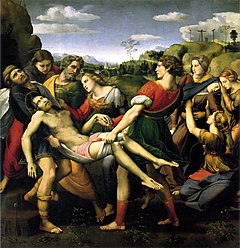
The Deposition (1507) by Raphael, showing a distressed, reddish-blond-haired Mary Magdalene dressed in fine clothes clutching the hand of Jesus's body as he is carried to the tomb[57]
All four canonical gospels, as well as the apocryphal Gospel of Peter, agree that Jesus's body was taken down from the cross and buried by a man named Joseph of Arimathea.[47] Mark 15:47 lists Mary Magdalene and Mary, mother of Jesus as witnesses to the burial of Jesus.[47] Matthew 27:61 lists Mary Magdalene and "the other Mary" as witnesses.[47] Luke 23:55 mentions "the women who had followed him from Galilee", but does not list any of their names.[47] John 19:39–42 does not mention any women present during Joseph's burial of Jesus,[47] but does mention the presence of Nicodemus, a Pharisee with whom Jesus had a conversation near the beginning of the gospel.[47] Ehrman, who previously accepted the story of Jesus's burial as historical, now rejects it as a later invention on the basis that Roman governors almost never allowed for executed criminals to be given any kind of burial[58] and Pontius Pilate in particular was not "the sort of ruler who would break with tradition and policy when kindly asked by a member of the Jewish council to provide a decent burial for a crucified victim." Casey argues that Jesus was given a proper burial by Joseph of Arimathea,[59] noting that, on some very rare occasions, Roman governors did release the bodies of executed prisoners for burial.[60] Nonetheless, he rejects that Jesus could have been interred in an expensive tomb with a stone rolled in front of it like the one described in the gospels,[61] leading him to conclude that Mary and the other women must not have seen the tomb.[61] Sanders affirms Jesus's burial by Joseph of Arimathea in the presence of Mary Magdalene and the other female followers as completely historical.[62]
Resurrection of Jesus[edit]
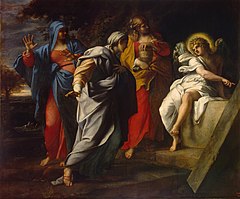
Holy Women at Christ's Tomb (c. 1590s) by Annibale Carracci. In Matthew 28:1–10, Mary Magdalene and "the other Mary" encounter an angel at the tomb, who tells them that Christ has risen.[63][64][65]
The earliest description of Jesus's post-resurrection appearances is a quotation of a pre-Pauline creed preserved by Paul the Apostle in 1 Corinthians 15:3–8, which was written roughly 20 years before any of the gospels.[66] This passage made no mention of Mary Magdalene, the other women, or the story of the empty tomb,[67][68] but rather credits Simon Peter with having been the first to see the risen Jesus.[67][69][70] Despite this, all four canonical gospels, as well as the apocryphal Gospel of Peter, agreed that Mary Magdalene, either alone or as a member of a group, was the first person to discover that Jesus's tomb was empty.[55][71] Nonetheless, the details of the accounts differ drastically.[64]
According to Mark 16:1–8, the earliest account of the discovery of the empty tomb, Mary Magdalene, Mary the mother of James, and Salome went to the tomb just after sunrise, a day and half after Jesus's burial and found that the stone had already been rolled away.[64][65][72] They went inside and saw a young man dressed in white, who told them that Jesus had risen from the dead and instructed them to tell the male disciples that he would meet them in Galilee.[63][64][65] Instead, the women ran away and told no one, because they were too afraid.[63][64][65] The original text of the gospel ends here, without the resurrected Jesus making an appearance to anyone.[63][65][73] Casey argues that the reason for this abrupt ending may be because the Gospel of Mark is an unfinished first draft.[63]
According to Matthew 28:1–10, Mary Magdalene and "the other Mary" went to the tomb.[63][64][65] An earthquake occurred and an angel dressed in white descended from Heaven and rolled aside the stone as the women were watching.[63][64][65] The angel told them that Jesus had risen from the dead.[64][65][63] Then the risen Jesus himself appeared to the women as they were leaving the tomb and told them to tell the other disciples that he would meet them in Galilee.[63][64][65]
According to Luke 24:1–12 Mary Magdalene, Joanna, and Mary the mother of James went to the tomb and found the stone already rolled away, as in Mark.[64][65][74] They went inside and saw two young men dressed in white who told them that Jesus had risen from the dead.[64][65][74] Then they went and told the eleven remaining apostles, who dismissed their story as nonsense.[64][65][74] In Luke's account, Jesus never appears to the women,[64][65][75] but instead makes his first appearance to Cleopas and an unnamed "disciple" on the road to Emmaus.[64][65][75] Luke's narrative also removes the injunction for the women to tell the disciples to return to Galilee and instead has Jesus tell the disciples not to return to Galilee, but rather to stay in the precincts of Jerusalem.[75][76]

Appearance of Jesus Christ to Maria Magdalena (1835) by Alexander Andreyevich Ivanov. In John 20:1–13, Mary Magdalene sees the risen Jesus alone[77][73] and he tells her "Don't touch me, for I have not yet ascended to my father."[73]
Mary Magdalene's role in the resurrection narrative is greatly increased in the account from the Gospel of John.[71][78] According to John 20:1–10, Mary Magdalene went to the tomb alone when it was still dark and saw that the stone had already been rolled away.[71][77][79] She did not see anyone, but immediately ran to tell Peter and the "beloved disciple",[71][79] who came with her to the tomb and confirmed that it was empty,[71][78] but returned home without seeing the risen Jesus.[78][71] According to John 20:11–18, Mary, now alone in the garden outside the tomb, saw two angels sitting where Jesus's body had been.[71] Then the risen Jesus approached her.[71][80] She at first mistook him for the gardener,[78][71] but, after she heard him say her name, she recognized him and cried out "Rabbouni!" (which is Aramaic for "teacher").[71][78] His next words may be translated as "Don't touch me, for I have not yet ascended to my Father" or "Stop clinging to me, [etc.]" the latter more probable in view of the grammar (negated present imperative: stop doing something already in progress) as well as Jesus's challenge to Thomas a week later (see John 20:24–29[81][73]). Jesus then sent her to tell the other apostles the good news of his resurrection.[78][71] The Gospel of John therefore portrays Mary Magdalene as the first apostle, the apostle sent to the apostles.[78][71]
Because scribes were unsatisfied with the abrupt ending of the Gospel of Mark, they wrote several different alternative endings for it.[82] In the "shorter ending", which is found in very few manuscripts, the women go to "those around Peter" and tell them what they had seen at the tomb, followed by a brief declaration of the gospel being preached from east to west.[82] This "very forced" ending contradicts the last verse of the original gospel, stating that the women "told no one".[82] The "longer ending", which is found in most surviving manuscripts, is an "amalgam of traditions" containing episodes derived from the other gospels.[82] First, it describes an appearance by Jesus to Mary Magdalene alone (as in the Gospel of John),[82] followed by brief descriptions of him appearing to the two disciples on the road to Emmaus (as in the Gospel of Luke) and to the eleven remaining disciples (as in the Gospel of Matthew).[82]
Comments