


This article is about the astronomer. For other uses, see Tycho Brahe (disambiguation).
| Tycho Brahe | |
|---|---|
| Portrait of Tycho, c. 1596 | |
| Born | Tyge Ottesen Brahe 14 December 1546Knutstorp Castle, Scania, Denmark–Norway |
| Died | 24 October 1601 (aged 54)Prague, Kingdom of Bohemia, Holy Roman Empire |
| Nationality | Danish |
| Alma mater | University of CopenhagenLeipzig UniversityUniversity of Rostock |
| Occupation(s) | Astronomer , writer |
| Known for | Tychonic systemTycho's supernovaRudolphine TablesVariation |
| Spouse | Kirsten Barbara Jørgensdatter |
| Children | 8 |
| Parents | Otte BraheBeate Clausdatter Bille |
| Signature | |
Tycho Brahe (/ˈtaɪkoʊ ˈbrɑː(h)i, - ˈbrɑː(hə)/ TY-koh BRAH-(h)ee, - BRAH(-hə), Danish: [ˈtsʰykʰo ˈpʁɑːə] ⓘ; born Tyge Ottesen Brahe, Danish: [ˈtsʰyːjə ˈʌtəsn̩ ˈpʁɑːə];[note 1] 14 December 1546 – 24 October 1601), generally called Tycho for short, was a Danish astronomer, known for his comprehensive and unprecedentedly accurate astronomical observations. He was known during his lifetime as an astronomer, astrologer, and alchemist. He was the last major astronomer before the invention of the telescope.
In 1572, Tycho noticed a completely new star that was brighter than any star or planet. Astonished by the existence of a star that ought not to have been there, he devoted himself to the creation of ever more accurate instruments of measurement over the next fifteen years (1576–1591). King Frederick II granted Tycho an estate on the island of Hven and the money to build Uraniborg, the first large observatory in Christian Europe. He later worked underground at Stjerneborg, where he realised that his instruments in Uraniborg were not sufficiently steady. His unprecedented research program both turned astronomy into the first modern science and also helped launch the Scientific Revolution.[3]
An heir to several noble families, Tycho was well-educated. He worked to combine what he saw as the geometrical benefits of Copernican heliocentrism with the philosophical benefits of the Ptolemaic system, and devised the Tychonic system, his own version of a model of the Universe, with the Sun orbiting the Earth, and the planets as orbiting the Sun. In De nova stella (1573), he refuted the Aristotelian belief in an unchanging celestial realm. His measurements indicated that "new stars" (stellae novae, now called supernovae) moved beyond the Moon, and he was able to show that comets were not atmospheric phenomena, as was previously thought.
In 1597, Tycho was forced by the new king, Christian IV, to leave Denmark. He was invited to Prague, where he became the official imperial astronomer, and built an observatory at Benátky nad Jizerou. Prior to his death in 1601, he was assisted for a year by Johannes Kepler, who went on to use Tycho's data to develop his own three laws of planetary motion.
Life[edit]

Tycho Brahe framed by the family shields of his noble ancestors, in a 1586 portrait by Jacques de Gheyn
Family[edit]
Tycho Brahe was born as heir to several of Denmark's most influential noble families and in addition to his immediate ancestry with the Brahe and the Bille families, he also counted the Rud, Trolle, Ulfstand, and Rosenkrantz families among his ancestors. Both of his grandfathers and all of his great-grandfathers had served as members of the Danish king's Privy Council. His paternal grandfather and namesake, Thyge Brahe, was the lord of Tosterup Castle in Scania and died in battle during the 1523 Siege of Malmö during the Lutheran Reformation Wars. His maternal grandfather, Claus Bille, lord to Bohus Castle and a second cousin of Swedish king Gustav Vasa, participated in the Stockholm Bloodbath on the side of the Danish king against the Swedish nobles. Tycho's father, Otte Brahe, a royal Privy Councilor (like his own father), married Beate Bille, a powerful figure at the Danish court holding several royal land titles. Tycho's parents are buried under the floor of the church of Kågeröd, four kilometres east of Knutstorp Castle.[4]
Early years[edit]
Tycho was born on 14 December 1546,[5] at his family's ancestral seat at Knutstorp (Knudstrup borg; Knutstorps borg), about 8 kilometres (5.0 mi) north of Svalöv in then Danish Scania. He was the oldest of 12 siblings, 8 of whom lived to adulthood, including Steen Brahe and Sophia Brahe. His twin brother died before being baptized. Tycho later wrote an ode in Latin to his dead twin,[6] which was printed in 1572 as his first published work. An epitaph, originally from Knutstorp, but now on a plaque near the church door, shows the whole family, including Tycho as a boy.
When he was only two years old Tycho was taken away to be raised by his uncle Jørgen Thygesen Brahe and his wife Inger Oxe (sister to Peder Oxe, Steward of the Realm) who were childless. It is unclear why Otte Brahe reached this arrangement with his brother, but Tycho was the only one of his siblings not to be raised by his mother at Knutstorp. Instead, Tycho was raised at Jørgen Brahe's estate at Tosterup and at Tranekær on the island of Langeland, and later at Næsbyhoved Castle near Odense, and later again at the Castle of Nykøbing on the island of Falster. Tycho later wrote that Jørgen Brahe "raised me and generously provided for me during his life until my eighteenth year; he always treated me as his own son and made me his heir".[7]
From ages 6 to 12, Tycho attended Latin school, probably in Nykøbing. At age 12, on 19 April 1559, Tycho began studies at the University of Copenhagen. There, following his uncle's wishes, he studied law, but also studied a variety of other subjects and became interested in astronomy. At the university, Aristotle was a staple of scientific theory, and Tycho likely received a thorough training in Aristotelian physics and cosmology. He experienced the solar eclipse of 21 August 1560, and was greatly impressed by the fact that it had been predicted, although the prediction based on current observational data was a day off. He realized that more accurate observations would be the key to making more exact predictions. He purchased an ephemeris and books on astronomy, including Johannes de Sacrobosco's De sphaera mundi, Petrus Apianus's Cosmographia seu descriptio totius orbis and Regiomontanus's De triangulis omnimodis.[7]
Jørgen Thygesen Brahe, however, wanted Tycho to educate himself in order to become a civil servant, and sent him on a study tour of Europe in early 1562. 15-year old Tycho was given as mentor the 19-year-old Anders Sørensen Vedel, whom he eventually talked into allowing the pursuit of astronomy during the tour.[8] Vedel and his pupil left Copenhagen in February 1562. On 24 March, they arrived in Leipzig, where they matriculated at the Lutheran Leipzig University.[9] In 1563, he observed a close conjunction of the planets Jupiter and Saturn, and noticed that the Copernican and Ptolemaic tables used to predict the conjunction were inaccurate. This led him to realise that progress in astronomy required systematic, rigorous observation, night after night, using the most accurate instruments obtainable. He began maintaining detailed journals of all his astronomical observations. In this period, he combined the study of astronomy with astrology, laying down horoscopes for different famous personalities.[10]
When Tycho and Vedel returned from Leipzig in 1565, Denmark was at war with Sweden, and as vice-admiral of the Danish fleet, Jørgen Brahe had become a national hero for having participated in the sinking of the Swedish warship Mars during the First battle of Öland (1564). Shortly after Tycho's arrival in Denmark, Jørgen Brahe was defeated in the action of 4 June 1565, and shortly afterwards died of a fever. Stories have it that he contracted pneumonia after a night of drinking with the Danish King Frederick II when the king fell into the water in a Copenhagen canal and Brahe jumped in after him. Brahe's possessions passed on to his wife Inger Oxe, who considered Tycho with special fondness.[11]
Tycho's nose[edit]
In 1566, Tycho left to study at the University of Rostock. There, he studied with professors of medicine at the university's famous medical school and became interested in medical alchemy and herbal medicine.[12] On 29 December 1566 at the age of 20, Tycho lost part of his nose in a sword duel with a fellow Danish nobleman, his third cousin Manderup Parsberg. The two had drunkenly quarreled over who was the superior mathematician at an engagement party at the home of Professor Lucas Bachmeister on 10 December.[13] Coming nearly to quarrel again with his cousin on 29 December, they ended up resolving their feud with a duel in the dark. Though the two were later reconciled, the duel resulted in Tycho losing the bridge of his nose and gaining a broad scar across his forehead. He received the best possible care at the university and wore a prosthetic nose for the rest of his life. It was kept in place with paste or glue and said to be made of silver and gold.[14] In November 2012, Danish and Czech researchers reported that the prosthesis was actually made of brass after chemically analyzing a small bone sample from the nose from the body exhumed in 2010.[15] The prostheses made of gold and silver were mostly worn for special occasions, rather than everyday wear.
Science and life on Uraniborg[edit]
In April 1567, Tycho returned home from his travels, with a firm intention of becoming an astrologer. Although he had been expected to go into politics and the law, like most of his kinsmen, and although Denmark was still at war with Sweden, his family supported his decision to dedicate himself to the sciences. His father wanted him to take up law, but Tycho was allowed to travel to Rostock and then to Augsburg (where he built a great quadrant), Basel, and Freiburg. In 1568, he was appointed a canon at the Cathedral of Roskilde, a largely honorary position that would allow him to focus on his studies. At the end of 1570, he was informed of his father's ill health, so he returned to Knutstorp Castle, where his father died on 9 May 1571. The war was over, and the Danish lords soon returned to prosperity. Soon, another uncle, Steen Bille, helped him build an observatory and alchemical laboratory at Herrevad Abbey where Tycho was also assisted by his keenest disciple, his younger sister Sophie Brahe.[16] Tycho was acknowledged by King Frederick II who proposed to him that an observatory be built to better study the night sky. After accepting this proposal, the location for the Uraniborg's construction was set on an island called Hven (now Ven) in the Sound not too far from Copenhagen,[17] the earliest large observatory in Christian Europe.[5]
Tycho Brahe was highly appreciated by King Frederick II, and he was accepted and supported by people of high power. He was even supported by the church. The support Tycho Brahe received from the king allowed him to continue his research and make significant contributions to the field of astronomy.
In the late 16th century, Tycho Brahe built an observatory called Uraniborg. It was built on the island of Hven located between the provinces of Zealand (Sjælland) and Scania (Skåne). The island was then an administrative part of Zealand. Later, after the Peace of Roskilde in 1658, Scania was conquered by the Swedes and in 1660, Hven went with it so that this whole area is now in Sweden. But in Tycho's time, it was all Denmark. He lived on Hven for approximately 21 years. He began to build Uraniborg in 1576 and moved there soon after. As Uraniborg was a significant and advanced observatory it took years to complete. Uraniborg was a place where Tycho Brahe could research and analyze his previous findings as well as explore new discoveries. Tycho Brahe was an astronomer of the pre-telescope era. Using just his naked eye, he observed the planets, moon, stars, and space and recorded everything he saw while completing a multitude of calculations daily. The location of Uraniborg was strategically chosen, with seclusion and support being the primary reasons for building on the island of Hven. Seclusion was essential for accurate observation and gave Tycho Brahe a better way to focus on his work without worrying about interruptions from other people. Seclusion was also important for observation as there was nothing interfering with time, light, or motion observations. Tycho Brahe was a perfectionist, and being secluded he had complete control over his research and was not limited by anyone else's restrictions, enabling him to develop innovative research. He could focus all of his energy on his work without receiving any backlash or questioning from anyone. The seclusion gave him the freedom to pursue his research without limitations and paved the way for groundbreaking discoveries in the field of astronomy. Uraniborg was one of the most advanced observatories of its time, equipped with several astronomical instruments, including quadrant instruments, sextants, and astronomical clocks. Tycho Brahe's observations and calculations at Uraniborg allowed him to develop more accurate solar system models. He also compiled the most extensive and accurate catalog of stellar positions up to that time. Tycho Brahe's observations and calculations at Uraniborg allowed him to lay the groundwork for astronomers in the future.[18]
Despite the success Tycho Brahe had on Hven, he eventually left the island after a disagreement with the new king of Denmark, Christian IV. In 1597 Tycho Brahe moved to Prague, where he continued his work and was eventually appointed by Emperor Rudolf II in 1601 as imperial mathematician.[19] However, Uraniborg remained a significant landmark in the history of astronomy.
Morganatic marriage to Kirsten Jørgensdatter[edit]
Towards the end of 1571, Tycho fell in love with Kirsten, daughter of Jørgen Hansen, the Lutheran minister in Knudstrup.[20] As she was a commoner, Tycho never formally married her, since if he did he would lose his noble privileges. However, Danish law permitted morganatic marriage, which meant that a nobleman and a common woman could live together openly as husband and wife for three years, and their alliance then became a legally binding marriage. However, each would maintain their social status, and any children they had together would be considered commoners, with no rights to titles, landholdings, coat of arms, or even their father's noble name.[21] While King Frederick respected Tycho's choice of wife, himself having been unable to marry the woman he loved, many of Tycho's family members disagreed, and many churchmen would continue to hold the lack of a divinely sanctioned marriage against him. Kirsten Jørgensdatter gave birth to their first daughter, Kirstine (named after Tycho's late sister) on 12 October 1573. Kirstine died from the plague in 1576, and Tycho wrote a heartfelt elegy for her tombstone.[22] In 1574, they moved to Copenhagen where their daughter Magdalene was born,[23] and later the family followed him into exile.[24] Kirsten and Tycho lived together for almost thirty years until Tycho's death. Together, they had eight children, six of whom lived to adulthood.
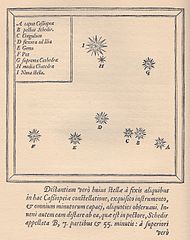
Star map of the constellation Cassiopeia showing the position of the supernova of 1572 (the topmost star, labelled I); from Tycho Brahe's De nova stella.
1572 supernova[edit]
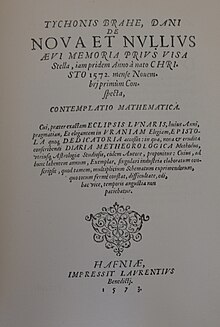
Title page to De nova stella, in a facsimile reprint of the original 1573 edition (1901)
On 11 November 1572, Tycho observed (from Herrevad Abbey) a very bright star, now numbered SN 1572, which had unexpectedly appeared in the constellation Cassiopeia. Because it had been maintained since antiquity that the world beyond the Moon's orbit was eternally unchangeable (celestial immutability was a fundamental axiom of the Aristotelian world-view), other observers held that the phenomenon was something in the terrestrial sphere below the Moon. However, Tycho observed that the object showed no daily parallax against the background of the fixed stars. This implied that it was at least farther away than the Moon and those planets that do show such parallax. He also found that the object did not change its position relative to the fixed stars over several months, as all planets did in their periodic orbital motions, even the outer planets, for which no daily parallax was detectable. This suggested that it was not even a planet, but a fixed star in the stellar sphere beyond all the planets. In 1573, he published a small book De nova stella,[25][better source needed] thereby coining the term nova for a "new" star (we now classify this star as a supernova and know that it is 7,500 light-years from Earth). This discovery was decisive for his choice of astronomy as a profession. Tycho was strongly critical of those who dismissed the implications of the astronomical appearance, writing in the preface to De nova stella: "O crassa ingenia. O caecos coeli spectatores" ("O thick wits. O blind watchers of the sky"). The publication of his discovery made him a well-known name among scientists in Europe.[26][27]
Lord of Hven[edit]
Tycho continued with his detailed observations, often assisted by his first assistant and student, his younger sister Sophie. In 1574, Tycho published the observations made in 1572 from his first observatory at Herrevad Abbey. He then started lecturing on astronomy, but gave it up and left Denmark in spring 1575 to tour abroad. He first visited William IV, Landgrave of Hesse-Kassel's observatory at Kassel, then went on to Frankfurt, Basel, and Venice, where he acted as an agent for the Danish king, contacting artisans and craftsmen whom the king wanted to work on his new palace at Elsinore. Upon his return, the King wished to repay Tycho's service by offering him a position worthy of his family; he offered him a choice of lordships of militarily and economically important estates, such as the castles of Hammershus or Helsingborg. But Tycho was reluctant to take up a position as a lord of the realm, preferring to focus on his science. He wrote to his friend Johannes Pratensis, "I did not want to take possession of any of the castles our benevolent king so graciously offered me. I am displeased with society here, customary forms and the whole rubbish".[28] Tycho secretly began to plan to move to Basel, wishing to participate in the burgeoning academic and scientific life there. But the King heard of Tycho's plans, and desiring to keep the distinguished scientist,[29] in 1576 he offered Tycho the island of Hven in Øresund and funding to set up an observatory.[5]

Tycho Brahe's large mural quadrant at Uraniborg

Engraving of the above ground parts of Tycho Brahe's underground observatory Stjerneborg
Until then, Hven had been property directly under the Crown, and the 50 families on the island considered themselves to be freeholding farmers, but with Tycho's appointment as Feudal Lord of Hven, this changed. Tycho took control of agricultural planning, requiring the peasants to cultivate twice as much as they had done before, and he also exacted corvée labor from the peasants for the construction of his new castle.[30] The peasants complained about Tycho's excessive taxation and took him to court. The court established Tycho's right to levy taxes and labor, and the result was a contract detailing the mutual obligations of lord and peasants on the island.[31]
Tycho envisioned his castle Uraniborg as a temple dedicated to the muses of arts and sciences, rather than as a military fortress; indeed, it was named after Urania, the muse of astronomy. Construction began in 1576 (with a laboratory for his alchemical experiments in the cellar). Uraniborg was inspired by the Venetian architect Andrea Palladio, and was one of the first buildings in northern Europe to show influence from Italian renaissance architecture.
Comments