


Who Was Charles Dickens?
Charles Dickens was a British author, journalist, editor, illustrator, and social commentator who wrote the beloved classics Oliver Twist, A Christmas Carol, and Great Expectations. His books were first published in monthly serial installments, which became a lucrative source of income following a childhood of abject poverty. Dickens wrote 15 novels in total, including Nicholas Nickleby, David Copperfield, and A Tale of Two Cities. His writing provided a stark portrait of poor and working class people in the Victorian era that helped to bring about social change. Dickens died in June 1870 at age 58 and is remembered as one of the most important and influential writers of the 19th century.
Early Life and Education
Charles John Huffam Dickens was born on February 7, 1812, in Portsmouth on the southern coast of England. He was the second of eight children born to John Dickens, a naval clerk who dreamed of striking it rich, and Elizabeth Barrow, who aspired to be a teacher and school director. Despite his parents’ best efforts, the family remained poor but nevertheless happy in the early days.
In 1816, they moved to Chatham, Kent, where young Dickens and his siblings were free to roam the countryside and explore the old castle at Rochester. Dickens was a sickly child and prone to spasms, which prevented him from playing sports. He compensated by reading avidly, including such books as Robinson Crusoe, Tom Jones, Peregrine Pickle, and The Arabian Nights, according to The World of Charles Dickens by Fido Martin.
In 1822, the Dickens family moved to Camden Town, a poor neighborhood in London. By then, the family’s financial situation had grown dire, as Charles’ father had a dangerous habit of living beyond the family’s means. Eventually, John was sent to prison for debt in 1824, when Charles was just 12 years old. He boarded with a sympathetic family friend named Elizabeth Roylance, who later inspired the character Mrs. Pipchin in Dickens’ 1847 novel Dombey and Son, according to Dickens: A Biography by Fred Kaplan.
MORE 19TH CENTURY AUTHORS


Following his father’s imprisonment, Dickens was forced to leave school to work at a boot-blacking factory alongside the River Thames. At the run-down, rodent-ridden factory, Dickens earned 6 shillings a week labeling pots of “blacking,” a substance used to clean fireplaces. It was the best he could do to help support his family, and the strenuous working conditions heavily influenced his future writing and his views on treatment of the poor and working class.
Much to his relief, Dickens was permitted to go back to school when his father received a family inheritance and used it to pay off his debts. He attended the Wellington House Academy in Camden Town, where he encountered what he called “haphazard, desultory teaching [and] poor discipline,” according to The World of Charles Dickens by Angus Wilson. The school’s sadistic headmaster was later the inspiration for the character Mr. Creakle in Dickens’ semi-autobiographical novel David Copperfield.
ALife as a Journalist, Editor, and Illustrator
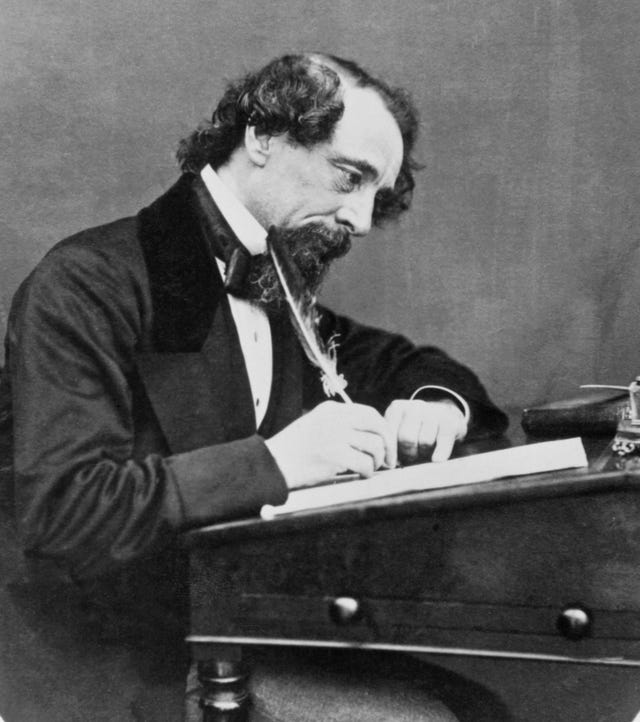
Charles Dickens wrote 15 novels in his lifetime.Getty Images
When Dickens was 15, his education was pulled out from under him once again. In 1827, he had to drop out of school and work as an office boy to contribute to his family’s income. However, as it turned out, the job became a launching point for his writing career. Within a year of being hired, Dickens began freelance reporting at the law courts of London. Just a few years later, he was reporting for two major London newspapers.
In 1833, he began submitting sketches to various magazines and newspapers under the pseudonym “Boz,” which was a family nickname. His first published story was “A Dinner at Poplar Walk,” which ran in London’s Monthly Magazine in 1833. Seeing his writing in print made his eyes “overflow with joy and pride,” according to Dickens: A Biography. In 1836, his clippings were published in his first book, Sketches by Boz.
Dickens later edited magazines including Household Words and All the Year Round, the latter of which he founded. In both, he promoted and originally published some of his own work such as Oliver Twist and A Tale of Two Cities.
Personal Life: Wife and Children
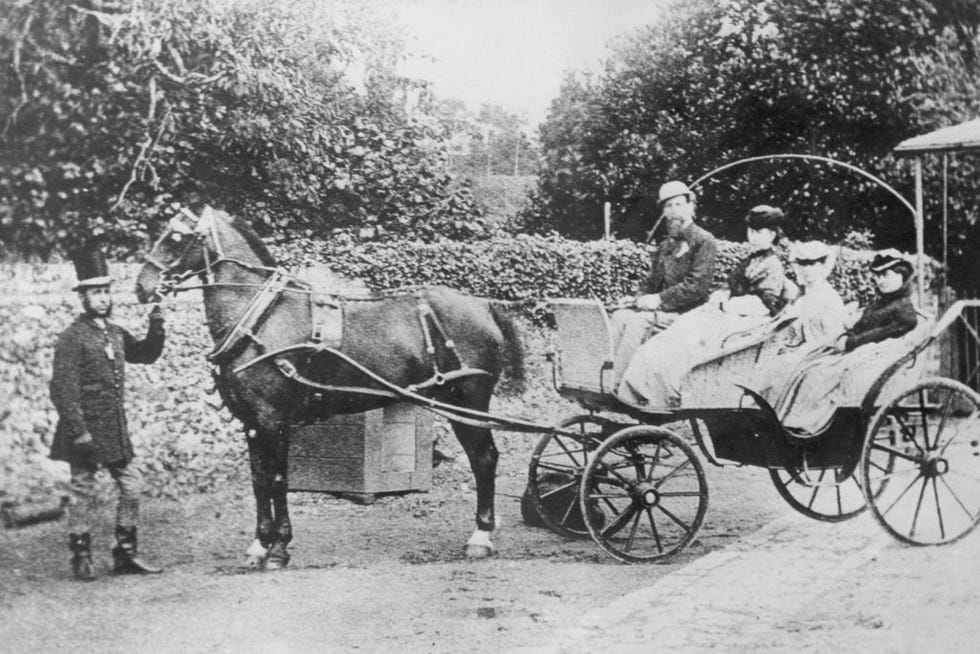
Charles Dickens pictured with his wife, Catherine Hogarth Dickens, and two of their daughters in a horse-drawn carriage, circa 1850.Getty Images
Dickens married Catherine Hogarth in 1836, soon after the publication of his first book, Sketches by Boz. She was the daughter of George Hogarth, the editor of the Evening Chronicle. Dickens and Hogarth went on to have 10 children between 1837 and 1852, according to biographer Fred Kaplan. Among them were magazine editor Charles Dickens Jr., painter Kate Dickens Perugini, barrister Henry Fielding Dickens, and Edward Dickens, who entered into politics after immigrating to the Australia.
In 1851, Dickens suffered two devastating losses: the deaths of his infant daughter, Dora, and his father, John. He also separated from his wife in 1858. Dickens slandered Catherine publicly and struck up an intimate relationship with a young actor named Ellen “Nelly” Ternan. Sources differ on whether the two started seeing each other before or after Dickens’ marital separation. It is also believed that he went to great lengths to erase any documentation alluding to Ternan’s presence in his life. These major losses and challenges seeped into Dickens’ writing in his “dark novel” period.
DIVE DEEPER

harles Dickens’ Books: 'Oliver Twist,' 'Great Expectations,' and More
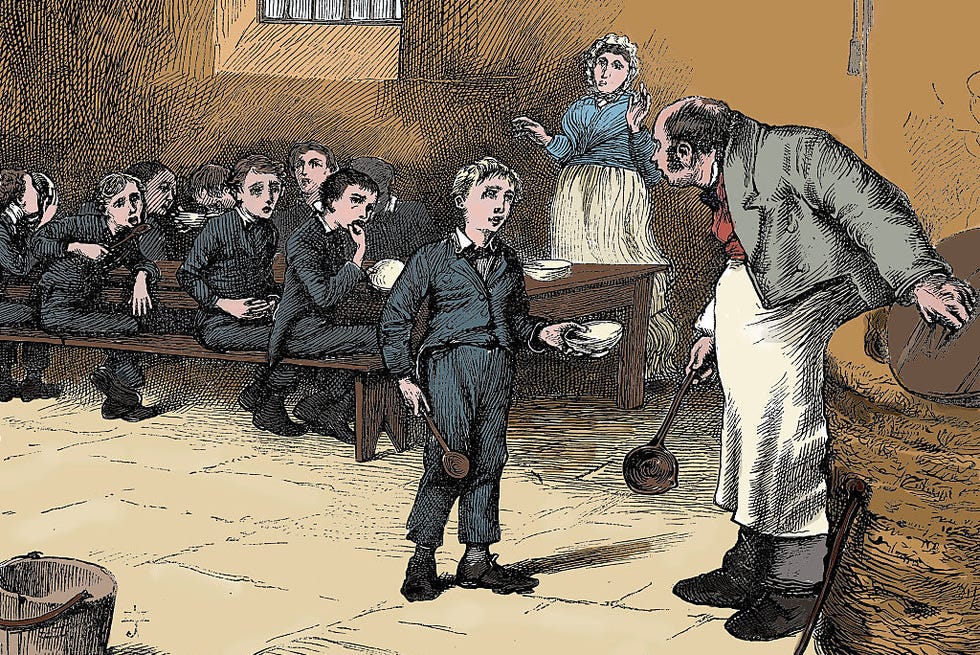
A vintage illustration of a scene from Charles Dickens’ Oliver Twist portraying Oliver as he asks for a second helping of porridge at the children’s ward of the workhouse.Getty Images
Best known for his fiction writing, Dickens wrote a total of 15 novels between 1836 and 1870. His first was The Posthumous Papers of the Pickwick Club, and his last was The Mystery of Edwin Drood, which went unfinished due to his death.
Dickens’ books were originally published in monthly serial installments that sold for 1 shilling each. The affordable price meant everyday citizens could follow along, though wealthier readers, such as Queen Victoria, were also among Dickens’ fans. Once complete, the stories were published again in novel form.
Dickens’ books provided a stark portrait of poor and working class people in the Victorian era that helped to bring about social change. In the 1850s, following the death of his father and infant daughter, as well as his separation from his wife, Dickens’ novels began to express a darkened worldview. His so-called dark novels are Bleak House (1853), Hard Times (1854), and Little Dorrit (1857). They feature more complicated, thematically grim plots and more complex characters, though Dickens didn’t stray from his typical societal commentary.
Read more about each of Charles Dickens’ novels below:
The Posthumous Papers of the Pickwick Club
Serial Publication: April 1836 to November 1837
Novel Publication: 1837
In 1836, the same year his first book of illustrations released, Dickens started publishing The Posthumous Papers of the Pickwick Club. His series, originally written as captions for artist Robert Seymour’s humorous sports-themed illustrations, took the form of monthly serial installments. It was wildly popular with readers, and Dickens’ captions proved even more popular than the illustrations they were meant to accompany.
Travels to the United States
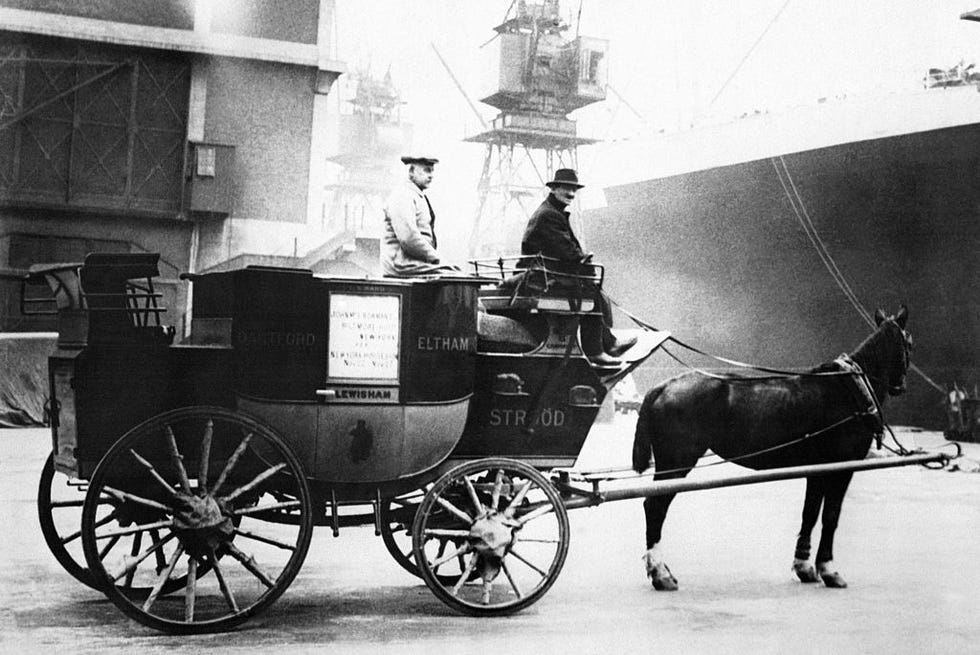
The carriage Commodore, once owned by Charles Dickens, in New York CityGetty Images
In 1842, Dickens and his wife, Catherine, embarked on a five-month lecture tour of the United States. Dickens spoke of his opposition to slavery and expressed his support for additional reform. His lectures, which began in Virginia and ended in Missouri, were so widely attended that ticket scalpers gathered outside his events. Biographer J.B. Priestley wrote that during the tour, Dickens enjoyed “the greatest welcome that probably any visitor to America has ever had.”
“They flock around me as if I were an idol,” bragged Dickens, a known show-off. Although he enjoyed the attention at first, he eventually resented the invasion of privacy. He was also annoyed by what he viewed as Americans’ gregariousness and crude habits, as he later expressed in American Notes for General Circulation (1842). The sarcastic travelogue, which Dickens’ penned upon his return to England, criticized American culture and materialism.
After his criticism of the American people during his first tour, Dickens later launched a second U.S. tour from 1867 to 1868, where he hoped to set things right with the public and made charismatic speeches promising to praise the United States in reprints of American Notes for General Circulation and Martin Chuzzlewit, his 1844 novel set in the American frontier.
'A Christmas Carol' and Other Works
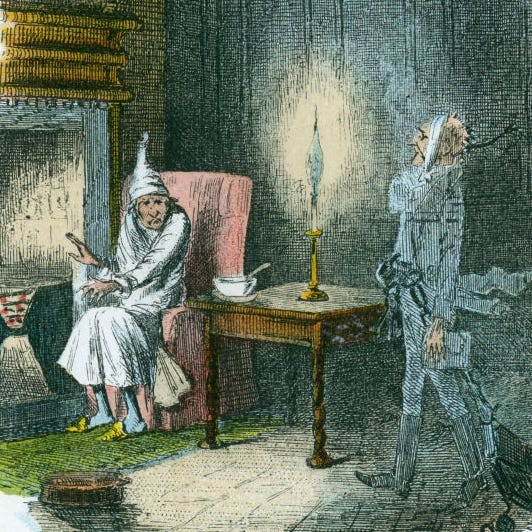
An illustrated scene from Charles Dickens’ A Christmas Carol when Ebenezer Scrooge is visited by the ghost of his old business partner, Jacob Marley.Getty ImagesAdvertisement - Continue Reading Below
On December 19, 1843, Dickens published A Christmas Carol, one of his most timeless and beloved works. The book features the famous protagonist Ebenezer Scrooge, a curmudgeonly old miser who—with the help of the Ghosts of Christmas Past, Present, and Yet to Come—finds the holiday spirit. Dickens penned the book in just six weeks, beginning in October and finishing just in time for Christmas celebrations. Like his earlier works, it was intended as a social criticism, to bring attention to the hardships faced by England’s poorer classes.
The book was a roaring success, selling more than 6,000 copies upon publication. Readers in England and America were touched by the book’s empathetic emotional depth; one American entrepreneur reportedly gave his employees an extra day’s holiday after reading it. Despite its incredible success, the high production costs and Dickens’ disagreements with the publisher meant he received relatively few profits for A Christmas Carol, according to Kaplan, which were further reduced when Dickens was forced to take legal action against the publishers for making illegal copies.
KEEP READING

A Christmas Carol was Dickens’ most popular book in the United States, selling more than two million copies in the century after its first publication there, according to Charles Dickens: A Life by Claire Tomalin. It is also one of Dickens’ most adapted works, and Ebenezer Scrooge has been portrayed by such actors as Michael Caine, Albert Finney, Patrick Stewart, Tim Curry, and Jim Carrey.
Dickens published several other Christmas novellas following A Christmas Carol, including The Chimes (1844) The Cricket on the Hearth (1845), The Battle of Life (1846), and The Haunted Man and the Ghost’s Bargain (1848). In 1867, he wrote a stage play titled No Thoroughfare.
Death
On June 8, 1870, Dickens had a stroke at his home in Kent, England, after a day of writing The Mystery of Edwin Drood. He died the next day at age 58.
At the time, Edwin Drood had begun its serial publication; it was never finished. Only half of the planned installments of his final novel were completed at the time of Dickens’ death, according to Fido.
Dickens was buried in Poet’s Corner at Westminster Abbey, with thousands of mourners gathering at the beloved author’s gravesite.
When 48 Doughty Street in London—which was Dickens’ home from 1837 to 1839—was threatened with demolition, it was saved by the Dickens Fellowship and renovated, becoming the Dickens House Museum. Open since 1925, it appears like a middle-class Victorian home exactly as Dickens lived in it, and it houses a significant collection related to Dickens and his works.
Advertisement - Continue Reading Below
Pop Culture Adaptations
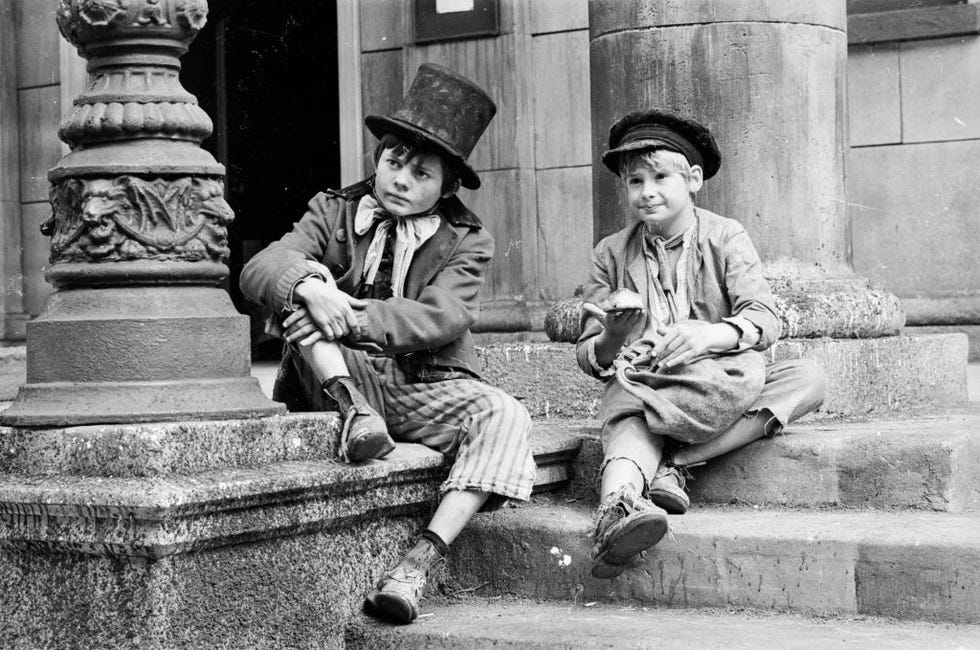
Actors Jack Wild and Mark Lester (respectively) portraying the Artful Dodger and Oliver Twist in Carol Reed’s film Oliver! (1968), based upon Charles Dickens’ novel A Christmas Carol (1843).Larry Ellis//Getty Images
Many of Dickens’ major works have been adapted for movies and stage plays, with some, like A Christmas Carol, repackaged in various forms over the years. Reginald Owen portrayed Ebenezer Scrooge in one of the earliest Hollywood adaptations of the novella in 1938, while Albert Finney played the character alongside Alec Guinness as Marley’s ghost in the 1970 film Scrooge.
Some adaptations have taken unique approaches to the source material. Michael Caine portrayed Scrooge in The Muppet Christmas Carol (1992), with members of the Muppets playing other characters from the story, and Gonzo the Great portraying Dickens as a narrator. Bill Murray played a version of Scrooge in a modern-day comedic take on the classic story. Several animated versions of A Christmas Carol have also been adapted, with Jim Carrey playing Scrooge in a 2009 computer-generated film that used motion-capture animation to create the character.
Several more of Dickens’ works have been similarly adapted. Famed director David Lean made celebrated adaptations of both Great Expectations (1946) and Oliver Twist (1948). The latter novel was also adapted into a successful 1960 stage musical called Oliver!, and a 1968 movie version—directed by Carol Reed—of that same musical won the Academy Award for Best Picture and Director.
More recently, The Personal History of David Copperfield (2019) put a comedic spin on Dickens’ personal favorite of his own works, with Dev Patel performing the title role. Barbara Kingsolver also adapted the novel in her Pulitzer Prize winner Demon Copperhead (2022).
Comments