


Eleanor of Aquitaine (Occitan: Alienòr d'Aquitània, pronounced [aljɛnɔɾ dakiˈtanjɔ] English: EH-leh-nohr; c. 1122 – 1 April 1204) was the suo jure Duchess of Aquitaine from 1137 to 1204 as the eldest child of her father, William X, Duke of Aquitaine, as well as Queen of France from 1137 to 1152 as the wife of King Louis VII,[1] and Queen of England from 1154 to 1189 as the wife of King Henry II. As the heiress of the House of Poitiers, which controlled much of southwestern France, she was one of the wealthiest and most powerful women in western Europe during the High Middle Ages. Militarily, she was a key leading figure in the Second Crusade, and in a revolt in favour of her son. Culturally, she was a patron of poets such as Wace, Benoît de Sainte-Maure, and Bernart de Ventadorn, and of the arts of the High Middle Ages.
Eleanor was the eldest daughter of William X, Duke of Aquitaine, and Aénor de Châtellerault. She became duchess upon her father's death in April 1137, and three months later she married Louis, son of her guardian King Louis VI of France. A few weeks later, Eleanor's father-in-law died and her husband succeeded him as Louis VII. Eleanor and Louis VII had two daughters, Marie and Alix. Soon afterwards, she sought an annulment of her marriage,[2] but her request was rejected by Pope Eugene III.[3] Eventually, Louis agreed to an annulment, as fifteen years of marriage had not produced a son.[4] The marriage was annulled on 21 March 1152 on the grounds of consanguinity within the fourth degree. Their daughters were declared legitimate, custody was awarded to Louis, and Eleanor's lands were restored to her.
As soon as the annulment was granted, Eleanor became engaged to her third cousin Henry, Duke of Normandy. The couple married on Whitsun, 18 May 1152 in Poitiers. Eleanor was crowned Queen of England at Westminster Abbey in 1154, when Henry acceded to the throne. They had five sons and three daughters. However, Henry and Eleanor eventually became estranged. Henry imprisoned her in 1173 for supporting the revolt of their eldest son, Henry the Young King, against him. She was not released until 6 July 1189, when her husband died and their third son, Richard I, ascended the throne. As queen dowager, Eleanor acted as regent while Richard went on the Third Crusade.[5] She lived well into the reign of her youngest son, John.
Early life[edit]
Eleanor's year of birth is not known precisely: a late 13th-century genealogy of her family listing her as 13 years old in the spring of 1137 provides the best evidence that Eleanor was perhaps born as late as 1124.[6] On the other hand, some chronicles mention a fidelity oath of some lords of Aquitaine on the occasion of Eleanor's fourteenth birthday in 1136. This, and her known age of 82 at her death make 1122 the most likely year of her birth.[7] Her parents almost certainly married in 1121. Her birthplace may have been Poitiers, Bordeaux, or Nieul-sur-l'Autise, where her mother and brother died when Eleanor was 6 or 8.[8]
Eleanor (or Aliénor) was the oldest of three children of William X, Duke of Aquitaine, whose glittering ducal court was renowned in early 12th-century Europe, and his wife, Aenor de Châtellerault, the daughter of Aimery I, Viscount of Châtellerault, and Dangereuse de l'Isle Bouchard, who was William IX's longtime mistress as well as Eleanor's maternal grandmother. Her parents' marriage had been arranged by Dangereuse with her paternal grandfather William IX.
Eleanor is said to have been named for her mother Aenor and called Aliénor from the Latin Alia Aenor, which means the other Aenor. It became Eléanor in the langues d'oïl of northern France and Eleanor in English.[4] There was, however, another prominent Eleanor before her—Eleanor of Normandy, an aunt of William the Conqueror, who lived a century earlier than Eleanor of Aquitaine. In Paris as the queen of France, she was called Helienordis, her honorific name as written in the Latin epistles.
By all accounts, Eleanor's father ensured that she had the best possible education.[9] Eleanor came to learn arithmetic, the constellations, and history.[4] She also learned domestic skills such as household management and the needle arts of embroidery, needlepoint, sewing, spinning, and weaving.[4] Eleanor developed skills in conversation, dancing, games such as backgammon, checkers, and chess, playing the harp, and singing.[4] Although her native tongue was Poitevin, she was taught to read and speak Latin, was well versed in music and literature, and schooled in riding, hawking, and hunting.[10] Eleanor was extroverted, lively, intelligent, and strong-willed. Her four-year-old brother William Aigret and their mother died at the castle of Talmont on Aquitaine's Atlantic coast in the spring of 1130. Eleanor became the heir presumptive to her father's domains. The Duchy of Aquitaine was the largest and richest province of France. Poitou, where Eleanor spent most of her childhood, and Aquitaine together were almost one-third the size of modern France. Eleanor had only one other legitimate sibling, a younger sister named Aelith (also called Petronilla). Her half-brother Joscelin was acknowledged by William X as a son, but not as his heir. The notion that she had another half-brother, William, has been discredited.[11] Later, during the first four years of Henry II's reign, her siblings joined Eleanor's royal household.
Inheritance[edit]
In 1137 Duke William X left Poitiers for Bordeaux and took his daughters with him. Upon reaching Bordeaux, he left them in the charge of the archbishop of Bordeaux, one of his few loyal vassals. The duke then set out for the Shrine of Saint James of Compostela in the company of other pilgrims. However, he died on Good Friday of that year (9 April).
Eleanor, aged 12 to 15, then became the duchess of Aquitaine, and thus the most eligible heiress in Europe. As these were the days when kidnapping an heiress was seen as a viable option for obtaining a title, William dictated a will on the very day he died that bequeathed his domains to Eleanor and appointed King Louis VI of France as her guardian.[12] William requested of the king that he take care of both the lands and the duchess, and find her a suitable husband.[9] However, until a husband was found, the king had the legal right to Eleanor's lands. The duke also insisted to his companions that his death be kept a secret until Louis was informed; the men were to journey from Saint James of Compostela across the Pyrenees as quickly as possible to call at Bordeaux to notify the archbishop, then to make all speed to Paris to inform the king.
The king of France, known as Louis the Fat, was also gravely ill at that time, suffering from a bout of dysentery from which he appeared unlikely to recover. Yet despite his impending death, Louis's mind remained clear. His eldest surviving son, Louis, had originally been destined for monastic life, but had become the heir apparent when the firstborn, Philip, died in a riding accident in 1131.[13]
The death of William, one of the king's most powerful vassals, made available the most desirable duchy in France. While presenting a solemn and dignified face to the grieving Aquitainian messengers, Louis exulted when they departed. Rather than act as guardian to the duchess and duchy, he decided to marry the duchess to his 17-year-old heir and bring Aquitaine under the control of the French crown, thereby greatly increasing the power and prominence of France and its ruling family, the House of Capet. Within hours, the king had arranged for his son Louis to be married to Eleanor, with Abbot Suger in charge of the wedding arrangements. Louis was sent to Bordeaux with an escort of 500 knights, along with Abbot Suger, Theobald II, Count of Champagne, and Raoul I, Count of Vermandois.
Queen of France[edit]

A 14th-century representation of, at left, the wedding of Louis and Eleanor; at right, Louis leaving on Crusade.

Eleanor's grandfather, William IX of Aquitaine, gave her this rock crystal vase, which she gave to Louis as a wedding gift. He later donated it to the Abbey of Saint-Denis. This is the only surviving artifact known to have belonged to Eleanor; it is now on display in the Louvre, Paris.
On 25 July 1137, Eleanor and Louis were married in the Cathedral of Saint-André in Bordeaux by the archbishop of Bordeaux.[9] Immediately after the wedding, the couple were enthroned as duke and duchess of Aquitaine.[9] It was agreed that the duchy would remain independent of France until Eleanor's oldest son became both king of France and duke of Aquitaine. Thus, her holdings would not be merged with France until the next generation. As a wedding present she gave Louis a rock crystal vase {fr}, currently on display at the Louvre.[9][13][14] Louis donated the vase to the Basilica of St Denis. This vase is the only object connected with Eleanor of Aquitaine that still survives.[15]
Louis's tenure as count of Poitou and duke of Aquitaine and Gascony lasted only a few days. Although he had been invested as such on 8 August 1137, a messenger gave him the news that Louis VI had died of dysentery on 1 August while he and Eleanor were making a tour of the provinces. He and Eleanor were anointed and crowned king and queen of France on Christmas Day of the same year.[9][16]
Possessing a high-spirited nature, Eleanor was not popular with the staid northerners; according to sources, Louis's mother Adelaide of Maurienne thought her flighty and a bad influence. She was not aided by memories of Constance of Arles, the Provençal wife of Robert II, tales of whose immodest dress and language were still told with horror.[a] Eleanor's conduct was repeatedly criticised by church elders, particularly Bernard of Clairvaux and Abbot Suger, as indecorous. The king was madly in love with his beautiful and worldly bride, however, and granted her every whim, even though her behaviour baffled and vexed him. Much money went into making the austere Cité Palace in Paris more comfortable for Eleanor's sake.[13]
Conflict[edit]
Louis soon came into violent conflict with Pope Innocent II. In 1141, the Archbishopric of Bourges became vacant, and the king put forward as a candidate one of his chancellors, Cadurc, while vetoing the one suitable candidate, Pierre de la Chatre, who was promptly elected by the canons of Bourges and consecrated by the Pope. Louis accordingly bolted the gates of Bourges against the new bishop. The Pope, recalling similar attempts by William X to exile supporters of Innocent from Poitou and replace them with priests loyal to himself, blamed Eleanor, saying that Louis was only a child and should be taught manners. Outraged, Louis swore upon relics that so long as he lived Pierre should never enter Bourges. An interdict was thereupon imposed upon the king's lands, and Pierre was given refuge by Theobald II, Count of Champagne.
Louis became involved in a war with Count Theobald by permitting Raoul I, Count of Vermandois and seneschal of France, to repudiate his wife Eleanor of Champagne, Theobald's sister, and to marry Petronilla of Aquitaine, the Queen's sister. Eleanor urged Louis to support her sister's marriage to Count Raoul. Theobald had also offended Louis by siding with the Pope in the dispute over Bourges. The war lasted two years (1142–44) and ended with the occupation of Champagne by the royal army. Louis was personally involved in the assault and burning of the town of Vitry. More than a thousand people sought refuge in the town church, but the church caught fire and everyone inside was burned alive. Horrified, and desiring an end to the war, Louis attempted to make peace with Theobald in exchange for his support in lifting the interdict on Raoul and Petronilla. This was duly lifted for long enough to allow Theobald's lands to be restored; it was then lowered once more when Raoul refused to repudiate Petronilla, prompting Louis to return to Champagne and ravage it once more.
In June 1144, the king and queen visited the newly built monastic church at Saint-Denis. While there, the queen met with Bernard of Clairvaux, asking him to use his influence with the Pope to have the excommunication of Petronilla and Raoul lifted, in exchange for which King Louis would make concessions in Champagne and recognise Pierre de la Chatre as archbishop of Bourges. Dismayed at her attitude, Bernard scolded Eleanor for her lack of penitence and interference in matters of state. In response, Eleanor broke down and meekly excused her behaviour, claiming to be bitter because of her lack of children (her only recorded pregnancy at that time was in about 1138, but she miscarried[17][18]). In response, Bernard became more kindly towards her: "My child, seek those things which make for peace. Cease to stir up the king against the Church, and urge upon him a better course of action. If you will promise to do this, I in return promise to entreat the merciful Lord to grant you offspring." In a matter of weeks, peace had returned to France: Theobald's provinces were returned and Pierre de la Chatre was installed as archbishop of Bourges. In April 1145, Eleanor gave birth to a daughter, Marie.
Louis, however, still burned with guilt over the massacre at Vitry and wished to make a pilgrimage to the Holy Land to atone for his sins. In autumn 1145, Pope Eugene III requested that Louis lead a Crusade to the Middle East to rescue the Frankish states there from disaster. Accordingly, Louis declared on Christmas Day 1145 at Bourges his intention of going on a crusade.
The Second Crusade[edit]
Eleanor of Aquitaine also formally took up the cross symbolic of the Second Crusade during a sermon preached by Bernard of Clairvaux. In addition, she had been corresponding with her uncle Raymond, Prince of Antioch, who was seeking further protection from the French crown against the Saracens. Eleanor recruited some of her royal ladies-in-waiting for the campaign as well as 300 non-noble Aquitainian vassals. She insisted on taking part in the Crusades as the feudal leader of the soldiers from her duchy. She left for the Second Crusade from Vézelay, the rumoured location of Mary Magdalene's grave, in June 1147.
The Crusade itself achieved little. Louis was a weak and ineffectual military leader with no skill for maintaining troop discipline or morale, or of making informed and logical tactical decisions. In eastern Europe, the French army was at times hindered by Manuel I Comnenus, the Byzantine Emperor, who feared that the Crusade would jeopardise the tenuous safety of his empire. Notwithstanding, during their three-week stay at Constantinople, Louis was fêted and Eleanor was much admired. She was compared with Penthesilea, mythical queen of the Amazons, by the Greek historian Nicetas Choniates. He added that she gained the epithet chrysopous (golden-foot) from the cloth of gold that decorated and fringed her robe. Louis and Eleanor stayed in the Philopation palace just outside the city walls.
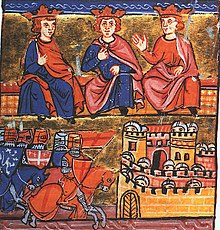
Second Crusade council: Conrad III of Germany, Eleanor's husband Louis VII of France, and Baldwin III of Jerusalem
From the moment the Crusaders entered Asia Minor, things began to go badly. The king and queen were still optimistic—the Byzantine Emperor had told them that King Conrad III of Germany had won a great victory against a Turkish army when in fact the German army had been almost completely destroyed at Dorylaeum. However, while camping near Nicea, the remnants of the German army, including a dazed and sick Conrad III, staggered past the French camp, bringing news of their disaster. The French, with what remained of the Germans, then began to march in increasingly disorganised fashion towards Antioch. They were in high spirits on Christmas Eve, when they chose to camp in a lush valley near Ephesus. Here they were ambushed by a Turkish detachment, but the French proceeded to slaughter this detachment and appropriate their camp.
Louis then decided to cross the Phrygian mountains directly in the hope of reaching Raymond of Poitiers in Antioch more quickly. As they ascended the mountains, however, the army and the king and queen were horrified to discover the unburied corpses of the Germans killed earlier.
On the day set for the crossing of Mount Cadmus, Louis chose to take charge of the rear of the column, where the unarmed pilgrims and the baggage trains marched. The vanguard, with which Queen Eleanor marched, was commanded by her Aquitainian vassal, Geoffrey de Rancon. Unencumbered by baggage, they reached the summit of Cadmus, where Rancon had been ordered to make camp for the night. Rancon, however, chose to continue on, deciding in concert with Amadeus III, Count of Savoy, Louis's uncle, that a nearby plateau would make a better campsite. Such disobedience was reportedly common.
Accordingly, by mid-afternoon, the rear of the column—believing the day's march to be nearly at an end—was dawdling. This resulted in the army becoming separated, with some having already crossed the summit and others still approaching it. In the ensuing Battle of Mount Cadmus, the Turks, who had been following and feinting for many days, seized their opportunity and attacked those who had not yet crossed the summit. The French, both soldiers and pilgrims, taken by surprise, were trapped. Those who tried to escape were caught and killed. Many men, horses, and much of the baggage were cast into the canyon below. The chronicler William of Tyre, writing between 1170 and 1184 and thus perhaps too long after the event to be considered historically accurate, placed the blame for this disaster firmly on the amount of baggage being carried, much of it reputedly belonging to Eleanor and her ladies, and the presence of non-combatants.
The king, having scorned royal apparel in favour of a simple pilgrim's tunic, escaped notice, unlike his bodyguards, whose skulls were brutally smashed and limbs severed. He reportedly "nimbly and bravely scaled a rock by making use of some tree roots which God had provided for his safety" and managed to survive the attack. Others were not so fortunate: "No aid came from Heaven, except that night fell."[19]
Official blame for the disaster was placed on Geoffrey de Rancon, who had made the decision to continue, and it was suggested that he be hanged, a suggestion which the king ignored. Since Geoffrey was Eleanor's vassal, many believed that it was she who had been ultimately responsible for the change in plan, and thus the massacre. This suspicion of responsibility did nothing for her popularity in Christendom. She was also blamed for the size of the baggage train and the fact that her Aquitanian soldiers had marched at the front and thus were not involved in the fight. Continuing on, the army became split, with the commoners marching towards Antioch and the royalty travelling by sea. When most of the land army arrived, the king and queen had a dispute. Some, such as John of Salisbury and William of Tyre, say Eleanor's reputation was sullied by rumours of an affair with her uncle Raymond.
However, this rumour may have been a ruse, as Raymond, through Eleanor, had been trying to induce Louis to use his army to attack the actual Muslim encampment at nearby Aleppo, gateway to retaking Edessa, which had all along, by papal decree, been the main objective of the Crusade. Although this was perhaps a better military plan, Louis was not keen to fight in northern Syria. One of Louis's avowed Crusade goals was to journey in pilgrimage to Jerusalem, and he stated his intention to continue. Reputedly Eleanor then requested to stay with Raymond and brought up the matter of consanguinity—the fact that she and her husband, King Louis, were perhaps too closely related. Consanguinity was grounds for annulment in the medieval period. But rather than allowing her to stay, Louis took Eleanor from Antioch against her will and continued on to Jerusalem with his dwindling army.[20]
Comments