


Public ministry
Main article: Ministry of Jesus

Sermon on the Mount, by Carl Bloch, 1877, depicts Jesus' important discourse.
The Synoptics depict two distinct geographical settings in Jesus' ministry. The first takes place north of Judea, in Galilee, where Jesus conducts a successful ministry, and the second shows Jesus rejected and killed when he travels to Jerusalem.[21] Often referred to as "rabbi",[21] Jesus preaches his message orally.[26] Notably, Jesus forbids those who recognize him as the messiah to speak of it, including people he heals and demons he exorcises (see Messianic Secret).[164]
John depicts Jesus' ministry as largely taking place in and around Jerusalem, rather than in Galilee; and Jesus' divine identity is openly proclaimed and immediately recognized.[98]
Scholars divide the ministry of Jesus into several stages. The Galilean ministry begins when Jesus returns to Galilee from the Judaean Desert after rebuffing the temptation of Satan. Jesus preaches around Galilee, and in Matthew 4:18–20, his first disciples, who will eventually form the core of the early Church, encounter him and begin to travel with him.[144][165] This period includes the Sermon on the Mount, one of Jesus' major discourses,[165][166] as well as the calming of the storm, the feeding of the 5,000, walking on water and a number of other miracles and parables.[167] It ends with the Confession of Peter and the Transfiguration.[168][169]
As Jesus travels towards Jerusalem, in the Perean ministry, he returns to the area where he was baptized, about a third of the way down from the Sea of Galilee along the Jordan River.[170][171][172] The final ministry in Jerusalem begins with Jesus' triumphal entry into the city on Palm Sunday.[173] In the Synoptic Gospels, during that week Jesus drives the money changers from the Second Temple and Judas bargains to betray him. This period culminates in the Last Supper and the Farewell Discourse.[142][173][174]
Disciples and followers
Main articles: Apostles in the New Testament and Commissioning of the Twelve Apostles

The Exhortation to the Apostles, by James Tissot, portrays Jesus talking to his 12 disciples.
Near the beginning of his ministry, Jesus appoints twelve apostles. In Matthew and Mark, despite Jesus only briefly requesting that they join him, Jesus' first four apostles, who were fishermen, are described as immediately consenting, and abandoning their nets and boats to do so.[175] In John, Jesus' first two apostles were disciples of John the Baptist. The Baptist sees Jesus and calls him the Lamb of God; the two hear this and follow Jesus.[176][177] In addition to the Twelve Apostles, the opening of the passage of the Sermon on the Plain identifies a much larger group of people as disciples.[178] Also, in Luke 10:1–16 Jesus sends 70 or 72 of his followers in pairs to prepare towns for his prospective visit. They are instructed to accept hospitality, heal the sick, and spread the word that the Kingdom of God is coming.[179]
In Mark, the disciples are notably obtuse. They fail to understand Jesus' miracles,[180] his parables,[181] or what "rising from the dead" means.[182] When Jesus is later arrested, they desert him.[164]
Teachings and miracles
Main articles: Sermon on the Mount, Parables of Jesus, and Miracles of JesusSee also: Sermon on the Plain, Five Discourses of Matthew, Farewell Discourse, Olivet Discourse, and Bread of Life Discourse

Jesus and the rich young man by Heinrich Hofmann, 1889
In the Synoptics, Jesus teaches extensively, often in parables,[183] about the Kingdom of God (or, in Matthew, the Kingdom of Heaven). The Kingdom is described as both imminent[184] and already present in the ministry of Jesus.[185] Jesus promises inclusion in the Kingdom for those who accept his message.[186] He talks of the "Son of Man", an apocalyptic figure who will come to gather the chosen.[41]
Jesus calls people to repent their sins and to devote themselves completely to God.[41] He tells his followers to adhere to Jewish law, although he is perceived by some to have broken the law himself, for example regarding the Sabbath.[41] When asked what the greatest commandment is, Jesus replies: "You shall love the Lord your God with all your heart, and with all your soul, and with all your mind ... And a second is like it: 'You shall love your neighbor as yourself.'"[187] Other ethical teachings of Jesus include loving your enemies, refraining from hatred and lust, turning the other cheek, and forgiving people who have sinned against you.[188][189]
John's Gospel presents the teachings of Jesus not merely as his own preaching, but as divine revelation. John the Baptist, for example, states in John 3:34: "He whom God has sent speaks the words of God, for he gives the Spirit without measure." In John 7:16 Jesus says, "My teaching is not mine but his who sent me." He asserts the same thing in John 14:10: "Do you not believe that I am in the Father and the Father is in me? The words that I say to you I do not speak on my own; but the Father who dwells in me does his works."[190][191]

The Return of the Prodigal Son by Pompeo Batoni, 1773
Approximately 30 parables form about one-third of Jesus' recorded teachings.[190][192] The parables appear within longer sermons and at other places in the narrative.[193] They often contain symbolism, and usually relate the physical world to the spiritual.[194][195] Common themes in these tales include the kindness and generosity of God and the perils of transgression.[196] Some of his parables, such as the Prodigal Son,[197] are relatively simple, while others, such as the Growing Seed,[198] are sophisticated, profound and abstruse.[199] When asked by his disciples why he speaks in parables to the people, Jesus replies that the chosen disciples have been given to "know the secrets of the kingdom of heaven", unlike the rest of their people, "For the one who has will be given more and he will have in abundance. But the one who does not have will be deprived even more", going on to say that the majority of their generation have grown "dull hearts" and thus are unable to understand.[200]

Jesus cleansing a leper, medieval mosaic from the Monreale Cathedral, late 12th to mid-13th centuries
In the gospel accounts, Jesus devotes a large portion of his ministry to performing miracles, especially healings.[201] The miracles can be classified into two main categories: healing miracles and nature miracles.[202] The healing miracles include cures for physical ailments, exorcisms,[91][203] and resurrections of the dead.[204] The nature miracles show Jesus' power over nature, and include turning water into wine, walking on water, and calming a storm, among others. Jesus states that his miracles are from a divine source. When his opponents suddenly accuse him of performing exorcisms by the power of Beelzebul, the prince of demons, Jesus counters that he performs them by the "Spirit of God" (Matthew 12:28) or "finger of God", arguing that all logic suggests that Satan would not let his demons assist the Children of God because it would divide Satan's house and bring his kingdom to desolation; furthermore, he asks his opponents that if he exorcises by Beel'zebub, "by whom do your sons cast them out?"[205][206][207] In Matthew 12:31–32, he goes on to say that while all manner of sin, "even insults against God" or "insults against the son of man", shall be forgiven, whoever insults goodness (or "The Holy Spirit") shall never be forgiven; they carry the guilt of their sin forever.
In John, Jesus' miracles are described as "signs", performed to prove his mission and divinity.[208][209] In the Synoptics, when asked by some teachers of the Law and some Pharisees to give miraculous signs to prove his authority, Jesus refuses,[208] saying that no sign shall come to corrupt and evil people except the sign of the prophet Jonah. Also, in the Synoptic Gospels, the crowds regularly respond to Jesus' miracles with awe and press on him to heal their sick. In John's Gospel, Jesus is presented as unpressured by the crowds, who often respond to his miracles with trust and faith.[210] One characteristic shared among all miracles of Jesus in the gospel accounts is that he performed them freely and never requested or accepted any form of payment.[211] The gospel episodes that include descriptions of the miracles of Jesus also often include teachings, and the miracles themselves involve an element of teaching.[212][213] Many of the miracles teach the importance of faith. In the cleansing of ten lepers and the raising of Jairus's daughter, for instance, the beneficiaries are told that their healing was due to their faith.[214][215]
Proclamation as Christ and Transfiguration
Main articles: Confession of Peter and Transfiguration of Jesus

The Transfiguration of Jesus, depicted by Carl Bloch, 19th century
At about the middle of each of the three Synoptic Gospels are two significant events: the Confession of Peter and the Transfiguration of Jesus.[169][216][149][150] These two events are not mentioned in the Gospel of John.[217]
In his Confession, Peter tells Jesus, "You are the Messiah, the Son of the living God."[218][219][220] Jesus affirms that Peter's confession is divinely revealed truth.[221][222] After the confession, Jesus tells his disciples about his upcoming death and resurrection.[223]
In the Transfiguration,[224][149][150][169] Jesus takes Peter and two other apostles up an unnamed mountain, where "he was transfigured before them, and his face shone like the sun, and his clothes became dazzling white."[225] A bright cloud appears around them, and a voice from the cloud says, "This is my Son, the Beloved; with him I am well pleased; listen to him."[226][149]
Passion Week
The description of the last week of the life of Jesus (often called Passion Week) occupies about one-third of the narrative in the canonical gospels,[102] starting with Jesus' triumphal entry into Jerusalem and ending with his Crucifixion.[142][173]
Activities in Jerusalem
Main articles: Triumphal entry into Jerusalem, Cleansing of the Temple, and Bargain of Judas

A painting of Jesus' final entry into Jerusalem, by Jean-Léon Gérôme, 1897
In the Synoptics, the last week in Jerusalem is the conclusion of the journey through Perea and Judea that Jesus began in Galilee.[173] Jesus rides a young donkey into Jerusalem, reflecting the tale of the Messiah's Donkey, an oracle from the Book of Zechariah in which the Jews' humble king enters Jerusalem this way.[227][69] People along the way lay cloaks and small branches of trees (known as palm fronds) in front of him and sing part of Psalms 118:25–26.[228][229][230][231]
Jesus next expels the money changers from the Second Temple, accusing them of turning it into a den of thieves through their commercial activities. He then prophesies about the coming destruction, including false prophets, wars, earthquakes, celestial disorders, persecution of the faithful, the appearance of an "abomination of desolation", and unendurable tribulations.[232] The mysterious "Son of Man", he says, will dispatch angels to gather the faithful from all parts of the earth.[233] Jesus warns that these wonders will occur in the lifetimes of the hearers.[234][164] In John, the Cleansing of the Temple occurs at the beginning of Jesus' ministry instead of at the end.[235][98]
Jesus comes into conflict with the Jewish elders, such as when they question his authority and when he criticizes them and calls them hypocrites.[229][231] Judas Iscariot, one of the twelve apostles, secretly strikes a bargain with the Jewish elders, agreeing to betray Jesus to them for 30 silver coins.[236][237]
The Gospel of John recounts two other feasts in which Jesus taught in Jerusalem before the Passion Week.[238][131] In Bethany, a village near Jerusalem, Jesus raises Lazarus from the dead. This potent sign[98] increases the tension with authorities,[173] who conspire to kill him.[239][131] Mary of Bethany anoints Jesus' feet, foreshadowing his entombment.[240] Jesus then makes his messianic entry into Jerusalem.[131] The cheering crowds greeting Jesus as he enters Jerusalem add to the animosity between him and the establishment.[173] In John, Jesus has already cleansed the Second Temple during an earlier Passover visit to Jerusalem. John next recounts Jesus' Last Supper with his disciples.[131]
Last Supper
Main article: Last SupperSee also: Jesus predicts his betrayal, Denial of Peter, and Last Supper in Christian art

The Last Supper, depicted by Juan de Juanes, c. 1562
The Last Supper is the final meal that Jesus shares with his twelve apostles in Jerusalem before his crucifixion. The Last Supper is mentioned in all four canonical gospels; Paul's First Epistle to the Corinthians[241] also refers to it.[54][55][242] During the meal, Jesus predicts that one of his apostles will betray him.[243] Despite each Apostle's assertion that he would not betray him, Jesus reiterates that the betrayer would be one of those present. Matthew 26:23–25 and John 13:26–27 specifically identify Judas as the traitor.[54][55][243]
In the Synoptics, Jesus takes bread, breaks it, and gives it to the disciples, saying, "This is my body, which is given for you". He then has them all drink from a cup, saying, "This cup that is poured out for you is the new covenant in my blood,"[244][54][245] The Christian sacrament or ordinance of the Eucharist is based on these events.[246] Although the Gospel of John does not include a description of the bread-and-wine ritual during the Last Supper, most scholars agree that John 6:22–59 (the Bread of Life Discourse) has a eucharistic character and resonates with the institution narratives in the Synoptic Gospels and in the Pauline writings on the Last Supper.[247]
In all four gospels, Jesus predicts that Peter will deny knowledge of him three times before the rooster crows the next morning.[248][249] In Luke and John, the prediction is made during the Supper.[250] In Matthew and Mark, the prediction is made after the Supper; Jesus also predicts that all his disciples will desert him.[251][252] The Gospel of John provides the only account of Jesus washing his disciples' feet after the meal.[119] John also includes a long sermon by Jesus, preparing his disciples (now without Judas) for his departure. Chapters 14–17 of the Gospel of John are known as the Farewell Discourse and are a significant source of Christological content.[253][254]
Agony in the Garden, betrayal, and arrest
Main articles: Agony in the Garden, Kiss of Judas, and Arrest of Jesus
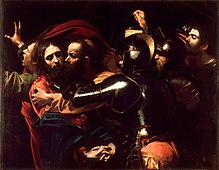
A depiction of the kiss of Judas and arrest of Jesus, by Caravaggio, c. 1602
In the Synoptics, Jesus and his disciples go to the garden Gethsemane, where Jesus prays to be spared his coming ordeal. Then Judas comes with an armed mob, sent by the chief priests, scribes and elders. He kisses Jesus to identify him to the crowd, which then arrests Jesus. In an attempt to stop them, an unnamed disciple of Jesus uses a sword to cut off the ear of a man in the crowd. After Jesus' arrest, his disciples go into hiding, and Peter, when questioned, thrice denies knowing Jesus. After the third denial, Peter hears the rooster crow and recalls Jesus' prediction about his denial. Peter then weeps bitterly.[252][164][248]
In John 18:1–11, Jesus does not pray to be spared his crucifixion, as the gospel portrays him as scarcely touched by such human weakness.[255] The people who arrest him are Roman soldiers and Temple guards.[256] Instead of being betrayed by a kiss, Jesus proclaims his identity, and when he does, the soldiers and officers fall to the ground. The gospel identifies Peter as the disciple who used the sword, and Jesus rebukes him for it.
Trials by the Sanhedrin, Herod, and Pilate
Main articles: Sanhedrin trial of Jesus, Pilate's Court, and Jesus at Herod's CourtSee also: Jesus, King of the Jews; John 18:38; and Ecce homo
After his arrest, Jesus is taken late at night to the private residence of the high priest, Caiaphas, who had been installed by Pilate's predecessor, the Roman procurator Valerius Gratus.[257] The Sanhedrin was a Jewish judicial body,[258] The gospel accounts differ on the details of the trials.[259] In Matthew 26:57, Mark 14:53 and Luke 22:54, Jesus is taken to the house of the high priest, Caiaphas, where he is mocked and beaten that night. Early the next morning, the chief priests and scribes lead Jesus away into their council.[260][261][262] John 18:12–14 states that Jesus is first taken to Annas, Caiaphas's father-in-law, and then to the high priest.[260][261][262]

Ecce homo! Antonio Ciseri's 1871 depiction of Pontius Pilate presenting Jesus to the public
During the trials Jesus speaks very little, mounts no defense, and gives very infrequent and indirect answers to the priests' questions, prompting an officer to slap him. In Matthew 26:62, Jesus' unresponsiveness leads Caiaphas to ask him, "Have you no answer?"[260][261][262] In Mark 14:61 the high priest then asks Jesus, "Are you the Messiah, the Son of the Blessed One?" Jesus replies, "I am", and then predicts the coming of the Son of Man.[41] This provokes Caiaphas to tear his own robe in anger and to accuse Jesus of blasphemy. In Matthew and Luke, Jesus' answer is more ambiguous:[41][263] in Matthew 26:64 he responds, "You have said so", and in Luke 22:70 he says, "You say that I am".[264][265]
The Jewish elders take Jesus to Pilate's Court and ask the Roman governor, Pontius Pilate, to judge and condemn Jesus for various allegations: subverting the nation, opposing the payment of tribute, claiming to be Christ, a King, and claiming to be the son of God.[266][262] The use of the word "king" is central to the discussion between Jesus and Pilate. In John 18:36 Jesus states, "My kingdom is not from this world", but he does not unequivocally deny being the King of the Jews.[267][268] In Luke 23:7–15, Pilate realizes that Jesus is a Galilean, and thus comes under the jurisdiction of Herod Antipas, the Tetrarch of Galilee and Perea.[269][270] Pilate sends Jesus to Herod to be tried,[271] but Jesus says almost nothing in response to Herod's questions. Herod and his soldiers mock Jesus, put an expensive robe on him to make him look like a king, and return him to Pilate,[269] who then calls together the Jewish elders and announces that he has "not found this man guilty".[271]
Observing a Passover custom of the time, Pilate allows one prisoner chosen by the crowd to be released. He gives the people a choice between Jesus and a murderer called Barabbas (בר-אבא or Bar-abbâ, "son of the father", from the common given name Abba: 'father').[272] Persuaded by the elders,[273] the mob chooses to release Barabbas and crucify Jesus.[274] Pilate writes a sign in Hebrew, Latin, and Greek that reads "Jesus of Nazareth, the King of the Jews" (abbreviated as INRI in depictions) to be affixed to Jesus' cross,[275][276] then scourges Jesus and sends him to be crucified. The soldiers place a crown of thorns on Jesus' head and ridicule him as the King of the Jews. They beat and taunt him before taking him to Calvary,[277] also called Golgotha, for crucifixion.[260][262][278]
Comments