


Peter I (Russian: Пётр I Алексеевич,romanized: Pyotr I Alekseyevich, IPA: [ˈpʲɵtr ɐlʲɪˈksʲejɪvʲɪtɕ]; 9 June [O.S. 30 May] 1672 – 8 February [O.S. 28 January] 1725), commonly known as Peter the Great,[note 1] was Tsar of all Russia from 1682, and the first Emperor of all Russia from 1721 until his death in 1725. He reigned jointly with his half-brother Ivan V until 1696. From this year, Peter was an absolute monarch who remained the ultimate authority. His methods were often harsh and autocratic.
Most of Peter's reign was consumed by long wars against the Ottoman and Swedish Empires. Despite initial difficulties, the wars were ultimately successful and led to expansion to the Sea of Azov and the Baltic Sea, thus laying the groundwork for the Imperial Russian Navy. His victory in the Great Northern War ended Sweden's era as a great power and its domination of the Baltic region while elevating Russia's standing to the extent it came to be acknowledged as an empire. Peter led a cultural revolution that replaced some of the traditionalist and medieval social and political systems with ones that were modern, scientific, Westernized, and based on radical Enlightenment.[1]
In 1700, he introduced the Gregorian calendar but the Russian Orthodox Church was particularly resistant to this change; they wanted to maintain its distinct identity and avoid appearing influenced by Catholic practices.[citation needed] In 1703, he introduced the first Russian newspaper, Sankt-Peterburgskie Vedomosti, ordered the civil script, designed by himself and became the main contributor. He founded the city of Saint Petersburg on the shore of the Neva as a "window to the West" in May 1703. In 1712 Peter moved the capital from Moscow to Saint Petersburg, where it remained – with only a brief interruption – until 1918. He promoted higher education and industrialization in the Russian Empire.
Peter had a great interest in plants, animals and minerals, in malformed creatures or exceptions to the law of nature for his cabinet of curiosities. He encouraged research of deformities, all along trying to debunk the superstitious fear of monsters.[2] The Russian Academy of Sciences and the Saint Petersburg State University were founded in 1724, a year before his death.
Peter is primarily credited with the modernization of the country, transforming it into a major European power. His administrative reforms, creating a Governing Senate in 1711, the Collegium in 1717 and the Table of Ranks in 1722 had a lasting impact on Russia, and many institutions of the Russian government trace their origins to his reign.
Early life
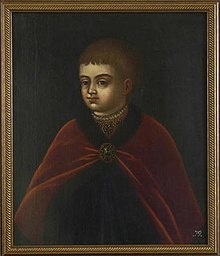
Peter the Great as a child
Peter was named after the apostle. He grew up at Izmaylovo Estate and was educated from an early age by several tutors commissioned by his father, Tsar Alexis of Russia, most notably Nikita Zotov, Patrick Gordon, and Paul Menesius. On 29 January 1676, Alexis died, leaving the sovereignty to Peter's elder half-brother, the weak and sickly Feodor III of Russia.[3] Throughout this period, the government was largely run by Artamon Matveev, an enlightened friend of Alexis, the political head of the Naryshkin family and one of Peter's greatest childhood benefactors.
This position changed when Feodor died in 1682. As Feodor did not leave any children, a dispute arose between the Miloslavsky family (Maria Miloslavskaya was the first wife of Alexis I) and Naryshkin family (Natalya Naryshkina was his second) over who should inherit the throne. He jointly ruled with his elder half-brother, Ivan V, until 1696. Ivan, was next in line but was chronically ill and of infirm mind. Consequently, the Boyar Duma (a council of Russian nobles) chose the 10-year-old Peter to become Tsar, with his mother as regent.
This arrangement was brought before the people of Moscow, as ancient tradition demanded, and was ratified. Sophia, one of Alexis' daughters from his first marriage, led a rebellion of the Streltsy (Russia's elite military corps) in April–May 1682. In the subsequent conflict, some of Peter's relatives and friends were murdered, including Artamon Matveyev, and Peter witnessed some of these acts of political violence.[4]
The Streltsy made it possible for Sophia, the Miloslavskys (the clan of Ivan) and their allies to insist that Peter and Ivan be proclaimed joint Tsars, with Ivan being acclaimed as the senior. Sophia then acted as regent during the minority of the sovereigns and exercised all power. For seven years, she ruled as an autocrat. A large hole was cut in the back of the dual-seated throne used by Ivan and Peter. Sophia would sit behind the throne and listen as Peter conversed with nobles, while feeding him information and giving him responses to questions and problems. He lived at Preobrazhenskoye. This throne can be seen in the Kremlin Armoury in Moscow.

Peter's ship, rigged with a sail and a mast with the help of Dutch carpenters
At the age of 16, Peter discovered an English boat on the estate, had it restored and learned to sail. He received a sextant, but did not know how to use the instrument. Therefore, he began a search for a foreign expert in the German Quarter. Peter befriended two Dutch carpenters, Frans Timmerman and Karsten Brandt, and several other foreigners in Russian service. Peter studied arithmetic, geometry, and military sciences. He was not interested in a musical education but seems to have liked fireworks and drumming.
Peter was not particularly concerned that others ruled in his name. He engaged in such pastimes as shipbuilding and sailing, as well as mock battles with his toy army. Peter's mother sought to force him to adopt a more conventional approach and arranged his marriage to Eudoxia Lopukhina in 1689.[5] The marriage was a failure, and ten years later Peter forced his wife to become a nun and thus freed himself from the union.
By the summer of 1689, Peter, planned to take power from his half-sister Sophia, whose position had been weakened by two unsuccessful Crimean campaigns against the Crimean Khanate in an attempt to stop devastating Crimean Tatar raids into Russia's southern lands. When she learned of his designs, Sophia conspired with some leaders of the Streltsy, who continually aroused disorder and dissent. Peter, warned by others from the Streltsy, escaped in the middle of the night to the impenetrable monastery of Troitse-Sergiyeva Lavra; there he slowly gathered adherents who perceived he would win the power struggle. Sophia was eventually overthrown, with Peter I and Ivan V continuing to act as co-tsars. Peter forced Sophia to enter a convent, where she gave up her name and her position as a member of the royal family.[6]

Peter's palace on the Yauza River in Moscow
Still, Peter could not acquire actual control over Russian affairs. Power was instead exercised by his mother, Natalya Naryshkina. It was only when Natalya died in 1694 that Peter, then aged 22, became an independent sovereign.[7] Formally, Ivan V was a co-ruler with Peter, though being ineffective. Peter became the sole ruler when Ivan died in 1696 without male offspring, two years later.
Peter grew to be extremely tall, especially for the time period, reportedly standing 6 ft 8 in (2.03 m).[7] Peter had noticeable facial tics, and he may have suffered from petit mal seizures, a form of epilepsy.[8] Meanwhile, he was a frequent guest in German quarter, where he met Anna and Willem Mons.
Reign

The Tsardom of Russia, c. 1700
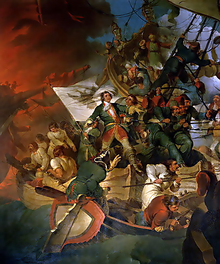
Capture of Azov, 1696, by Robert Ker Porter
Peter implemented sweeping reforms aimed at modernizing Russia.[9] Heavily influenced by his advisors from Western Europe, Peter reorganized the Russian army along modern lines and dreamed of making Russia a maritime power. He faced much opposition to these policies at home but brutally suppressed rebellions against his authority, including by the Streltsy, Bashkirs, Astrakhan, and the greatest civil uprising of his reign, the Bulavin Rebellion.
Peter implemented social modernization in an absolute manner by introducing French and western dress to his court and requiring courtiers, state officials, and the military to shave their beards and adopt modern clothing styles.[10] One means of achieving this end was the introduction of taxes for long beards and robes in September 1698.[11]
In his process to westernize Russia, he wanted members of his family to marry other European royalty. In the past, his ancestors had been snubbed at the idea, but now, it was proving fruitful. He negotiated with Frederick William, Duke of Courland to marry his niece, Anna Ivanovna. He used the wedding in order to launch his new capital, St Petersburg, where he had already ordered building projects of westernized palaces and buildings. Peter hired Italian and German architects to design it.[12]
As part of his reforms, Peter started an industrialization effort that was slow but eventually successful. Russian manufacturing and main exports were based on the mining and lumber industries. For example, by the end of the century Russia came to export more iron than any other country in the world.[13]
To improve his nation's position on the seas, Peter sought more maritime outlets. His only outlet at the time was the White Sea at Arkhangelsk. The Baltic Sea was at the time controlled by Sweden in the north, while the Black Sea and the Caspian Sea were controlled by the Ottoman Empire and Safavid Empire respectively in the south.
Peter attempted to acquire control of the Black Sea, which would require expelling the Tatars from the surrounding areas. As part of an agreement with Poland that ceded Kiev to Russia, Peter was forced to wage war against the Crimean Khan and against the Khan's overlord, the Ottoman Sultan. Peter's primary objective became the capture of the Ottoman fortress of Azov, near the Don River. In the summer of 1695 Peter organized the Azov campaigns to take the fortress, but his attempts ended in failure.
Peter returned to Moscow in November 1695 and began building a large navy in Voronezh. He launched about thirty ships against the Ottomans in 1696, capturing Azov in July of that year.
Grand Embassy
Main article: Grand Embassy of Peter the Great

Abraham Storck- Spectacle on the Amstel river, August 1697

The frigate Pieter and Paul on the IJ while Peter stands on the small ship on the right. Painting by A. Storck. This ship sank on his second voyage.

Joseph Mulder (1726) - View on the VOC wharf and warehouse
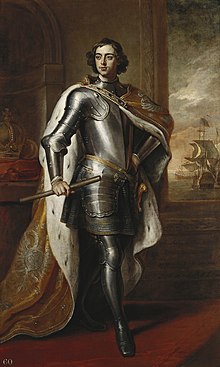
Portrait of Peter I by Godfrey Kneller, 1698. This portrait was Peter's gift to the King of England.
Peter knew that Russia could not face the Ottoman Empire alone. In 1697, he traveled "incognito" to Western Europe on an 18-month journey with a large Russian delegation–the so-called "Grand Embassy". He used a fake name, allowing him to escape social and diplomatic events, but since he was far taller than most others, he could not fool anyone. One goal was to seek the aid of European monarchs, but Peter's hopes were dashed. France was a traditional ally of the Ottoman Sultan, and Austria was eager to maintain peace in the east while conducting its own wars in the west. Peter, furthermore, had chosen an inopportune moment: the Europeans at the time were more concerned about the War of the Spanish Succession over who would succeed the childless King Charles II of Spain than about fighting the Ottoman Sultan.[5]
In Königsberg, the Tsar was apprenticed for two months to an artillery engineer. In July he met Sophia of Hanover at Coppenbrügge castle. She described him: "The tsar is a tall, handsome man, with an attractive face. He has a lively mind is very witty. Only, someone so well endowed by nature could be a little better mannered."[14] Peter rented a ship in Emmerich am Rhein and sailed to Zaandam, where he arrived on 18 August 1697. He studied saw-mills, manufacturing and shipbuilding but left after a week.[15][note 2] Through the mediation of Nicolaas Witsen, an expert on Russia, the Tsar was given the opportunity to gain practical experience in shipyard, belonging to the Dutch East India Company, for a period of four months, under the supervision of Gerrit Claesz Pool. The diligent and capable Tsar assisted in the construction of an East Indiaman ship Peter and Paul specially laid down for him. During his stay the Tsar engaged many skilled workers such as builders of locks, fortresses, shipwrights, and seamen—including Cornelis Cruys, a vice-admiral who became, under Franz Lefort, the Tsar's advisor in maritime affairs. Peter later put his knowledge of shipbuilding to use in helping build Russia's navy.[16]
Peter felt that the ship's carpenters in Holland worked too much by eye and lacked accurate construction drawings. On 11 January 1698 (Old Style) Peter arrived at Victoria Embankment with four chamberlains, three interpreters, two clock makers, a cook, a priest, six trumpeters, 70 soldiers from the Preobrazhensky regiment, four dwarfs and a monkey. Peter stayed at 21 Norfolk Street, Strand and met with King William III and Gilbert Burnet, attended a session of the Royal Society, received a doctorate from Oxford University, trained a telescope on Venus at the Greenwich Observatory, and saw a Fleet Review by Royal Navy at Deptford. He studied the English techniques of city-building he would later use to great effect at Saint Petersburg.[17] At the end of April 1698 he left after learning to make watches, carpenting coffins and posing for Sir Godfrey Kneller.
The Embassy next went to Leipzig, Dresden, Prague and Vienna. Peter spoke with Augustus II the Strong and Leopold I, Holy Roman Emperor.[17] Peter's visit was cut short, when he was forced to rush home by a rebellion of the Streltsy. The rebellion was easily crushed before Peter returned home; of the Tsar's troops, only one was killed. Peter nevertheless acted ruthlessly towards the mutineers. Over one thousand two hundred of the rebels were tortured and executed, and Peter ordered that their bodies be publicly exhibited as a warning to future conspirators.[18] The Streltsy were disbanded, some of the rebels were deported to Siberia, and the individual they sought to put on the Throne — Peter's half-sister Sophia — was forced to become a nun.
Peter's visits to the West impressed upon him the notion that European customs were in several respects superior to Russian traditions. He commanded all of his courtiers and officials to wear European clothing and cut off their long beards, causing his Boyars, who were very fond of their beards, great upset.[19] Boyars who sought to retain their beards were required to pay an annual beard tax of one hundred rubles. Peter also sought to end arranged marriages, which were the norm among the Russian nobility, because he thought such a practice was barbaric and led to domestic violence, since the partners usually resented each other.[20]
In 1698, Peter I instituted a beard tax to modernize Russian society. In the same year Peter sent a delegation to Malta, under boyar Boris Sheremetev, to observe the training and abilities of the Knights of Malta and their fleet. Sheremetev investigated the possibility of future joint ventures with the Knights, including action against the Turks and the possibility of a future Russian naval base.[21] On 12 September 1698, Peter officially founded the first Russian Navy base, Taganrog on the Sea of Azov.
In 1699, Peter changed the date of the celebration of the new year from 1 September to 1 January. Traditionally, the years were reckoned from the purported creation of the World, but after Peter's reforms, they were to be counted from the birth of Christ. Thus, in the year 7207 of the old Russian calendar, Peter proclaimed that the Julian Calendar was in effect and the year was 1700.[22] On the death of Lefort in 1699, Menshikov succeeded him as Peter's prime favourite and confidant.
Comments