


Ramesses II[a] (/ˈræməsiːz, ˈræmsiːz, ˈræmziːz/; Ancient Egyptian: rꜥ-ms-sw, Rīꜥa-masē-sə,[b] Semitic pronunciation: [ɾiːʕamaˈseːsə]; c. 1303 BC – 1213 BC),[7] commonly known as Ramesses the Great, was an Egyptian pharaoh. He was the third ruler of the Nineteenth Dynasty. Along with Thutmose III of the Eighteenth Dynasty, he is often regarded as the greatest, most celebrated, and most powerful pharaoh of the New Kingdom, which itself was the most powerful period of ancient Egypt.[8] He is also widely considered one of ancient Egypt's most successful warrior pharaohs, conducting no fewer than 15 military campaigns, all resulting in victories, excluding the Battle of Kadesh, generally considered a stalemate.[9]
In ancient Greek sources, he is called Ozymandias,[c][10] derived from the first part of his Egyptian-language regnal name: Usermaatre Setepenre.[d][11] Ramesses was also referred to as the "Great Ancestor" by successor pharaohs and the Egyptian people.
For the early part of his reign, he focused on building cities, temples, and monuments. After establishing the city of Pi-Ramesses in the Nile Delta, he designated it as Egypt's new capital and used it as the main staging point for his campaigns in Syria. Ramesses led several military expeditions into the Levant, where he reasserted Egyptian control over Canaan and Phoenicia; he also led a number of expeditions into Nubia, all commemorated in inscriptions at Beit el-Wali and Gerf Hussein. He celebrated an unprecedented thirteen or fourteen Sed festivals—more than any other pharaoh.[12]
Estimates of his age at death vary, though 90 or 91 is considered to be the most likely figure.[13][14] Upon his death, he was buried in a tomb (KV7) in the Valley of the Kings;[15] his body was later moved to the Royal Cache, where it was discovered by archaeologists in 1881. Ramesses' mummy is now on display at the National Museum of Egyptian Civilization, located in the city of Cairo.[16]
Early life
Ramesses II was born a civilian. His grandfather, Ramesses I, was a civilian military officer during the reign of pharaoh Horemheb, who appointed Ramesses I as his successor. Ramesses was approximately eleven years old at the time of his father's accession.[17]

Ramesses II as a child embraced by Hauron (Egyptian Museum, Cairo)
After Ramesses I died, his son, Seti I became king, who designated his son, Ramesses II, as Egypt's prince regent by his father. Ramesses II was approximately fourteen years of age at the time.[8] Today, most Egyptologists believe that Ramesses formally assumed the throne on 31 May 1279 BC, based on his known accession date: III Season of the Harvest, day 27.[13][14]
Military campaigns
Early in his life, Ramesses II embarked on numerous campaigns to restore possession of previously held territories lost to the Nubians and Hittites and to secure Egypt's borders. He was also responsible for suppressing some Nubian revolts and carrying out a campaign in Libya. Though the Battle of Kadesh often dominates the scholarly view of Ramesses II's military prowess and power, he nevertheless enjoyed more than a few outright victories over Egypt's enemies. During his reign, the Egyptian army is estimated to have totaled some 100,000 men: a formidable force that he used to strengthen Egyptian influence.[18]
Battle against Sherden pirates
In his second year, Ramesses II decisively defeated the Sherden sea pirates who were wreaking havoc along Egypt's Mediterranean coast by attacking cargo-laden vessels travelling the sea routes to Egypt.[19] The Sherden people probably came from the coast of Ionia, from southwest Anatolia or perhaps, also from the island of Sardinia.[20][21][22] Ramesses posted troops and ships at strategic points along the coast and patiently allowed the pirates to attack their perceived prey before skillfully catching them by surprise in a sea battle and capturing them all in a single action.[23] A stele from Tanis speaks of their having come "in their war-ships from the midst of the sea, and none were able to stand before them". There probably was a naval battle somewhere near the mouth of the Nile, as shortly afterward, many Sherden are seen among the pharaoh's body-guard where they are conspicuous by their horned helmets having a ball projecting from the middle, their round shields, and the great Naue II swords with which they are depicted in inscriptions of the Battle of Kadesh.[24] In that sea battle, together with the Sherden, the pharaoh also defeated the Lukka (L'kkw, possibly the people later known as the Lycians), and the Šqrsšw (Shekelesh) peoples.
First Syrian campaign

A relief of Ramesses II from Memphis showing him capturing enemies: a Nubian, a Libyan and a Syrian, c. 1250 BC. Cairo Museum.[25]
The immediate antecedents to the Battle of Kadesh were the early campaigns of Ramesses II into Canaan. His first campaign seems to have taken place in the fourth year of his reign and was commemorated by the erection of what became the first of the Commemorative stelae of Nahr el-Kalb near what is now Beirut. The inscription is almost totally illegible due to weathering.
In the fourth year of his reign, he captured the Hittite vassal state of the Amurru during his campaign in Syria.[26]
Second Syrian campaign
Main article: Battle of Kadesh
The Battle of Kadesh in his fifth regnal year was the climactic engagement in a campaign that Ramesses fought in Syria, against the resurgent Hittite forces of Muwatallis. The pharaoh wanted a victory at Kadesh both to expand Egypt's frontiers into Syria, and to emulate his father Seti I's triumphal entry into the city just a decade or so earlier. He also constructed his new capital, Pi-Ramesses. There he built factories to manufacture weapons, chariots, and shields, supposedly producing some 1,000 weapons in a week, about 250 chariots in two weeks, and 1,000 shields in a week and a half. After these preparations, Ramesses moved to attack territory in the Levant, which belonged to a more substantial enemy than any he had ever faced in war: the Hittite Empire.[27]
Ramesses's forces were caught in a Hittite ambush and outnumbered at Kadesh when they counterattacked and routed the Hittites, whose survivors abandoned their chariots and swam the Orontes river to reach the safe city walls.[citation needed] Ramesses, logistically unable to sustain a long siege, returned to Egypt.[28][29]
Third Syrian campaign
Egypt's sphere of influence was now restricted to Canaan while Syria fell into Hittite hands. Canaanite princes, seemingly encouraged by the Egyptian incapacity to impose their will and goaded on by the Hittites, began revolts against Egypt. In the seventh year of his reign, Ramesses II returned to Syria once again. This time he proved more successful against his Hittite foes. During this campaign he split his army into two forces. One force was led by his son, Amun-her-khepeshef, and it chased warriors of the Šhasu tribes across the Negev as far as the Dead Sea, capturing Edom-Seir. It then marched on to capture Moab. The other force, led by Ramesses, attacked Jerusalem and Jericho. He, too, then entered Moab, where he rejoined his son. The reunited army then marched on Hesbon, Damascus, on to Kumidi, and finally, recaptured Upi (the land around Damascus), reestablishing Egypt's former sphere of influence.[30]
Later Syrian campaigns
Main article: Siege of Dapur

Color reproduction of the relief depicting Ramesses II storming the Hittite fortress of Dapur
Ramesses extended his military successes in his eighth and ninth years. He crossed the Dog River (Nahr al-Kalb) and pushed north into Amurru. His armies managed to march as far north as Dapur,[31] where he had a statue of himself erected. The Egyptian pharaoh thus found himself in northern Amurru, well past Kadesh, in Tunip, where no Egyptian soldier had been seen since the time of Thutmose III, almost 120 years earlier. He laid siege to the city before capturing it. His victory proved to be ephemeral. In year nine, Ramesses erected a stele at Beth Shean. After having reasserted his power over Canaan, Ramesses led his army north. A mostly illegible stele near Beirut, which appears to be dated to the king's second year, was probably set up there in his tenth.[32] The thin strip of territory pinched between Amurru and Kadesh did not make for a stable possession. Within a year, they had returned to the Hittite fold, so that Ramesses had to march against Dapur once more in his tenth year. This time he claimed to have fought the battle without even bothering to put on his corslet, until two hours after the fighting began. Six of Ramesses's youthful sons, still wearing their side locks, took part in this conquest. He took towns in Retjenu,[33] and Tunip in Naharin,[34] later recorded on the walls of the Ramesseum.[35] This second success at the location was equally as meaningless as his first, as neither power could decisively defeat the other in battle.[36]
Peace treaty with the Hittites
Main article: Egyptian–Hittite peace treaty

Tablet of treaty between Ḫattušili III of Hatti and Ramesses II of Egypt, at the İstanbul Archaeology Museums
The deposed Hittite king, Mursili III, fled to Egypt, the land of his country's enemy, after the failure of his plots to oust his uncle from the throne. Ḫattušili III responded by demanding that Ramesses II extradite his nephew back to Hatti.[37]
This demand precipitated a crisis in relations between Egypt and Hatti when Ramesses denied any knowledge of Mursili's whereabouts in his country, and the two empires came dangerously close to war. Eventually, in the twenty-first year of his reign (1258 BC), Ramesses decided to conclude an agreement with the new Hittite king, Ḫattušili III, at Kadesh to end the conflict. The ensuing document is the earliest known peace treaty in world history.[30]
The peace treaty was recorded in two versions, one in Egyptian hieroglyphs, the other in Hittite, using cuneiform script; both versions survive. Such dual-language recording is common to many subsequent treaties. This treaty differs from others, in that the two language versions are worded differently. While the majority of the text is identical, the Hittite version says the Egyptians came suing for peace and the Egyptian version says the reverse.[38] The treaty was given to the Egyptians in the form of a silver plaque, and this "pocket-book" version was taken back to Egypt and carved into the temple at Karnak.
The treaty was concluded between Ramesses II and Ḫattušili III in year 21 of Ramesses's reign (c. 1258 BC).[39] Its 18 articles call for peace between Egypt and Hatti and then proceeds to maintain that their respective deities also demand peace. The frontiers are not laid down in this treaty, but may be inferred from other documents. The Anastasy A papyrus describes Canaan during the latter part of the reign of Ramesses II and enumerates and names the Phoenician coastal towns under Egyptian control. The harbour town of Sumur, north of Byblos, is mentioned as the northernmost town belonging to Egypt, suggesting it contained an Egyptian garrison.[40]
No further Egyptian campaigns in Canaan are mentioned after the conclusion of the peace treaty. The northern border seems to have been safe and quiet, so the rule of the pharaoh was strong until Ramesses II's death, and the waning of the dynasty.[41] When the King of Mira attempted to involve Ramesses in a hostile act against the Hittites, the Egyptian responded that the times of intrigue in support of Mursili III, had passed. Ḫattušili III wrote to Kadashman-Enlil II, Kassite king of Karduniaš (Babylon) in the same spirit, reminding him of the time when his father, Kadashman-Turgu, had offered to fight Ramesses II, the king of Egypt. The Hittite king encouraged the Babylonian to oppose another enemy, which must have been the king of Assyria, whose allies had killed the messenger of the Egyptian king. Ḫattušili encouraged Kadashman-Enlil to come to his aid and prevent the Assyrians from cutting the link between the Canaanite province of Egypt and Mursili III, the ally of Ramesses.
Nubian campaigns
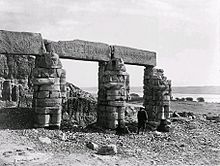
Part of Gerf Hussein temple, originally in Nubia
Ramesses II also campaigned south of the first cataract of the Nile into Nubia. When Ramesses was about 22, two of his own sons, including Amun-her-khepeshef, accompanied him in at least one of those campaigns. By the time of Ramesses, Nubia had been a colony for 200 years, but its conquest was recalled in decoration from the temples Ramesses II built at Beit el-Wali[42] (which was the subject of epigraphic work by the Oriental Institute during the Nubian salvage campaign of the 1960s),[43] Gerf Hussein and Kalabsha in northern Nubia. On the south wall of the Beit el-Wali temple, Ramesses II is depicted charging into battle against tribes south of Egypt in a war chariot, while his two young sons, Amun-her-khepsef and Khaemwaset, are shown behind him, also in war chariots. A wall in one of Ramesses's temples says he had to fight one battle with those tribes without help from his soldiers.[clarification needed]
Libyan campaigns
During the reign of Ramesses II, the Egyptians were evidently active on a 300-kilometre (190 mi) stretch along the Mediterranean coast, at least as far as Zawyet Umm El Rakham, where remains of a fortress described by its texts as built on Libyans land have been found.[44] Although the exact events surrounding the foundation of the coastal forts and fortresses is not clear, some degree of political and military control must have been held over the region to allow their construction.
There are no detailed accounts of Ramesses II's undertaking large military actions against the Libyans, only generalised records of his conquering and crushing them, which may or may not refer to specific events that were otherwise unrecorded. It may be that some of the records, such as the Aswan Stele of his year 2, are harking back to Ramesses's presence on his father's Libyan campaigns. Perhaps it was Seti I who achieved this supposed control over the region, and who planned to establish the defensive system, in a manner similar to how he rebuilt those to the east, the Ways of Horus across Northern Sinai.
Sed festivals
Main article: Sed festival
After reigning for 30 years, Ramesses joined a select group that included only a handful of Egypt's longest-lived rulers. By tradition, in the 30th year of his reign Ramesses celebrated a jubilee called the Sed festival. These were held to honour and rejuvenate the pharaoh's strength.[45] Only halfway through what would be a 66-year reign, Ramesses had already eclipsed all but a few of his greatest predecessors in his achievements. He had brought peace, maintained Egyptian borders, and built great and numerous monuments across the empire. His country was more prosperous and powerful than it had been in nearly a century.
Sed festivals traditionally were held again every three years after the 30th year; Ramesses II, who sometimes held them after two years, eventually celebrated an unprecedented thirteen or fourteen.[46]
Building projects and monuments
| This section needs additional citations for verification. Please help improve this article by adding citations to reliable sources in this section. Unsourced material may be challenged and removed. Find sources: "Ramesses II" – news · newspapers · books · scholar · JSTOR (May 2017) (Learn how and when to remove this template message) |
In the third year of his reign, Ramesses started the most ambitious building project after the pyramids, which were built almost 1,500 years earlier. The population was put to work changing the face of Egypt. Ramesses built extensively from the Delta to Nubia, "covering the land with buildings in a way no monarch before him had."[47]

Colossal Statue of Ramesses II in the first peristyle court at Luxor
Some of the activities undertaken were focused on remodeling or usurping existing works, improving masonry techniques, and using art as propaganda.
- In Thebes, the ancient temples were transformed, so that each one of them reflected honour to Ramesses as a symbol of his putative divine nature and power.
- The elegant but shallow reliefs of previous pharaohs were easily transformed, and so their images and words could easily be obliterated by their successors. Ramesses insisted that his carvings be deeply engraved into the stone, which made them not only less susceptible to later alteration, but also made them more prominent in the Egyptian sun, reflecting his relationship with the sun deity, Ra.
- Ramesses used art as a means of propaganda for his victories over foreigners, which are depicted on numerous temple reliefs.
- His cartouches are prominently displayed even in buildings that he did not construct.[48]
- He founded a new capital city in the Delta during his reign, called Pi-Ramesses. It previously had served as a summer palace during Seti I's reign.[49]
- Ramesses II expanded gold mining operations in Akuyati (modern day Wadi Allaqi).[50]
Ramesses also undertook many new construction projects. Two of his biggest works, besides Pi-Ramesses, were the temple complex of Abu Simbel and the Ramesseum, a mortuary temple in western Thebes.
Pi-Ramesses
Main article: Pi-Ramesses
Ramesses II moved the capital of his kingdom from Thebes in the Nile valley to a new site in the eastern Delta. His motives are uncertain, although he possibly wished to be closer to his territories in Canaan and Syria. The new city of Pi-Ramesses (or to give the full name, Pi-Ramesses Aa-nakhtu, meaning "Domain of Ramesses, Great in Victory")[51] was dominated by huge temples and his vast residential palace, complete with its own zoo. In the 10th century AD, the Bible exegete Rabbi Saadia Gaon believed that the biblical site of Ramesses had to be identified with Ain Shams.[52] For a time, during the early 20th century, the site was misidentified as that of Tanis, due to the amount of statuary and other material from Pi-Ramesses found there, but it now is recognized that the Ramesside remains at Tanis were brought there from elsewhere, and the real Pi-Ramesses lies about 30 km (18.6 mi) south, near modern Qantir.[53] The colossal feet of the statue of Ramesses are almost all that remains above ground today. The rest is buried in the fields.[51]
Comments