


In the moments before he died, King George V made an eerily accurate prophecy for his son and future king:“After I am dead, the boy will ruin himself in 12 months”.
No one would have quite believed how such events would have played out when Edward VIII met his future wife, the American divorcee Wallis Simpson.
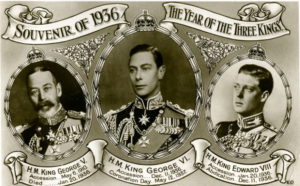
Born on 23rd June 1894, he inherited the throne on his father’s death in January 1936, only to abdicate months later on 11th December 1936, sending the monarchy and country spinning into crisis mode.

Four generations: Queen Victoria, Prince of Wales (Edward VII), George (George V) and Edward (in Victoria’s arms)
Edward had been Prince of Wales since the age of sixteen and taken part in a number of overseas tours as part of his royal duty. These trips were goodwill diplomatic exercises meant to boost the profile of the monarchy whilst maintaining good relations. Edward was just the man for the job as his more laid-back, informal style helped him attain a type of celebrity status more associated with Hollywood than monarchy.
As a dashing eligible bachelor, Edward made the most of his youth, engaging in numerous relationships and enjoying the high society lifestyle. His dalliances with numerous women was made all the more controversial by the fact many of them were married. His pursuit of pleasure and more relaxed style began to concern not only his father, but also the British Prime Minister at the time, Stanley Baldwin.
It was at this time, approaching forty, that his relationship with his father deteriorated. In contrast to George V who epitomised duty and responsibility, Edward was keen to enjoy himself and forged a new kind of celebrity status.
In 1931, his future was sealed when he engaged in a liaison with the American, soon to be twice-divorced, Wallis Simpson. A controversial figure emerging on the high society circuit, she was sophisticated and captivated Edward’s attention, representing the type of lifestyle he so desperately craved.
Wallis Simpson would prove to be a problematic candidate as the potential wife of the future king. As an American she was not ideal, however, the most insurmountable boundary would be her status as a divorcee. With Edward soon to be king, he would not only assume the role of reigning monarch, but also Supreme Governor of the Church of England.
Whilst there was no formal legal barrier to their union, as there would have been had she been a Catholic, Edward’s role as the head of the Church of England would have been explicitly compromised by their royal marriage. The Church of England did not allow marriages to divorcees to take place in church.
The prospect of their union had massive constitutional ramifications which neither seemed to be overtly aware of, compounded further by the social and cultural expectations which not only his father had for him, but more importantly the general public. Wallis Simpson was not, and never could be, a viable candidate as queen.
Nevertheless, upon the death of his father George V in January 1936, Edward’s accession was still seen as a celebratory moment. The enthusiasm for the new king however was about to dissipate in the following months at a rather alarming rate.
From the beginning his laissez-faire attitude with regard to his duty and royal responsibilities proved a matter of concern for his courtiers.
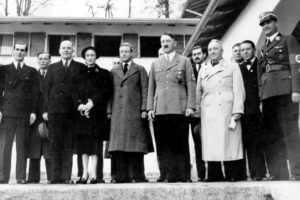
Made worse at this critical moment in European relations, was his apparent interest and affection for Germany and Adolf Hitler. Edward had previously travelled to Germany on one of his many foreign trips as Prince of Wales. Initially visiting in 1912, his affection for the country grew and would prove problematic when the unfolding conflict of the Second World War would call into question his allegiances.
Edward quickly showed himself to disregard royal and constitutional protocol, maintaining his status as a pleasure-seeker above all else.

Edward and Wallis
His attitude towards responsibility was not welcomed when he was king, however his engagement to Wallis Simpson only a few months into his reign set the wheels in motion for his departure.
Unsurprisingly, the marriage was opposed, not only by his own family but by the Prime Minister as well. A prospective queen consort with the baggage of former relationships would greatly compromise her ability to uphold the social and cultural expectations of the day, not to mention its direct infringement of Edward’s role as Head of the Church of England.
A constitutional crisis proved inevitable and Edward was keenly aware of the fact that Stanley Baldwin and his government would have to resign if the marriage was to go ahead. Thus, a political crisis would ensue, forcing through another general election and proving Edward’s inability to uphold his royal and constitutional duty.
Left with no choice but still more determined than ever to marry Wallis Simpson, Edward in a bid to avoid a full-scale constitutional crisis abdicated, leaving his younger brother George VI as the new king.
On 16th November 1936 he spoke to Prime Minister Baldwin, informing him of his plans to abdicate so that he could marry Mrs Simpson.
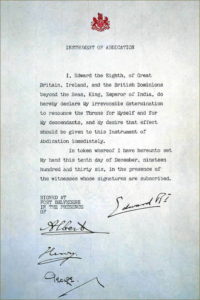
A month later, the deed was done and the throne was passed on to George VI, leaving Edward to console himself with a reign that lasted all of three hundred and twenty-six days, one of the shortest on record.
Whilst the immediate political crisis was averted by such a choice, the damage to the family, their status and the principles upheld by the institution of constitutional monarchy was clear for all to see.
Upon hearing the news Mrs Simpson fled the country, sheltering in the splendour of the South of France. On 12th December, Edward fled to the continent as well, travelling on board a naval destroyer.
His pursuit of happiness came at a cost.
After his abdication and the accession of his brother, he was given the title of the Duke of Windsor.
With nothing standing in his way, he went ahead with his plans and on 3rd June 1937 at a private ceremony at the Château de Candé in Tours, the Duke of Windsor and Mrs Simpson married.
Whilst the Church of England refused to sanction the marriage, Reverend Robert Anderson Jardine offered to perform the ceremony which turned out to be an extremely modest affair, with not one member of the royal family in attendance. Not even Lord Mountbatten, deemed to be Edward’s closest friend, attended the event.
The Duke of Windsor would remain resentful of his brother, now George VI, for forbidding attendance of the ceremony. This animosity was made worse by the king’s decision to withhold the title of Royal Highness to the now Duchess of Windsor. Without the title and with a financial settlement, the slight against the couple was felt very keenly by a spurned Edward.
With their fate as a celebrity couple and royal non-persons now sealed, the Duke and Duchess were to live the rest of their days in the vapid splendour and opulence they so desperately craved.
Comments