
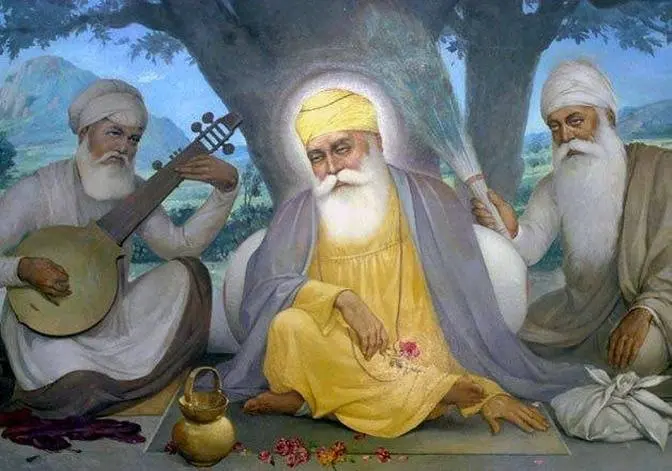

1. Introduction
Gurū Nānak (15 April 1469 – 22 September 1539), also referred to as Bābā Nānak ('father Nānak'),[1] was the founder of Sikhism and is the first of the ten Sikh Gurus. His birth is celebrated worldwide as Guru Nanak Gurpurab on Katak Pooranmashi ('full-moon of Kattak'), i.e. October–November.
Nanak is said to have travelled far and wide across Asia teaching people the message of ik onkar (ੴ, 'one God'), who dwells in every one of his creations and constitutes the eternal Truth.[2] With this concept, he would set up a unique spiritual, social, and political platform based on equality, fraternal love, goodness, and virtue.[3][4][5]
Nanak's words are registered in the form of 974 poetic hymns, or shabda, in the holy text of Sikhism, the Guru Granth Sahib, with some of the major prayers being the Japji Sahib (jap, 'to recite'; ji and sahib are suffixes signifying respect); the Asa di Var ('ballad of hope'); and the Sidh Gosht ('discussion with the Siddhas'). It is part of Sikh religious belief that the spirit of Nanak's sanctity, divinity, and religious authority had descended upon each of the nine subsequent Gurus when the Guruship was devolved on to them.
2. Biography
2.1. Birth

The Gurdwara Janam Asthan in Nankana Sahib, Pakistan, commemorates the site where Nanak is believed to have been born. https://handwiki.org/wiki/index.php?curid=1891055
Nanak was born on 15 April 1469 at Rāi Bhoi Kī Talvaṇḍī village (present-day Nankana Sahib, Punjab, Pakistan) in the Lahore province of the Delhi Sultanate,[6][7] although according to one tradition, he was born in the Indian month of Kārtik or November, known as Kattak in Punjabi.[8]
Most janamsakhis (ਜਨਮਸਾਖੀ, 'birth stories'), or traditional biographies of Nanak, mention that he was born on the third day of the bright lunar fortnight, in the Baisakh month (April) of Samvat 1526.[8] These include the Puratan ('traditional' or 'ancient') janamsakhi, Miharban janamsakhi, Gyan-ratanavali by Bhai Mani Singh, and the Vilayat Vali janamsakhi.[9] The Sikh records state that Nanak died on the 10th day of the Asauj month of Samvat 1596 (22 September 1539 CE), at the age of 70 years, 5 months, and 7 days. This further suggests that he was born in the month of Vaisakh (April), not Kattak (November).[10]
Kattak birthdate
In as late as 1815, during the reign of Ranjit Singh, the festival commemorating Nanak's birthday was held in April at the place of his birth, known by then as Nankana Sahib.[9] However, the anniversary of Nanak's birth—the Gurpurab (gur + purab, 'celebration')—subsequently came to be celebrated on the full moon day of the Kattak month in November. The earliest record of such a celebration in Nankana Sahib is from 1868 CE.[11]
There may be several reasons for the adoption of the Kattak birthdate by the Sikh community. For one, it may have been the date of Nanak's enlightenment or "spiritual birth" in 1496, as suggested by the Dabestan-e Mazaheb.
The only janamsakhi that supports the Kattak birth tradition is that of Bhai Bala. Bhai Bala is said to have obtained Nanak's horoscope from Nanak's uncle Lalu, according to which, Nanak was born on a date corresponding to 20 October 1469 CE. However, this janamsakhi was written by Handalis—a sect of Sikhs who followed a Sikh-convert known as Handal—attempting to depict the founder as superior to Nanak.[12] According to a superstition prevailing in contemporary northern India, a child born in the Kattak month was believed to be weak and unlucky, hence why the work states that Nanak was born in that month.[12]
Bhai Gurdas, having written on a full-moon-day of the Kattak month several decades after Nanak's death, mentions that Nanak had "obtained omniscience" on the same day, and it was now the author's turn to "get divine light."[13]
According to Max Arthur Macauliffe (1909), a Hindu festival held in the 19th century on Kartik Purnima in Amritsar attracted a large number of Sikhs. The Sikh community leader Giani Sant Singh did not like this, thus starting a festival at the Sikh shrine of the Golden Temple on the same day, presenting it as the birth anniversary celebration of Guru Nanak.[14]
Macauliffe also notes that Vaisakh (March–April) already saw a number of important festivals—such as Holi, Rama Navami, and Vaisakhi—therefore people would be busy in agricultural activities after the harvest festival of Baisakhi. Therefore, holding Nanak's birth anniversary celebrations immediately after Vaisakhi would have resulted in thin attendance, and therefore, smaller donations for the Sikh shrines. On the other hand, by the Kattak full moon day, the major Hindu festival of Diwali was already over, and the peasants—who had surplus cash from crop sales—were able to donate generously.[15]
2.2. Family and Early Life
Nanak's parents, including father Kalyan Chand Das Bedi (commonly shortened to Mehta Kalu) and mother Mata Tripta,[16] were both Hindu Khatris and employed as merchants.[17][18] His father, in particular, was the local patwari (accountant) for crop revenue in the village of Talwandi.[19]
According to Sikh traditions, the birth and early years of Nanak's life were marked with many events that demonstrated that Nanak had been blessed with divine grace.[20] Commentaries on his life give details of his blossoming awareness from a young age. For instance, at the age of five, Nanak is said to have voiced interest in divine subjects. At age seven, his father enrolled him at the village school, as per custom.[21] Notable lore recounts that, as a child, Nanak astonished his teacher by describing the implicit symbolism of the first letter of the alphabet, resembling the mathematical version of one, as denoting the unity or oneness of God.[22] Other stories of his childhood refer to strange and miraculous events about Nanak, such as the one witnessed by Rai Bular, in which the sleeping child's head was shaded from the harsh sunlight by, in one account, by the stationary shadow of a tree or, in another, by a venomous cobra.[23]
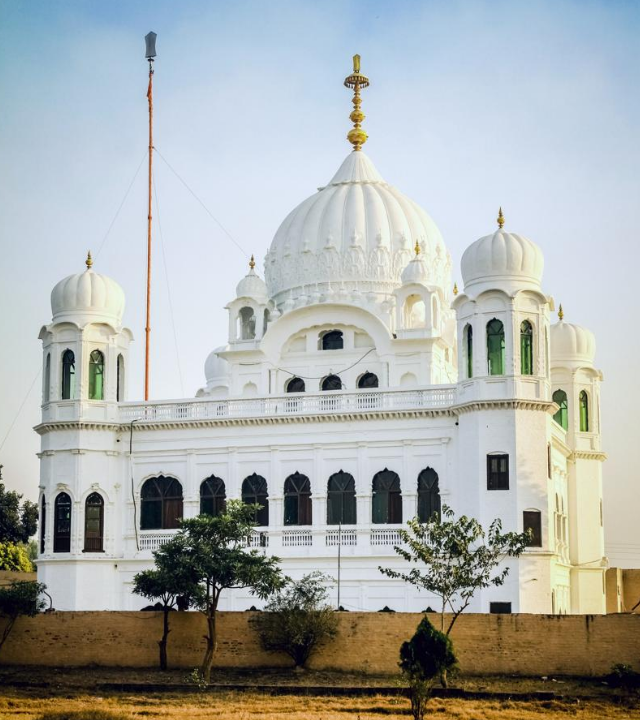
Gurdwara Darbar Sahib Kartar Pur in Narowal, Pakistan, marks the site where Guru Nanak is said to have died.[24] https://handwiki.org/wiki/index.php?curid=1551056
Nanaki, Nanak's only sister, was five years older than him. In 1475, she married and moved to Sultanpur. Jai Ram, Nanaki's husband, was employed at a modikhana (a storehouse for revenues collected in non-cash form), in the service of the Delhi Sultanate's Lahore governor Daulat Khan, at which Ram would help Nanak get a job.[25] Nanak moved to Sultanpur, and started working at the modikhana around the age of 16.
As a young man,[26] Nanak married Sulakhani, daughter of Mūl Chand (aka Mula)[27][28] They were married on 24 September 1487, in the town of Batala,[29] and would go on to have two sons, Sri Chand and Lakhmi Chand[25] (or Lakhmi Das).[30][31] Nanak lived in Sultanpur until c. 1500,[25] which would be a formative time for him, as the puratan janamsakhi suggests, and in his numerous allusions to governmental structure in his hymns, most likely gained at this time.
2.3. Final Years
Around the age of 55, Nanak settled in Kartarpur, living there until his death in September 1539. During this period, he went on short journeys to the Nath yogi centre of Achal, and the Sufi centres of Pakpattan and Multan. By the time of his death, Nanak had acquired several followers in the Punjab region, although it is hard to estimate their number based on the extant historical evidence.[32]
Guru Nanak appointed Bhai Lehna as the successor Guru, renaming him as Guru Angad, meaning "one's very own" or "part of you". Shortly after proclaiming his successor, Guru Nanak died on 22 September 1539 in Kartarpur, at the age of 70. According to Sikh hagiography, Guru Nanak's body was never found. When the quarreling Hindus and Muslims tugged at the sheet covering Nanak’s body, they found instead a heap of flowers—and so Nanak’s simple faith would, in course of time, flower into a religion, beset by its own contradictions and customary practices.[33]
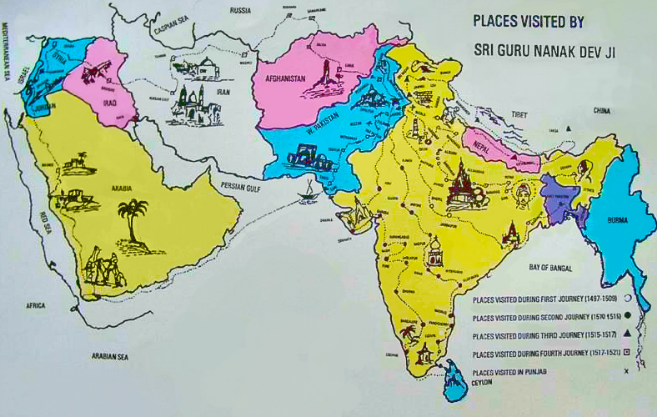
The four Udasis and other locations visited by Guru Nanak. https://handwiki.org/wiki/index.php?curid=1157971
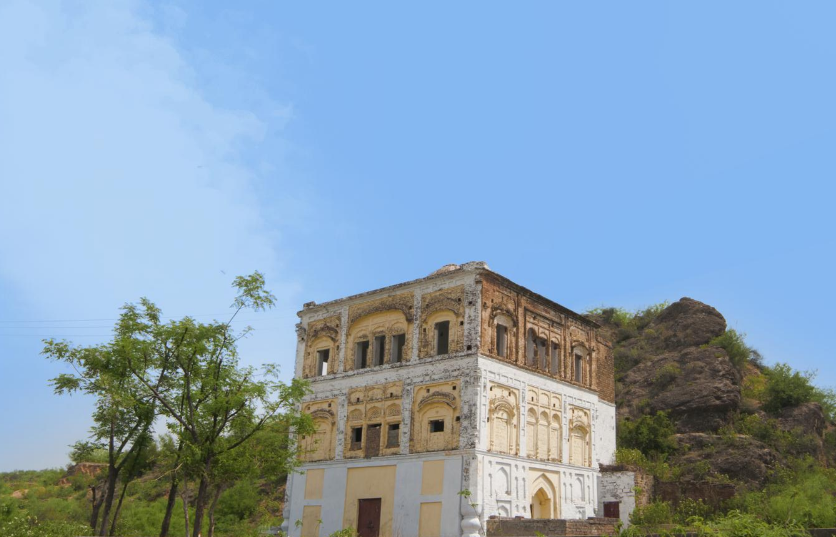
The abandoned Gurudwara Chowa Sahib, located near the Rohtas Fort in Pakistan , commemorates the site where Guru Nanak is popularly believed to have created a water-spring during one of his udasis.[34] https://handwiki.org/wiki/index.php?curid=1588267
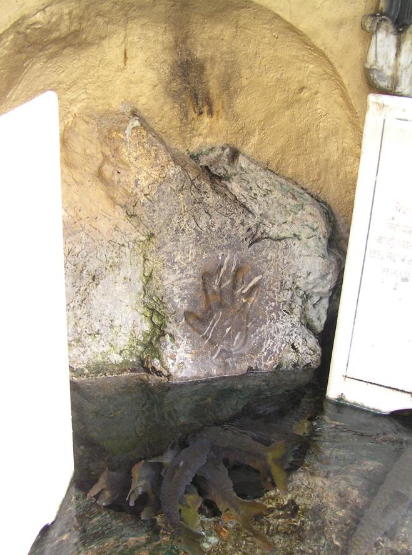
Guru Nanak's handprint is believed to be preserved on a boulder at the Gurdwara Panja Sahib in Hasan Abdal, Pakistan. https://handwiki.org/wiki/index.php?curid=1665528
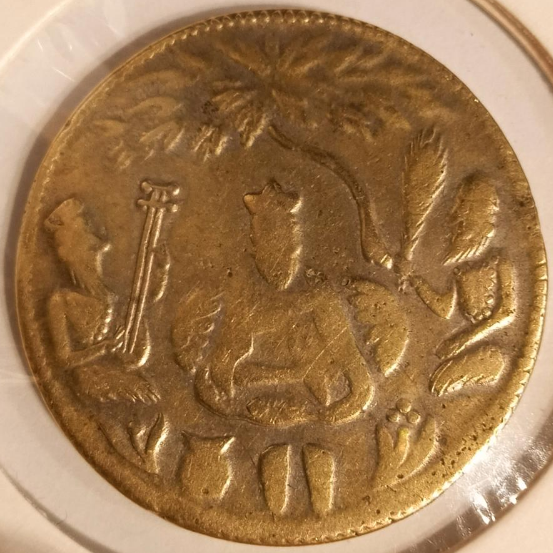
Coin from 1747 CE depicting Guru Nanak with his two disciples, Bhai Mardana and Bhai Bala waving a chaur (fly-whisk) as a mark of respect. https://handwiki.org/wiki/index.php?curid=1987619
3. Odysseys (Udasis)
During first quarter of the 16th century, Nanak went on long udasiya ('journeys') for spiritual pursuits. A verse authored by him states that he visited several places in "nau-khand" ('the nine regions of the earth'), presumably the major Hindu and Muslim pilgrimage centres.[25]
Some modern accounts state that he visited Tibet, most of South Asia, and Arabia, starting in 1496 at age 27, when he left his family for a thirty-year period.[20][35][36] These claims include Nanak's visit to Mount Sumeru of Indian mythology, as well as Mecca, Baghdad, Achal Batala, and Multan, where he would debate religious ideas with opposing groups.[37] These stories became widely popular in the 19th and 20th century, and exist in many versions.[37][38]
In 1508, Nanak visited the Sylhet region in Bengal. The janamsakhis suggest that Nanak visited the Ram Janmabhoomi temple in Ayodhya in 1510–11 CE.[39]
The Baghdad inscription remains the basis of writing by Indian scholars that Guru Nanak journeyed in the Middle East, with some claiming he visited Jerusalem, Mecca, Vatican, Azerbaijan and Sudan.[40]
3.1. Disputes
The hagiographic details are a subject of dispute, with modern scholarship questioning the details and authenticity of many claims. For example, Callewaert and Snell (1994) state that early Sikh texts do not contain such stories.[37] From when the travel stories first appear in hagiographic accounts of Guru Nanak, centuries after his death, they continue to become more sophisticated as time goes on, with the late phase Puratan version describing four missionary journeys, which differ from the Miharban version.[37][41]
Some of the stories about Guru Nanak's extensive travels first appear in the 19th-century 1. IntroductionPuratan janamsakhi, though even this version does not mention Nanak's travel to Baghdad.[37] Such embellishments and insertion of new stories, according to Callewaert and Snell (1993), closely parallel claims of miracles by Islamic pirs found in Sufi tadhkirahs of the same era, giving reason to believe that these legends may have been written in a competition.[37][42]
Gurū Nānak (15 April 1469 – 22 September 1539), also referred to as Bābā Nānak ('father Nānak'),[1] was the founder of Sikhism and is the first of the ten Sikh Gurus. His birth is celebrated worldwide as Guru Nanak Gurpurab on Katak Pooranmashi ('full-moon of Kattak'), i.e. October–November.
Nanak is said to have travelled far and wide across Asia teaching people the message of ik onkar (ੴ, 'one God'), who dwells in every one of his creations and constitutes the eternal Truth.[2] With this concept, he would set up a unique spiritual, social, and political platform based on equality, fraternal love, goodness, and virtue.[3][4][5]
Nanak's words are registered in the form of 974 poetic hymns, or shabda, in the holy text of Sikhism, the Guru Granth Sahib, with some of the major prayers being the Japji Sahib (jap, 'to recite'; ji and sahib are suffixes signifying respect); the Asa di Var ('ballad of hope'); and the Sidh Gosht ('discussion with the Siddhas'). It is part of Sikh religious belief that the spirit of Nanak's sanctity, divinity, and religious authority had descended upon each of the nine subsequent Gurus when the Guruship was devolved on to them.
Comments