
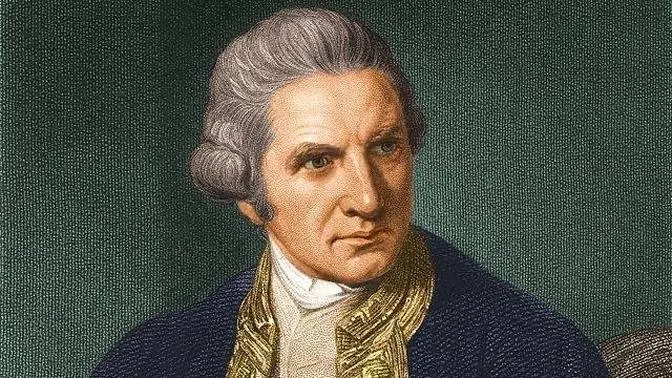

Who was James Cook?
James Cook was a British explorer and cartographer whose three voyages to the Pacific were central to its charting and subsequent opening up to European trade and colonisation.
Cook was born in 1728 at Marton in Yorkshire, where his father worked as a farm labourer. In 1746 he was apprenticed to John Walker, a ship owner in the nearby port of Whitby. Walker owned a fleet of ships that carried coal from Newcastle to London, and during his years working for him, Cook learned the art of navigation.
In 1755 Cook signed on as an able seaman in the Royal Navy. He served in the Seven Years’ War, during which he learned how to survey and chart rivers and coastlines and became skilled in astronomy.
Cook's first voyage
In 1768 Cook was selected to lead a joint Admiralty-Royal Society expedition to Tahiti. This was part of the Royal Society’s plan to use the Transit of Venus (the passing of Venus across the face of the Sun) to try to calculate the distance from the Earth to the Sun. The Admiralty also saw it as an opportunity to search out new lands and trading opportunities.
The Endeavour sailed from Britain in August 1768, carrying 94 men, including a party of artists and scientists led by Joseph Banks. At Tahiti Cook observed the Transit of Venus and also charted the coasts of the island.
After leaving Tahiti, he followed a set of secret orders from the Admiralty to search for land in the Pacific. He charted the coast of New Zealand, only part of which was known in Europe, and the east coast of Australia (the other coasts had been largely charted by Dutch navigators). His claiming of the east coast, which he called New South Wales, was the first step towards the British colonisation of Australia and other parts of the Pacific.
Cook's second voyage
In 1772, Cook was sent back to the Pacific by the Admiralty to search for the Great Southern Continent known as Terra Australis, believed by some in Europe to encircle the South Pole and to balance the weight of the landmasses of the northern hemisphere.
The expedition circumnavigated the globe further south than had been done before, allowing Cook to rule out the existence of a continent ‘unless near the pole and out of reach of navigation’. Cook’s ships were the first to cross the Antarctic Circle and set a record for the Farthest South that would stand for 49 years.
During the voyage Cook also charted the location of several islands and island groups in the Pacific and Atlantic that were not previously accurately plotted on European maps.
Cook’s third and final voyage
In 1776 Cook returned to the Pacific, this time with Admiralty orders to search for a sea passage to the North Atlantic (known as the Northwest Passage), which it was hoped would provide a new trade route from Britain. En route, his ships were the first from Europe known to have called at the Hawaiian Islands.
The ships explored the west coast of North America without finding a passage to the east. In August 1778 they sailed north through the Bering Strait, but were soon halted by an ice sheet extending from Alaska to Asia.
Cook decided to sail south to spend the winter in Hawai’i. During the stay, one of the ship’s boats was stolen. Cook attempted to take the Hawaiian high chief hostage in order to force its return, a tactic he had used in other places before. Violence broke out as the party returned to the beach and Cook was killed there with several others, both British and Hawaiian, on 14 February 1779.
Book now for our exhibitionJames Cook: The Voyages, open until 28 August 2018.
Further information about the life of James Cook can be found Who was James Cook?here via the Oxford Dictionary of National Biography.
James Cook was a British explorer and cartographer whose three voyages to the Pacific were central to its charting and subsequent opening up to European trade and colonisation.
Cook was born in 1728 at Marton in Yorkshire, where his father worked as a farm labourer. In 1746 he was apprenticed to John Walker, a ship owner in the nearby port of Whitby. Walker owned a fleet of ships that carried coal from Newcastle to London, and during his years working for him, Cook learned the art of navigation.
In 1755 Cook signed on as an able seaman in the Royal Navy. He served in the Seven Years’ War, during which he learned how to survey and chart rivers and coastlines and became skilled in astronomy.
Cook's first voyage
In 1768 Cook was selected to lead a joint Admiralty-Royal Society expedition to Tahiti. This was part of the Royal Society’s plan to use the Transit of Venus (the passing of Venus across the face of the Sun) to try to calculate the distance from the Earth to the Sun. The Admiralty also saw it as an opportunity to search out new lands and trading opportunities.
The Endeavour sailed from Britain in August 1768, carrying 94 men, including a party of artists and scientists led by Joseph Banks. At Tahiti Cook observed the Transit of Venus and also charted the coasts of the island.
After leaving Tahiti, he followed a set of secret orders from the Admiralty to search for land in the Pacific. He charted the coast of New Zealand, only part of which was known in Europe, and the east coast of Australia (the other coasts had been largely charted by Dutch navigators). His claiming of the east coast, which he called New South Wales, was the first step towards the British colonisation of Australia and other parts of the Pacific.
Cook's second voyage
In 1772, Cook was sent back to the Pacific by the Admiralty to search for the Great Southern Continent known as Terra Australis, believed by some in Europe to encircle the South Pole and to balance the weight of the landmasses of the northern hemisphere.
The expedition circumnavigated the globe further south than had been done before, allowing Cook to rule out the existence of a continent ‘unless near the pole and out of reach of navigation’. Cook’s ships were the first to cross the Antarctic Circle and set a record for the Farthest South that would stand for 49 years.
During the voyage Cook also charted the location of several islands and island groups in the Pacific and Atlantic that were not previously accurately plotted on European maps.
Cook’s third and final voyage
In 1776 Cook returned to the Pacific, this time with Admiralty orders to search for a sea passage to the North Atlantic (known as the Northwest Passage), which it was hoped would provide a new trade route from Britain. En route, his ships were the first from Europe known to have called at the Hawaiian Islands.
The ships explored the west coast of North America without finding a passage to the east. In August 1778 they sailed north through the Bering Strait, but were soon halted by an ice sheet extending from Alaska to Asia.
Cook decided to sail south to spend the winter in Hawai’i. During the stay, one of the ship’s boats was stolen. Cook attempted to take the Hawaiian high chief hostage in order to force its return, a tactic he had used in other places before. Violence broke out as the party returned to the beach and Cook was killed there with several others, both British and Hawaiian, on 14 February 1779.
Book now for our exhibitionJames Cook: The Voyages, open until 28 August 2018.
Further information about the life of James Cook can be found here via the Oxford Dictionary of National Biography.
Comments