
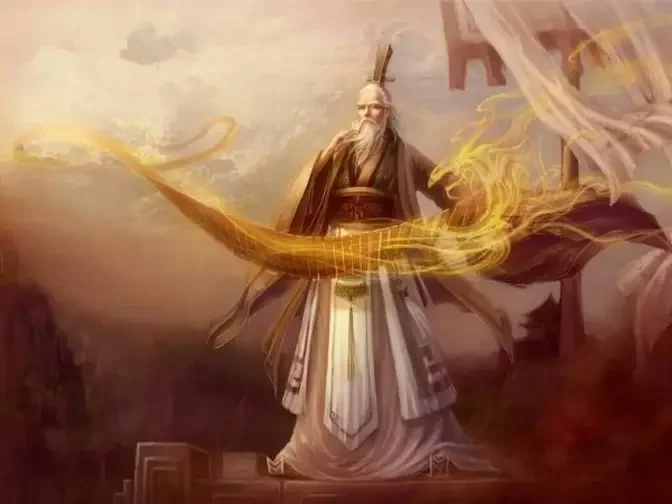

In this episode, I want to introduce you to a few of the legendary advisers in Chinese history. I’m going to cover four guys: Jiang (1) Ziya (3,2), Zhang (1) Liang (2), Guan (3) Zhong (4), and Yue (4) Yi (4). Ever since we were introduced to Zhuge Liang in the novel, we have been hearing a lot of comparisons to these guys, so I think it would be helpful to give you some context about who they were.
First, let’s talk about Jiang Ziya, the earliest of the four. He lived at the end of the Shang Dynasty, around the 1100s B.C. The Shang was considered the second Chinese dynasty, although it is the first dynasty for which we have solid evidence of its existence. The Shang was said to have lasted something like 700 years, but by the time of JIang Ziya, it was fading fast. According to some versions of his story, Jiang Ziya supposedly served in the court of the last king of the Shang for a while, but left because of the king’s wicked ways. From there, he was said to have traveled near and far to the surrounding kingdoms, but none of their rulers really made much use of him. Before you know it, Jiang Ziya was an old man who had accomplished little and was living in poverty.
Meanwhile, one of the vassals of the Shang, King Wen (2) of the kingdom of Zhou, was in the midst of searching for talented men. As the story goes, one day, before the king went out hunting, he took the auspices, and the diviner informed him that on the north bank of the Wei (4) River, he would net a big catch, but that this catch would not be in the form of a dragon, a tiger, or a bear. Instead, he was told, he would find an official who would help him achieve his grand plans.
So King Wen (2) went off on his hunt, and on the north bank of the Wei (4) River, he came upon an old man sitting on a grass mat and fishing. King Wen noticed something odd about the old man’s fishing line. At the end of the line was not a hook, but a straight needle, or according to some version of the story, nothing at all. This obviously was not going to snag any fish.
Intrigued, the king asked the old man about his strange method of fishing. This old man, who of course, was none other than JIang Ziya, replied, “Those who are ready will come to me on their own volition.” He then added, “The willing will come; the unwilling will go away.”

When the king heard this, he couldn’t quite shake the feeling that the old man was maybe not talking so much about fish as he was about the king. So he began to converse with Jiang Ziya and soon recognized that he was talking to a man possessing great political and military knowledge. So the king asked Jiang Ziya to be his teacher. To show his respect, the king asked Jiang Ziya to sit in his chariot, then personally drove the chariot back to his capital, where he made Jiang Ziya his prime minister.
King Wen’s faith in Jiang Ziya was not misplaced. After King Wen died, his son, King Wu (3), came the throne and decided to overthrow the Shang Dynasty. Jiang Ziya was his main strategist in the ensuing war and was instrumental in the eventual victory that marked the beginning of the Zhou Dynasty, which would last about 800 years. For his contributions, Jiang Ziya was made the ruler of the vassal kingdom of Qi (2), and he ruled that territory wisely and made it prosper.
To this day, Jiang Ziya is something of a revered, half-mythical figure in China, and the benchmark against which all advisers who came afterward would be measured. And his rags-to-riches transformation in his old age gives us all hope that it’s never too late to make something of ourselves.
The next great adviser in our lineup is Guan (3) Zhong (4), who lived from 723 to 645 BC, during the Spring and Autumn period. During this period, even though the Zhou Dynasty still technically existed and the King of Zhou was technically the ruler of the empire, in reality he had little sway and all the vassal kingdoms were vying with each other for dominance. The aim of these individual kingdoms wasn’t so much to conquer the rest of the empire as it was to dominate the other kingdoms and make yourself the biggest, baddest kid on the block.
Guan Zhong’s father was an official in the state of Qi (2), which coincidentally, was the fiefdom that was ruled by Jiang Ziya some 400 years earlier. After his father died, Guan Zhong’s family fell into poverty. He tried his hand at business with a friend named Bao (1) Shuya (1,2). That venture went bust, though during his time as a two-bit merchant, Guan Zhong traveled all around, which gave him a lot of life experience. He also tried his hand at being a soldier, but fled in the face of battle. He later tried to become an official but also had no luck.
Eventually, though, Guan Zhong’s fortunes took a turn for the better. He and Bao (1) Shuya (1,2), who was a pretty learned scholar in his own right, became tutors to two of the sons of the Duke of Qi. This Duke had three sons. The eldest was his successor, but this heir was a man of dubious character. Guan Zhong and Bao Shuya, meanwhile, were tutors to the two younger sons, each taking on one prince.
After the old Duke died, his no-good heir came to the throne, and things soon hit the fan. The new Duke’s cousin, who held a grudge because of some personal slight, staged a coup, killed the Duke, and put himself on the throne. Amid the chaos, the dead Duke’s younger brothers, the ones tutored by Guan Zhong and Bao Shuya, fled with their teachers to different corners of the empire.
A year after the coup, the new new Duke got his comeuppance, as members of the ruling house staged their own coup and killed him. At this point, the state of Qi was without a ruler. This was the opportunity the two princes in exile were waiting for, and they both began to rush back, since the first one to make it home would have an advantage in vying for the throne.
Xiaobai (3,2), the prince who was tutored by Bao Shuya, set off first and looked to be the frontrunner. But Guan Zhong got wind of this, so he led some war chariots and raced on ahead of his own prince to cut off Xiaobai along the way. When he approached Xiaobai’s chariot, Guan Zhong suddenly shot an arrow at the prince. Prince Xiaobai was struck, spat up blood, and slumped in his chariot. Seeing that his master’s rival was now dead, Guan Zhong rode away, rejoined his prince, and continued on their journey at a leisurely pace.
Unbeknownst to Guan Zhong, however, Prince Xiaobai was very much alive. The arrow had struck his belt buckle, and Xiaobai, thinking quickly, bit his own tongue to spit up blood and make Guan Zhong think he was dead. But as soon as Guan Zhong was out of sight, Xiaobai and Bao Shuya pressed forward at double time, and they beat their rival home. Upon entering the capital, Xiaobai was crowned Duke Huan (2) of Qi.
This turn of events did not bode well for his brother. Guan Zhong and his prince soon discovered that they had been duped and that they were now out in the cold as far as the throne was concerned. At this time, they were backed by the state of Lu (3), and the Duke of Lu (3) launched an attack on Qi to try to put his man on the throne by force. But Duke Huan (2) of Qi repelled this attack and even chased the defeated Lu (3) troops back into their own territory. At this point, Duke Huan (2) wrote to the Duke of Lu (3) and told him that if he did not want any trouble, he needed to kill the renegade prince and hand over Guan Zhong. So Guan Zhong’s master was eventually forced to commit suicide, while Guan Zhong was placed in a prison cart and shipped back to Qi.
While this was going on, Duke Huan was getting his court in order, and he asked his teacher, Bao Shuya, to serve as his prime minister. Bao Shuya, however, told his pupil that he was not worthy and suggested another man for the job. And that man was … Guan Zhong.
Duke Huan was taken aback by this suggestion. I mean, did you forget that Guan Zhong was the guy who, you know, tried to put an arrow through my heart? But Bao Shuya told him that Guan Zhong was a rare talent, superior to me in every way. Besides, Bao Shuya said, Guan Zhong was merely serving his own master when he shot you, and you can’t fault a man for being loyal to his liege. Bao Shuya eventually convinced Duke Huan to drop his grudge.
When Guan Zhong’s prison cart arrived in Qi, Bao Shuya was at the border to greet him. Guan Zhong was released, given a bath and a fresh set of clothes, and told that, oh hey, instead of killing you, the Duke wants you to be his right-hand man. Guan Zhong was initially reluctant because 1) he failed to help his own master take the throne, and 2) he failed to follow his master in death. So what would people say if he now served his former enemy? But Bao Shuya eventually persuaded him to reconsider.
So now that both parties were receptive to each other, Duke Huan personally went to welcome Guan Zhong and entrusted him with the affairs of his kingdom. Guan Zhong lived up to Bao Shuya’s praise, as his policies made the kingdom of Qi strong and prosperous. Over the course of two decades, Guan Zhong helped Duke Huan defeat a bunch of rival kingdoms, until he was declared the hegemon, or in other words, the biggest, baddest kid on the block.

Comments