


William Wallace
William Wallace is a significant figure in Scottish history who fought for the protection of Scotland. He battled against invasion from the English army. Since his death in 1305, he became a much-celebrated individual, and he has many monuments dedicated to his memory. Who was William Wallace?
- William Wallace is a national hero for many Scots, and his legacy continues to this day.
- He fought in the Scottish Wars of Independence, which resisted the English army of King Edward I.
- William Wallace led an army to fight against the English and successfully won the Battle of Stirling Bridge.
- Unfortunately, Scots lost at the subsequent battle, the Battle of Falkirk.
- William Wallace was eventually captured and killed brutally by the English.
- He lived from around 1270 to 1305.
- His bravery and actions have inspired books, poetry, music and film.
Twinkl has an amazing selection of engaging learning materials. Subscribe and download today to get involved!

Where was William Wallace born?
Not very much is known about William Wallace's early life. As he was born a long time ago, there weren’t a lot of records that were kept to detail where and when people were born. This is partly because many people weren’t literate like they are today. However, it is believed that William Wallace born around 1270 in Elderslie, Renfrewshire to a family of lower nobility.
Much of the way Wallace has been characterised is based on a 15th Century poem by a poet called Blind Harry. In ‘The Wallace’, Blind Harry wrote that Wallace was the son of Sir Malcolm of Elderslie, however, his official seal states that he is the son of Alan Wallace.
Because there is very little factual information about William Wallace, poets like Blind Harry and films such as Braveheart have used fiction to make the hero come to life.
How tall was William Wallace?
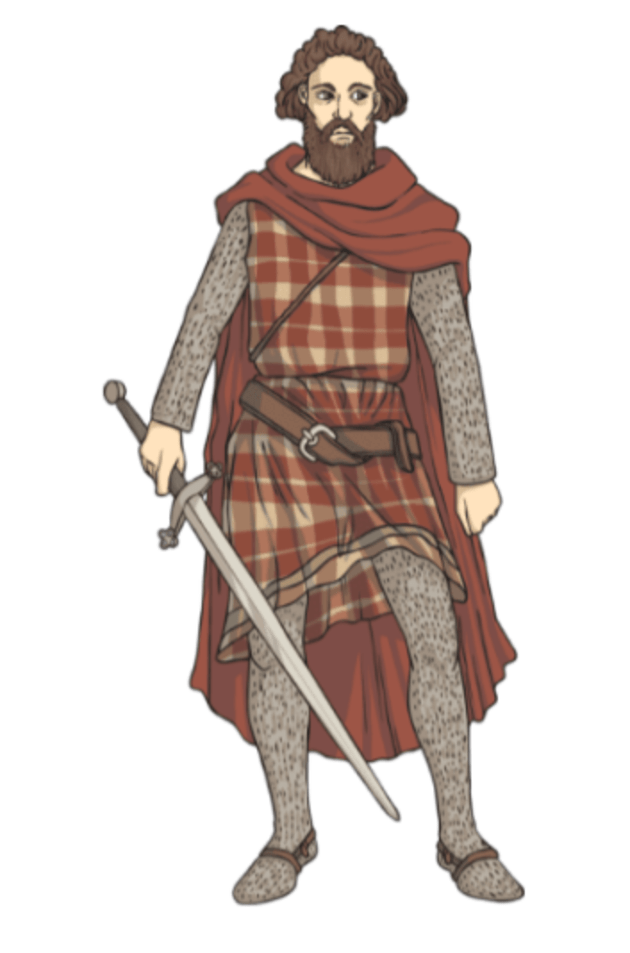
William Wallace is well known to have a large height. Wallace was nearly two metres tall! This is the equivalent of being 6ft 4in.
This meant that he was a commanding presence, and much taller than most people at the time. Because of this, he was able to yield a large sword. His most famous weapon, which can still be seen today at the Wallace Monument, is 5ft 3in.
Who was William Wallace's wife?
According to Blind Harry's poem, which details a lot of information about Braveheart, William Wallace's wife was called Marion Braidfute. It has often been speculated that it was her murder by the Sheriff of Lanark that caused William Wallace to rebel against English forces.
However, it is unclear whether she has existed, and she was first mentioned in literature 200 years after Wallace's death.
What started the Wars of Independence?
At the time when William Wallace was growing into adulthood, the King of Scots was Alexander III. The king died unexpectedly by falling off his horse in 1286. This was a real problem for the crown because all of his children had died before him. His three-year-old granddaughter, Margaret, Maid of Norway was his nearest heir. Unfortunately, however, she died on the boat when travelling to Scotland.

This meant that it was unclear who was going to be the next monarch of Scotland. 13 people claimed that they deserved to be the next king, and a civil war was at risk of happening in Scotland.
As a result, Edward I, the King of England, was called upon to decide who would be the next King of Scotland. However, it seemed that Edward wanted to appoint a king that he could easily control. This meant that he appointed John Balliol as King of Scots.
Despite this, Edward’s plan didn’t work. Edward expected Scotland to support them with the war they were having with France, but Scotland united with the French against the English and formed what is now known as the ‘Auld Alliance’.
This enraged Edward I, and he instructed the English army to invade Scotland. The result was, Scotland had to fight to maintain its independence.

Why did William Wallace fight the English?
Due to his success at leading Scottish rebel forces, it is believed that William Wallace must have had some army training before taking part in the First War of Scottish Independence. The seal that Wallace used featured the symbol of an archer. This suggests that he was trained to use a bow and arrow.

Wallace first gained notoriety when he killed the Sheriff of Lanark, William Heselrig, who was of English origin. Not very much is known what motivated Wallace to do this. Many have speculated that it was an act of revenge for Heselrig killing his wife.
Whatever the reason, the killing sent a big message to Edward I that Scotland was prepared to fight. William Wallace, who was from lower nobility, became a notable figure to fight against England.
William Wallace and the Battle of Stirling Bridge
William Wallace, who was empowered by killing the Sheriff of Lanark, teamed up with Andrew de Moray to fight at the Battle of Stirling Bridge. It was considered at the time that whoever controlled Stirling had the ‘key to Scotland’. For this reason, it was very important for both sides to win the battle.
The English forces arrived in 1297, and it is believed that they had 2,000 more men than the Scots. The Scots were on one side of the river, and the English the other. The old Stirling Bridge was made of wood and quite narrow. It was reported that only two English horsemen could cross side by side.
William Wallace and Andrew de Moray decided to wait until enough of the English army had crossed, that they believed they could beat. Once that was the case, the Scots charged from higher ground, on horseback and with arrows. Doing so meant that while the English army outnumbered the Scots, not all of them were able to fight.

After this, the Scottish forces destroyed the bridge, meaning that the rest of the English army couldn’t take part in the battle. The destruction of the bridge also removed an opportunity for the stranded members of the English army to retreat.
Andrew de Moray died from wounds during the battle, but it was a big success for the Scots and for William Wallace, who was granted “Guardian of the Kingdom of Scotland and commander of its army”.
Whilst King Edward and the English were defeated, they were planning another battle, the Battle of Falkirk, which was to lead to Wallace’s downfall.

William Wallace and the Battle of Falkirk
The Battle of Falkirk was where things began to get very bad for William Wallace. The battle took place in 1298, a year after the one in Stirling. Edward I managed to hold a truce with France, and this allowed him to devote his attention to Falkirk.
This time, there were about 15,000 English soldiers, which over double the amount that Scotland had at 6,000. The English army managed to surround different parts of the Scots forces. Many of the Scots weren’t very well-trained, and it resulted in them being surrounded with little option for them to attack or escape.
The battle was a terrible defeat for the Scots, and for Wallace, who luckily managed to escape. His reputation was diminished, and he resigned the title Guardian of Scotland to Robert the Bruce.

How was William Wallace caught?
It is believed that William Wallace travelled to France to try to get support from the French army against the English. This would have also allowed him to hide from the English army, who would have undoubtedly wanted to capture him.
However, in 1305 he was captured. Wallace's hiding place was discovered by a Scottish nobleman, John de Menteith, who was loyal to the English. It is reported that Menteith captured Wallace during his sleep.
Wallace was then imprisoned and transferred to King Edward. He was charged with treason against Edward, even though he wasn’t Wallace’s king.
How William Wallace died:
After getting charged, William Wallace was sentenced to death.Wallace was hung, drawn and quartered, which was an extremely brutal and merciless punishment to people who were seen as traitors. Parts of his body were displayed throughout Great Britain, in Stirling, Perth, Newcastle and Berwick. His head was put on a spike in London Bridge.

Where Was William Wallace Buried?
As Wiliam Wallace's body was torn apart and sent to different parts of Great Britain as a warning, there is sadly no full resting place for William Wallace. However, it is believed that the quarter of his body that was displayed on the rebuilt Stirling Bridge, was retrieved by Monks at Cambuskenneth Abbey in order to give Wallace a christian burial. This would have had to have been under the cloak of darkness, and highly sercrative, as the English army would have surely killed the Monks if they were caught.
It is also believed that William Wallace's arm is buried within the walls of St Machar's Cathedral in Aberdeen.
What is William Wallace’s legacy?
Since his death, William Wallace has become an iconic figure for Scotland. He is noted for his strength in fighting to defend his country, as well as his bravery, which gave him the famous nickname, Braveheart.
There have been many tributes and landmarks dedicated to his memory, most specifically the Wallace Monument. This building was completed in 1869 and is found in Stirling. At 246 steps, and 67 metres tall, it is noticeable from far and wide. Its great height also means it overlooks the land where the Battle of Stirling Bridge happened.

Where is William Wallace's sword?
William Wallace's iconic sword can still be visited today! It is permanently on display at the National Wallace Monument in Stirling.
When you see the sword, you can imagine how tall William Wallace must have been to have been able to use it.

What are William Wallace's nicknames?
- Braveheart
- Hammer of the Scots
- The Guardian of Scotland
- Uilleam Uallas (the Gaelic translation)
Who were William Wallace’s allies?
Here is a list of some of the people who supported William Wallace and his cause:
- Andrew de Moray: He joint led the Battle of Stirling Bridge, and he died from the wounds there.
- John Balliol: The King of Scots at the time, who designated Wallace as the Guardian of Scotland.
- John de Graham: A nobleman who fought alongside Wallace. He died at the Battle of Falkirk.
- Sir William Douglas: The first nobleman to lend his support for Wallace against the English.
- Robert the Bruce: His successor as the Guardian of Scotland and future King of Scots.

Who were William Wallace’s enemies?
- Edward I: The King of England, who was invading Scotland.
- William Heselrig: The Sheriff of Lanark that Wallace murdered, possibly for killing his wife.
- John de Warenne: The military leader for the English army.
- Hugh Cressingham: The strategist for the Battle of Stirling Bridge, who later died in the fight.
- John de Menteith: The nobleman who captured Wallace.

What resources are there to teach who William Wallace was?
We have a load of excellent learning materials available to help teach your pupils about William Wallace and his legacy.
- Our William Wallace PowerPoint is an ideal start to show who William Wallace was.
- For some quick pieces of information, the William Wallace Fact File will be a great help.
- The Battle of Stirling Bridge PowerPoint gives excellent details about the heroic battle.
- You can also try our Scottish Wars of Independence Timeline Display Posters to fill your class with important moments about the wars.
- The William Wallace Resource Pack is a brilliant selection of materials to engage your class about the Scottish hero.
- Our Uilleam Uallas Category Page has some lovely information about the Scottish hero in Gaelic.
Comments