

Service in Shu Han[edit]
In 221, Liu Bei declared himself emperor and founded the state of Shu Han. He promoted Zhang Fei to General of Chariots and Cavalry (車騎將軍) and Colonel-Director of Retainers (司隸校尉), and enfeoffed him as the Marquis of Xi District (西鄉侯).[30]
Liu Bei sent an imperial edict to Zhang Fei as follows:
"I have received the Mandate of Heaven and inherited the noble work of my ancestors. I am obliged to restore peace and purge the Empire of chaos. As of now, there are villains and barbarians causing destruction and harm to the people, while those who miss the Han dynasty eagerly hope for its restoration. I feel distressed, I can neither rest well nor have my meals in peace. I have prepared the armies and made an oath to bring Heaven's punishment upon those evildoers. You are loyal and resolute, your deeds are comparable to those of Shao Hu,[c] your fame spreads near and far. As such, I give you special appointments, grant you a peerage, and put you in charge of affairs in the capital. You are born with Heaven's might, you use virtue to win over others, and you dish out punishments to wrongdoers. I am very pleased with you. The Classic of Poetry says: 'Not to distress the people, nor with urgency, but making them conform to the royal state. You have commenced and earnestly displayed your merit, and I will make you happy.'[31] How can I not give encouragement to you?"[32]
Death[edit]

An illustration of Zhang Fei's assassination at the Long Corridor of the Summer Palace, Beijing.
Earlier in late 219, Sun Quan broke his alliance with Liu Bei and sent his general Lü Meng to lead an invasion of Liu Bei's territories in Jing Province, which resulted in the death of Guan Yu. Around July or August 221, Liu Bei launched a campaign against Sun Quan to take revenge and seize back his territories in Jing Province. Zhang Fei was ordered to lead 10,000 troops from Langzhong to rendezvous with Liu Bei's main force at Jiangzhou.[33]
During the mobilisation, Zhang Fei's subordinates Fan Qiang (范彊) and Zhang Da (張達) assassinated their commander, decapitated the corpse, and brought the head along with them as they defected to Sun Quan's side.[34]
When Liu Bei heard that Zhang Fei's adjutant had sent him a report, he exclaimed: "Oh! (Zhang) Fei is dead."[35]
In October or November 260, Liu Bei's son and successor Liu Shan granted Zhang Fei the posthumous name "Marquis Huan" (桓侯).[36][37]
Family and descendants[edit]
In the year 200, Zhang Fei chanced upon Xiahou Yuan's niece, Lady Xiahou, while she was out gathering firewood and abducted her. She was around 13 years old at the time. Zhang Fei knew that she was of good upbringing, so he married her. They had one daughter,[d] who later married Liu Shan and became Empress of the state of Shu.[38][39] Empress Jing'ai had a younger sister who also married Liu Shan and was known as Empress Zhang.[40]
Zhang Fei's eldest son, Zhang Bao, died at a young age.[41] Zhang Bao's son, Zhang Zun (張遵), served as a Master of Writing (尚書). In 263, during the Conquest of Shu by Wei, he followed Zhuge Zhan to defend Mianzhu from the Wei general Deng Ai but was killed in action.[42][43]
Zhang Fei's second son, Zhang Shao (張紹), inherited his father's marquis title and served as a Palace Attendant (侍中) and Supervisor of the Masters of Writing (尚書僕射) in Shu.[44] In 263, the Shu emperor Liu Shan ordered Zhang Shao, Qiao Zhou and Deng Liang (鄧良) to represent him when he officially surrendered to Deng Ai and brought an end to the Shu regime. After the fall of Shu, Zhang Shao accompanied Liu Shan to the Wei capital Luoyang, where he was enfeoffed as a marquis along with other former Shu officials.[45]
Appraisal[edit]

illustration of Zhang Fei by Yashima Gakutei in the Chester Beatty Library
Chen Shou, who wrote Zhang Fei's biography in the Sanguozhi, commented on the latter as follows: "Guan Yu and Zhang Fei were praised as mighty warriors capable of fighting ten thousand of enemies (萬人敵). They were like tigers among (Liu Bei's) subjects. Guan Yu and Zhang Fei both had the style of a guoshi.[e] Guan Yu repaid Cao Cao's kindness while Zhang Fei released Yan Yan out of righteousness. However, Guan Yu was unrelenting and conceited while Zhang Fei was brutal and heartless. These shortcomings resulted in their downfalls. This was not something uncommon."[46]
Cheng Yu, an adviser to Cao Cao, also once mentioned that Guan Yu and Zhang Fei were "capable of fighting ten thousand of enemies" (萬人敵). In the main text of Zhang Fei's biography, Chen Shou wrote that Zhang Fei respected virtuous persons and detested those of vile character. Liu Bei had constantly warned Zhang Fei about his barbaric behaviour as he once told the latter: "You have dealt out far too excessive punishments. You often flog your men, who are actually the ones who will carry out your orders. Your behaviour will get you into trouble." Zhang Fei still did not change his ways.[47]
Both Guan Yu and Zhang Fei had a prominent reputation during their lifetimes as great warriors. To the point that eminent officials from other kingdoms such as Guo Jia and Zhou Yu directly referred to them as warriors who are a match for ten thousand men (萬人敵) and generals with the might of bears and tigers. Such was the extent of their fames.[48][49] Another lesser known official working for Cao Cao's state, Fu Gan (傅幹) qualified Zhang Fei and Guan Yu as heroes of their time possessing both braveness and righteousness; and also repeat the assessment that they are warriors who are a match for ten thousand men (萬人敵).[50]
The appraisal used by people of their lifetimes to describe Guan Yu and Zhang Fei as warriors who are a match for ten thousand men (萬人敵) would transcend the Three Kingdoms era and later be used in Chinese culture as an idiom to characterize someone as possessing extraordinary strength.[51]
The Australian sinologist Rafe de Crespigny commented: "There are anecdotes describing Zhang Fei as a man of literary tastes who composed verse in the midst of battle, but he is more generally known as arrogant, impetuous and brutal. While Guan Yu was said to be harsh towards men of the gentry but treated his soldiers well, Zhang Fei was courteous towards the virtuous but cruel to his rank and file. The two men were nonetheless regarded as the finest fighting men of their lifetime."[2]
In Romance of the Three Kingdoms[edit]

Statues of the three sworn brothers. From left to right: Liu Bei, Guan Yu, Zhang Fei.
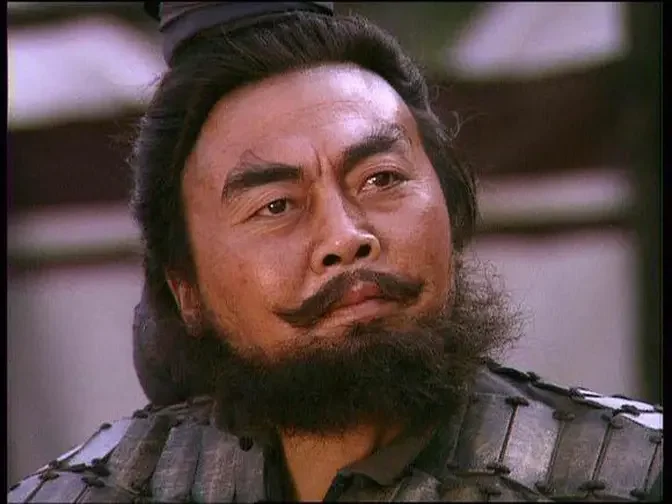
In the historical novel Romance of the Three Kingdoms, Zhang Fei's physical appearance was described in the following: eight spans tall (身高八尺), had a head of a panther's and huge round eyes (豹頭環眼), a swallow's jowls and a tiger's beard(燕頷虎鬚),a voice like thunder and a stance of a dashing horse (聲若巨雷 勢如奔馬). Zhang Fei's courtesy name is written as 翼德 in Chinese instead of 益德, but both names have the same pronunciation in Mandarin. Zhang Fei was also described to be an alcoholic, and his obsession with alcohol caused his judgment to be affected from time to time. Throughout the novel, Zhang Fei was shown as an exceedingly loyal and formidable warrior, but also a short-tempered man, who often got into trouble more often when he was not on the battlefield. His weapon was a "1.8 zhang long refined steel spear" (丈八點鋼矛), which was also called a "1.8 zhang long serpent spear" (丈八蛇矛), meaning "spear as long as a 1.8 zhang serpent" or later "1.8 zhang spear with serpent-shaped head".
See the following for some fictitious stories in Romance of the Three Kingdoms involving Zhang Fei:
- Oath of the Peach Garden
- List of fictitious stories in Romance of the Three Kingdoms#Zhang Fei thrashes the imperial inspector
- Battle of Hulao Pass
- Battle of Changban#In fiction
- Battle of Jiameng Pass
In popular culture[edit]
Zhang Fei sometimes appears as a door god in Chinese and Taoist temples, partnered with Guan Yu.
Zhang Fei appears on the Kunqu stage as a hualian. In one particular famous scene, The Swaying Reeds, Zhang Fei ambushes and humiliates Zhou Yu before setting him free.
Zhang Fakui, a general in the National Revolutionary Army, was nicknamed "Zhang Fei".[52] In 1959, Peng Dehuai, a marshal of the People's Liberation Army, identified himself with Zhang Fei. Because Mao Zedong was popularly associated with Cao Cao, Mao and other members of the Chinese Communist Party interpreted Peng's identification with Zhang as confrontational, eventually leading to Mao ending Peng's career.[53]
Notable actors who have portrayed Zhang Fei in films and television series include: Li Jingfei in Romance of the Three Kingdoms (1994); Chen Zhihui in Three Kingdoms: Resurrection of the Dragon (2008); Zang Jinsheng in Red Cliff (2008–09); Kang Kai in Three Kingdoms (2010); Justin Cheung in Dynasty Warriors (2019).
Zhang Fei is featured as a playable character in all instalments of Koei's Dynasty Warriors video game series, as well as Warriors Orochi, a crossover between Dynasty Warriors and Samurai Warriors. He also appears in other video games produced by Koei, such as Romance of the Three Kingdoms, Dynasty Tactics and Kessen II. Other non-Koei titles that he is featured in include Heroes Evolved, Clash of Kingdoms, Three Kingdoms: Fate of the Dragon, Destiny of an Emperor and Koihime Musō.
The creative nonfiction travel essay 'Facing Zhang Fei: Hero or Villain or Man' featured in The Bangalore Review (April 2020). The narrative follows the movements of Australian writer Dean Kerrison in the ancient town Langzhong, Sichuan, which Zhang Fei governed and died in. The piece mixes insights of contemporary Chinese culture, critique relating to Zhang Fei and the Three Kingdoms period, and the theme of heroism including relevant personal anecdotes.[54]
In the collectible card game Magic: The Gathering, there is a card named "Zhang Fei, Fierce Warrior" in the Portal Three Kingdoms set.
Comments