


Queen Emma of Normandy navigated both political instability and Viking usurpers on her way to becoming the richest and most powerful woman in England.
Emma Of Normandy
Wikimedia Commons
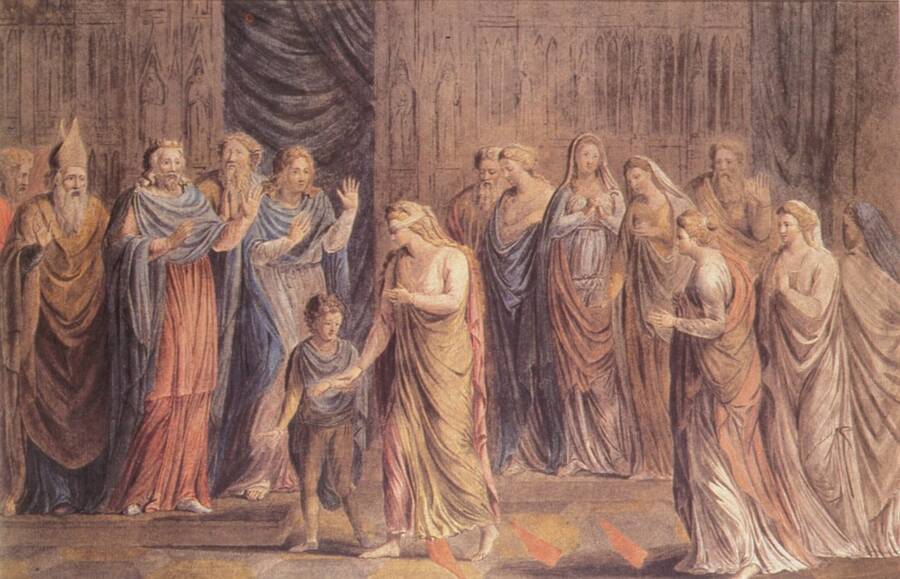
The Ordeal of Queen Emma (1779) by William Blake.
It has been said that behind every great man is a great woman, and Emma of Normandy was no exception. And at times, she was well ahead of them. Married to two kings of England, her political maneuverings helped guide the country through the Viking age and ensured that her sons would maintain the crown.
Emma of Normandy first became a queen when she was just a teenager. Descended from Norman Vikings, her father was Richard I, Duke of Normandy, and she was married off to King Aethelred II of England in 1002.
At the time, England was under constant threat of invasion by Viking forces from France that terrorized the people. The lack of a resolute response saw the king called “Aethelred the Unready. And he hoped his political union with the House of Normandy would ease those tensions.
But by the time she was scarcely 30, Aethelred was dead, and Emma needed to secure her status. So she married the man who stole his crown, the Danish king Cnut the Great. And from there, her influence only grew. At a time when women were deemed mere nurturers, her achievements in politics, religious order, and Norman-English relations broke the mold and remain historic.
Queen Emma Of Normandy’s First Marriage To Aethelred II
Born around 984 C.E., Emma of Normandy would enter the world of politics at a young age. She was raised in northern France, where Viking influence had grown drastically and where many of the raids on England by these relentless Norsemen were based. Ultimately, many from both sides sought compromise.
Encomium Emmae Reginae
Photo12/UIG/Getty Images
Queen Emma and her sons as illustrated in the Encomium Emmae Reginae from the mid-11th century.
Her father, Richard I, Duke of Normandy, was desperate to improve his standing with the English since the House of Normandy lacked the necessary political ties to bolster its influence. For King Aethelred the Unready, also known as Aethelred II, a union between the regions could unite them against a common Viking threat — and improve his own reputation.
Arranged in 1002, the political match saw Emma of Normandy cross the English Channel and marry a man some 20 years her senior. King Aethelred II had been married once before, but his first wife had died young after providing him with 10 children. This would later only complicate the chain of succession.
Eager to expel all Danes, King Aethelred II orchestrated the St. Brice’s Day Massacre on the outskirts of northern England. Esteemed figures like Gunhilde, sister of Denmark’s King Sweyn I, were killed. While Emma focused on producing offspring, the results of that event would follow her.
Queen Emma gave birth to Edward the Confessor around 1003, with a second son named Alfred Aetheling and a daughter named Godgifu to follow. Aethelred gave her vast land and properties in Winchester, Devonshire, Oxfordshire, Exeter, Suffolk, and Rutland — but growing tensions now overshadowed her luxurious new life.
Ethelred The Unready
Wikimedia Commons
Aethelred the Unready as illustrated in The Chronicle of Abindon (1220).
King Sweyn’s Viking invasions in the first decade of the 11th century would last three years and see Emma flee to Normandy by 1013. King Aethelred, himself, was forced to escape to the Isle of Wight — while King Sweyn successfully took England over. Though Sweyn would die in 1014, Queen Emma’s return was anything but peaceful.
Comments