
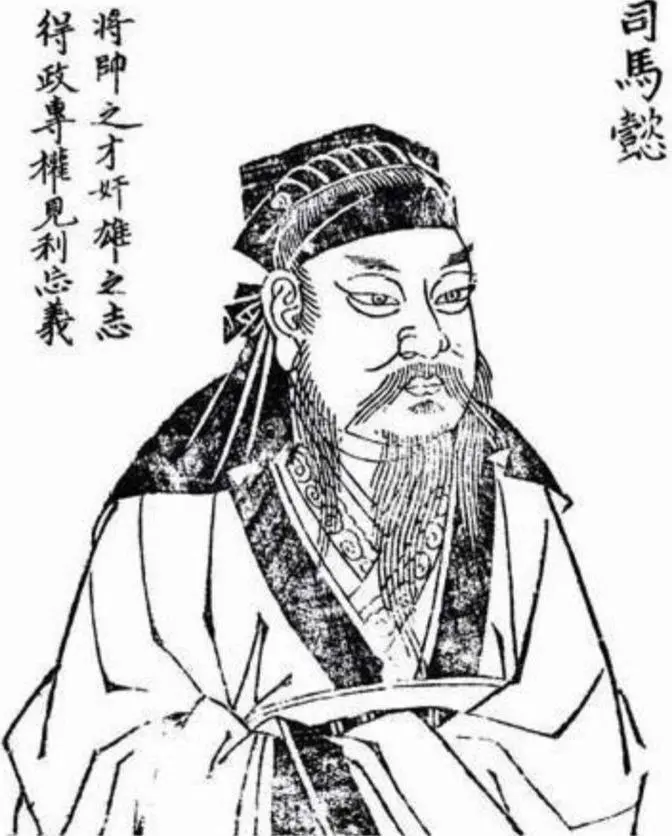

Incident at Gaoping Tombs
The Book of Jin asserts that on the night of 4 February, the day before the planned coup, Sima Yi sent spies to monitor the behaviour of his two eldest children. Some hours later, in the early morning, the spies reported to Sima Yi that Sima Shi went to bed as usual and slept peacefully, whereas Sima Zhao, having allegedly only been informed of the plan during the prior evening, tossed and turned in his bed.
On 5 February 249, Cao Shuang and his brothers accompanied the emperor, Cao Fang, on a visit to the Gaoping Tombs (高平陵) to pay their respects to the late emperor, Cao Rui. On that day, Sima Yi seized the opportunity to stage a coup d'état against his co-regent. He went to Yongning Palace to meet Empress Dowager Guo to request the memorialisation of a decree ordering the removal of Cao Shuang and his brothers from power. Thereafter, all the city gates were closed while Sima Shi's previously-arranged 3,000 forces which had gathered at the Sima Gate (司馬門) under his command were led to occupy the palace gates. Sima Yi later even commented: "This son really worked well." Soon, the troops were lined up along the palace grounds, passing through Cao Shuang's camp. Cao Shuang's Controller of Camp, Yan Shi (嚴世), was on the upper floor, drawing his crossbow, intending to shoot the passing Sima Yi. His colleague Sun Qian (孫謙) stopped him and said: "We wouldn't know what will happen." Three times he focused, three times he stopped, every time pulling back his elbow, but not getting to shoot.
Meanwhile, Sima Yi granted imperial authority to Gao Rou, the Minister over the Masses, and further appointed him as acting General-in-Chief (大將軍) and ordered him to take command of Cao Shuang's troops while stating: "You're now like Zhou Bo." He also appointed Wang Guan, the Minister Coachman (太僕), and a man whom Sima Yi had previously recommended during Cao Rui's reign, as acting Commandant of the Central Army (中領軍) and ordered him to seize command of the troops under Cao Shuang's brother Cao Xi (曹羲).
Sima Yi, along with the Grand Commandant (太尉) Jiang Ji and others, led troops out of Luoyang to the floating bridge above the Luo River, where he sent a memorial to the emperor, Cao Fang, listing out Cao Shuang's crimes (e.g. not fulfilling his duty as regent, corrupting the government, conspiring against the throne) and requesting the emperor to remove Cao Shuang and his brothers from their positions of power. Cao Shuang blocked the memorial from reaching Cao Fang and left the emperor at the south of the Yi River while ordering his men to cut down trees to build anti-cavalry blockades and station about 1,000 troops nearby to guard against Sima Yi's advances. Sima Yi sent Xu Yun (許允) and Chen Tai to persuade Cao Shuang to plead guilty as early as possible. He additionally sent Yin Damu (尹大目), a man whom Cao Shuang trusted, to tell him that nothing more would result from this aside from his dismissal. Huan Fan, the Minister of Finance (大司農), had previously left the city to visit Cao Shuang's camp, with Sima Yi commenting: "The 'bag of wisdom' is gone." Jiang Ji responded: "Huan Fan is indeed wise, but stupid horses are too much attached to the beans in their manger. Cao Shuang is certain not to employ his counsel." Huan Fan attempted to convince Cao Shuang and his brothers to flee to Xuchang with the emperor, and to issue an edict denouncing Sima Yi as a traitor and drafting troops to fight back, but they remained undecided. Cao Shuang ultimately surrendered to Sima Yi and gave up his powers, thinking that he could still lead a luxurious life in retirement. Huan Fan scolded them, saying: "Cao Zhen was a good man, yet sired you and your brothers, little pigs and calves that you are! I never expected to be involved with you and have my family annihilated."
After returning to Luoyang, Cao Shuang and his brothers were carefully guarded, and on 9 February 249, Cao Shuang was accused of plotting treason, after the palace eunuch, Zhang Dang (張當), who had himself been sent to the tingyu, had testified that Cao Shuang and his associates were planning to seize the throne for themselves. Cao Shuang was arrested along with his brothers and his supporters, including He Yan, Ding Mi, Deng Yang, Bi Gui, Li Sheng, and Huan Fan. They were subsequently executed along with the rest of their families and relatives on the same day. Jiang Ji had attempted to persuade Sima Yi to spare Cao Shuang and his brothers in consideration of the meritorious service rendered by their father, Cao Zhen, but Sima Yi refused. Two of Cao Shuang's subordinates, Lu Zhi (魯芝) and Yang Zong (楊綜), had been implicated in the plot and arrested as well, although Sima Yi pardoned them under the rationale that: "Each of them was serving his own master."
Earlier on, when Huan Fan escaped from Luoyang to join Cao Shuang, he encountered Si Fan (司蕃), who was guarding the Changping Gate. As Si Fan used to serve under Huan Fan, he trusted Huan Fan and allowed him to pass through. Once he was out of Luoyang, Huan Fan turned back and told Si Fan: "The Imperial Tutor (Sima Yi) is planning to commit treason. You should come with me!" However, Si Fan stayed behind and hid himself. After the coup d'état, Si Fan surrendered himself to Sima Yi and told him what happened earlier. Sima Yi asked: "What's the punishment for falsely accusing someone of treason?" The reply was: "According to the law, the one who makes the false accusation shall be punished for treason." Huan Fan was then executed along with the rest of his family.
Cao Shuang's younger cousin, Cao Wenshu, had perished, and the family of his widowed wife, Xiahou Lingnu, wanted to remarry her to someone else, in response to which she cut off both her ears, and later her nose. Her family asserted that the Cao clan was exterminated, but she retorted by saying: "I have heard that a person of worth does not renounce his principles because of changes in fortune, nor a righteous person change his mind with a view to preservation or destruction. While the Cao flourished, I was bent on keeping my chastity. Now that they have declined and perished, can I bear to renounce them? Even animals do not act this way; how can I?" When Sima Yi heard of this, he allowed her to adopt a son as an heir to the Cao clan.
The contemporary Shu official and regent, Fei Yi, gave his own comment regarding the coup as follows:
[...] If Sima Yi really considered Cao Shuang to be guilty of extravagance and arrogance, it would suffice for him to execute him according to the law. However, he exterminated even his infant children, branding them with the name of disloyalty, effectively wiping out Zidan's line. Also, He Yan's son was a nephew of the Wei ruler, and even he was killed. Sima Yi was assuming too much power and behaving improperly.
On 18 February (or sometime in March) 249, Cao Fang appointed Sima Yi as Imperial Chancellor (丞相) and added another four counties – Fanchang (繁昌), Yanling (鄢陵), Xinji (新汲), and Fucheng (父城) – to Sima Yi's marquisate, bringing the size of the marquisate to a total of eight counties and 20,000 taxable households. Cao Fang also awarded Sima Yi the privilege of not having to announce his name when he spoke to the emperor. Sima Yi declined the appointment of Imperial Chancellor. In January or February 250, Cao Fang awarded Sima Yi the nine bestowments and an additional privilege of not having to kowtow during imperial court sessions. Sima Yi declined the nine bestowments. In February or March 250, Cao Fang had an ancestral shrine built for the Sima family in Luoyang, increased the size of Sima Yi's personal staff, promoted some of Sima Yi's personal staff, and enfeoffed Sima Yi's sons Sima Rong (司馬肜) and Sima Lun as village marquises. At the time, as Sima Yi was chronically ill, he could not regularly attend imperial court sessions, so Cao Fang often visited him at his residence to consult him on policy matters.
Suppressing Wang Ling's rebellion
Wang Ling, the Grand Commandant (太尉), and his nephew Linghu Yu (令狐愚), the Inspector of Yan Province, became worried of Sima Yi's growing influence over the emperor, Cao Fang, so they plotted to replace Cao Fang with Cao Biao, the Prince of Chu, while instating his capital city as Xuchang, and then to overthrow Sima Yi. Linghu Yu, however, died in December 249 or January 250.
In February 251, Wang Ling either lied by stating that Eastern Wu forces were approaching the Tu River (塗水) and requested that the Wei government give him troops to resist the invaders, or was telling the truth in that they were actually obstructing the river, but wanted to use the troops for his own malicious purposes. Either way, Sima Yi was suspicious of Wang Ling's intention, and so he refused to approve the request. On 7 June 251, upon receiving intelligence of Wang Ling's plot from two officials named Yang Hong (楊弘) and Huang Hua (黃華), Sima Yi immediately mobilised troops to attack Wang Ling and moved by travelling down the river while bestowing additional authority upon Zhuge Dan and ordering him to lead his own forces to encroach upon Wang Ling's position. He first issued a pardon to Wang Ling and sent a secretary to call for his surrender, while Sima Yi's army ultimately reached Gancheng (甘城) within a few days and advanced to within 100 chi of Wang Ling's base to put pressure on him. Wang Ling knew that Sima Yi already knew about his plans to rebel, and he also knew that his forces were too weak, so he gave up, sent his subordinate Wang Yu (王彧) to apologise on his behalf, and handed over his official seal and ceremonial axe to Sima Yi. When Sima Yi's army reached Qiutou (丘頭), Wang Ling tied himself up, but Sima Yi, acting on imperial order, sent a Registrar (主簿) to unbind Wang Ling and reassure him of his safety and return to him his official seal and ceremonial axe.
He thereafter met with Sima Yi at Wuqiu (武丘), with a distance of more than ten zhang between both of them, and Wang Ling told him: "If I am guilty, you can summon me to meet you. Why do you need to come here?" Sima Yi replied: "That's because you don't respond to summons." Wang Ling exclaimed: "You have failed me!" Sima Yi responded by claiming: "I would rather fail you than fail the state." Wang Ling was then escorted as a prisoner back to Luoyang. To discern Sima Yi's true intentions, Wang Ling asked him if he could receive nails for his coffin. Sima Yi had them given to him. Along the way, when Wang Ling passed by a shrine honouring the Wei general Jia Kui, he exclaimed: "Jia Liangdao! Only the gods know Wang Ling is truly loyal to Wei." Wang Ling later committed suicide on 15 June 251 by consuming poison at Xiang County (項縣; present-day Shenqiu County, Henan). Sima Yi had Wang Ling's conspirators arrested and executed along with their families.
Cao Fang sent Wei Dan (韋誕) as an emissary to meet Sima Yi at Wuchi (五池) and congratulate him on his success in suppressing Wang Ling's rebellion. Later, when Sima Yi reached Gancheng, Cao Fang sent Yu Ni (庾嶷) as an emissary to appoint Sima Yi as Chancellor of State (相國) and promote him from a marquis to a duke under the title "Duke of Anping Commandery" (安平郡公). One of Sima Yi's grandsons and one of his brothers were also enfeoffed as marquises. At the time, the Sima family had a total of 19 marquises and 50,000 taxable households in all their marquisates combined. Sima Yi declined the appointment of Chancellor of State and refused to accept his enfeoffment as a duke.
Reportedly, Guo Huai's wife, the younger sister of Wang Ling, was taken into custody by imperial censors. Guo Huai apprehensively relented and let her be taken, not wanting to push things further, but when his five sons kowtowed before him until their foreheads started bleeding, he finally relented and ordered his subordinates to bring back his wife from the imperial censors. He thereafter wrote a letter to Sima Yi: "My five sons are willing to sacrifice their lives for their mother. If they lose their mother, I lose them too. Without my five sons, I will no longer exist. If I have violated the law by seizing back my wife from the imperial censors, I am willing to see the Emperor and take full responsibility for my actions." After reading Guo Huai's letter, Sima Yi made an exception for Guo Huai's wife and pardoned her.
During that time, the Weilüe recounts a story of how a man named Yang Kang (楊康), who had been a personal aide of Linghu Yu, divulged the conspiracy of Linghu Yu having wanted to engage in a rebellion when he was still alive in 249 or 250. Sima Yi, while stationed in Shouchun, personally asked Shan Gu (單固), another former aide: "Did Linghu Yu plot a rebellion?" He denied this, but Sima Yi doubted him as Yang Kang had previously asserted that Shan Gu had also been involved in the plot, so Shan Gu and his family were arrested, and he was tortured and interrogated. Shan Gu remained firm in his denial, and so Sima Yi had Yang Kang called in to compare their testimonies. Yang Kang was unable to defend his own rhetoric, so Shan Gu began cursing at Yang Kang. Yang Kang had thought he would be enfeoffed as a reward, but as his own testimony had been inconsistent, he was instead sentenced to death together with Shan Gu, with both of them being dragged out and executed.
Around that time, the corpses of Wang Ling and Linghu Yu had been dragged out of their tombs and their bodies had been exposed for three days in the nearest market place.
In July 251, Cao Biao was forced to commit suicide. Sima Yi then relocated the other nobles from the Cao family to Ye, where they were effectively put under house arrest there.
DEATH AND POSTHUMOUS HONOURS
In July 251, when Sima Yi became critically ill, he dreamt of Jia Kui and Wang Ling being honoured, and he felt disturbed after that. He died on 7 September 251 in Luoyang at the age of 73 (by East Asian age reckoning). The emperor, Cao Fang, donned mourning garments, attended Sima Yi's funeral in person, and even ordered Sima Yi to be buried with the same honours as those accorded to Huo Guang in the Western Han dynasty. He also posthumously appointed Sima Yi as Chancellor of State (相國) and posthumously elevated him to the status of a duke. However, Sima Yi's younger brother, Sima Fu, declined the ducal title and a wenliangche (轀輬車) on behalf of his deceased brother, stating that Sima Yi would have done that if he were still alive.
Sima Yi was buried on 19 October 251 at Heyin County (河陰縣; north of present-day Mengjin County, Henan). Cao Fang granted him the posthumous title "Wenzhen" (文貞), which was later changed to "Wenxuan" (文宣). However, before his death, Sima Yi had made arrangements to be buried at Mount Shouyang (首陽山; in present-day Yanshi, Luoyang, Henan) with no markers (e.g. tombstone, trees) around his tomb, to be dressed in plain clothes, and have no luxury items buried with him. He also made a rule stating that his family members who died after him should not be buried with him.
After Sima Yi's death, his eldest son, Sima Shi, assumed his father's authority up until his own death on 23 March 255, after which Sima Yi's second eldest son, Sima Zhao, took up his elder brother's position. On 2 May 264, when the Wei emperor, Cao Huan, enfeoffed Sima Zhao as the vassal "Prince/King of Jin" (晉王), Sima Zhao went on to honour his father with the posthumous title "Prince/King Xuan of Jin" (宣王). Sima Zhao died on 6 September 265, and his eldest son, Sima Yan, succeeded him in his position. By the next year, in 266, after Sima Yi's grandson, Sima Yan, usurped the throne from Cao Huan and established the Jin dynasty with himself as the emperor, he honoured his grandfather with the posthumous title "Emperor Xuan of Jin" (宣皇帝), with the temple name "Gaozu" (高祖), and named his grandfather's burial place "Gaoyuan Mausoleum" (高原陵).
Comments