
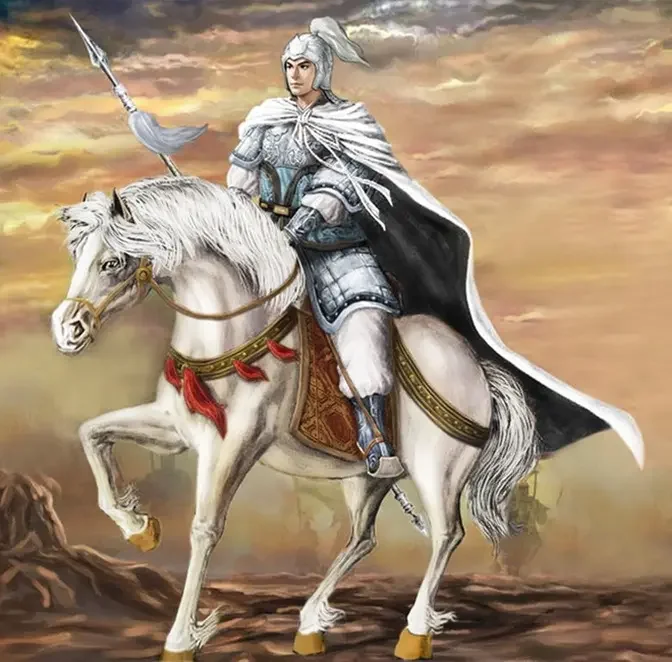

Zhao Yun, Zilong (AD 168–229) hailed from Zhending of Changshan (present day Hebei Zhending). Zhao Yun was originally under Gongsun Zan and when Gongsun Zan ordered Liu Bei to assist Tian Kai to fend off Yuan Shao, Zhao Yun followed along as Liu Bei’s main cavalry forces (1). During the time when Liu Bei was pursued by Cao Cao’s forces at Dangyang Changban, Liu Bei abandoned his wife and child to flee south. Zhao Yun carried the young child, who was Liu Shan and also protected Lady Gan, the mother of Liu Shan, hence all of them were able to escape the dangers. Zhao Yun was later appointed as YaMen JiangJun (General of the Standard). While Liu Bei entered the Shu region, Zhao Yun remained in Jingzhou (2).
In the seventeenth year of JianAn (AD 212), Liu Bei began to attack Liu Zhang and ordered Zhuge Liang, Zhang Fei and Zhao Yun to assist him in Shu. Zhao Yun led his troops from Jiangzhou (present day Chong Qing) to Jiangyang (present day Sichuan Luzhou) and prepared to attack Chengdu. When Liu Bei conquered Chengdu, he appointed Zhao Yun as Yijun JiangJun (General of the Flying Army) (3).
In the first year of JianXing (AD 222), Zhao Yun was appointed as Zhonghu JiangJun (General Who Protects the Center) and Zhengnan JiangJun (General Who Conquers the South), given the title of YongChang Tinghou (Marquis of Yongchang). In the early days of Liu Shan’s ascent to the throne, the diplomatic relations between Shu and Wu was very unstable and so subsequently Zhao Yun was appointed as the General Who Guards the East (Zhendong JiangJun) to be in charge of the army stationed at Ba. In the fifth year of JianXing (AD 227), he was stationed in Hanzhong with Zhuge Liang (4). In the next year, when Zhuge Liang went on a northern campaign, Zhao Yun and Deng Zhi’s troops went under cover to Jigu. After the retreat, Zhao Yun was demoted to Zhenjun Jiangjun (General of the Centre Army).
Zhao Yun died of illness during the seventh year of JianXing (AD 229) and he was around the age of sixty-one. During the time when Liu Bei was on the throne, only Fa Zheng was given an honorable title after his death. During Liu Shan’s reign, due to the immense contributions given by Zhuge Liang, Jiang Wan and Fei Yi, they were also given posthumous temple names to commemorate their efforts. The families of the deceased were also specially rewarded and taken care of by the state; similarly, Xiahou Ba who came from far was also rewarded an honorable title after his death. Guan Yu, Zhang Fei, Ma Chao, Pang Tong, Huang Zhong and Zhao Yun were all subsequently compensated with a title during Liu Shan’s time and this title rewarding was deemed as a great honor (5). Zhao Yun’s deeds were thus also commemorated and he was given the posthumous temple name of the Marquis of Shunping in the fourth year of Jingyao (AD 261) (see Liu Shan’s bio) Zhao Tong succeeded his late father and was appointed Huben Zhonglang (General of Tiger Swiftness) and was in charge of an army. The second son Zhao Guang was appointed YaMen JiangJun (General of the Standard) and followed Jiang Wei in a later expedition but died during battle.
Chen Shou’s final thoughts on the Five Tiger Generals: Guan Yu, Zhang Fei, etc were known to be powerful generals who could fight ten thousand men and accredited to be among the best of their times. Guan Yu repaid Lord Cao’s favour, Zhang Fei’s releasing of Yan Yan out of righteousness were deeds held in high esteem in the country. However, Guan Yu was unyielding and overly self-respect, whereas Zhang Fei was hot-tempered and without kindness, their short-comings leading to their defeats. This is common logic indeed. Ma Chao betrayed the minority tribes and lacked courage; he was a disappointment for his people, what a pity! Having been able to rise from rags to riches, is this not better? Huang Zhong and Zhao Yun both strong and valiant were good subordinates of their lord, like the claws and teeth to a beast. Can they not compare to the likes of Guan Yin and Xiahou Yin?
Comments