
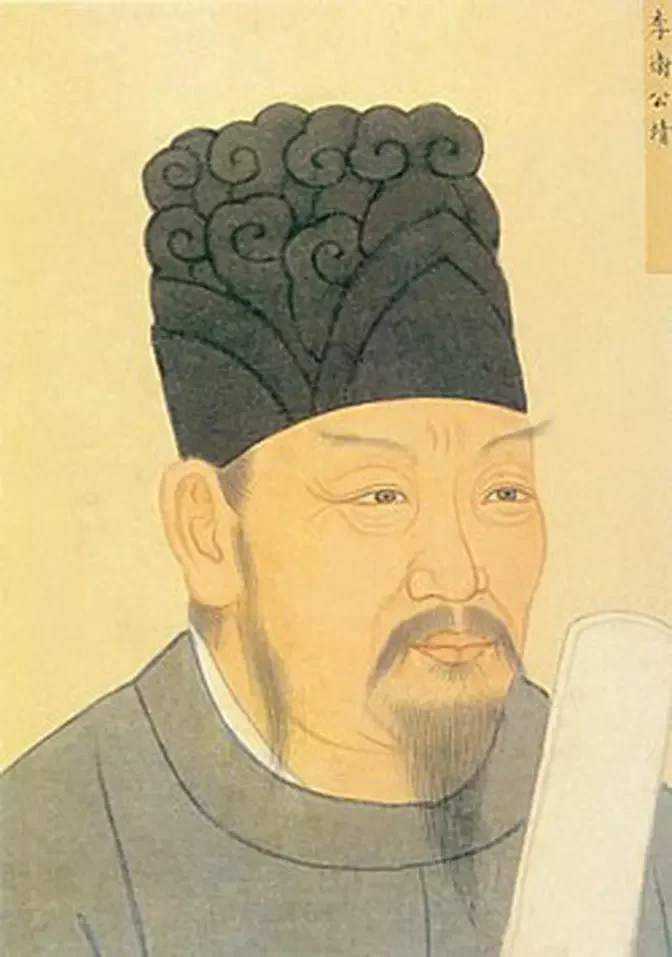

Previous article summary : In 571 AD, it was in the Northern and Southern Dynasties in Chinese history. Li Quan, the son of Yongkang Gong Li Chongyi, who once served in the Great Zhou Yongzhou Dazhongzheng, Guang, He, Fu, Xia, and Yin five states, welcomed his The third son, according to the prevailing Buddhist beliefs at the time, Li Quan named his son Pharmacist, and later changed his name to Li Jing. His eldest brother was named Yaowang, and later two younger brothers were named Keshi and Zhengming.
So why did the brothers Li Yaoshi and Li Yaowang later change their names to Li Jing and Li Duan? This may have something to do with a major event that occurred during the Jiande period of the Northern Zhou Dynasty. On May 15th in the third year of Jiande (574 AD), Emperor Wu of Zhou issued an edict to "break the two religions of Buddhism and Taoism. , And ordered to return to the people. And forbid all obscenities, and those not contained in the rituals, get rid of them.” This is also the famous incident of Emperor Zhou Wu’s extinction of Buddha in Chinese history. Although Emperor Wu didn't take long to destroy the Buddha-Yang Jian declared it to stop after he came to power-it was one of the most severe movements to destroy Buddha in Chinese history. In those few years, almost everyone who had something to do with Buddhism was under attack. When the extermination of Buddhism movement began, Xiao Li Yaoshi was only four years old, and Li Yaowang was only eight years old. Their father and grandfather, as the imperial commanders of the Northern Zhou Dynasty, could not escape the political whirlpool of this movement. Probably during this period, the elders changed their names with Buddhist symbolic meanings, and gave them a single-character name according to the most orthodox naming rules of the ancient Chinese.
▲Figure/Network.
Of course, this time for the extinction of the Buddha movement is not long. When Yang Jian comes to power, everything is business as usual. Those who are willing to worship Buddha will continue to worship Buddha, and those who are willing to use the original name will continue to use the original name. King Li Yao chose to use the original name more, so in the end his epitaph also named King Yao. However, Yaoshi Li finally became more known to the world under the name Li Jing.
So the so-called "Public Taboo Jing, the word pharmacist," in "The Old Book of the Tang Dynasty You Pu She Te Jin Kaifu Yi Tong San Si Shang Zhu Kingdom Donated Situ Bing Zhou Du Du Wei Jing Wu Gong (Li Jing) Stele (and preface)" Also from Longxi Chengji." What happened again? We know that this Shinto monument was erected during Gaozong’s Xianqing reign. The inscription was written by the then prime minister Xu Jingzong, and the writer was Wang Zhijing, a famous calligrapher of the dynasty. It stands to reason that Xu Jingzong and Li Jing worked together for more than 20 years. It's impossible to get the name wrong. Is there anything else inside?
▲Figure/Network.
Li Jing was his real name when he was a child, but when he grew up, his nickname became a character. This phenomenon is actually related to the special political and cultural environment of the late Southern and Northern Dynasties-we can actually cite many similar examples, such as the Great Prime Minister of the Eastern Wei Dynasty-Gao Huan, who was regarded as the Emperor Wu of the Northern Qi Dynasty. According to the Book of Northern Qi: "Emperor Qi Gaozu Shenwu, the surname Gao Minghuan, the word He Liuhun, Bohai Jin also." In fact, "He Liuhun" is the Xianbei name of Qi Shenwu, and Gao Huan is the Han name; another example is the Great Prime Minister of the Western Wei Dynasty-was honored by the Northern Zhou Dynasty. Yu Wentai, who is Emperor Wen, according to the "Book of Zhou": "Emperor Taizu Wen's surname is Yuwen, Yutai, and the word is black otter, which is also a native of Wuchuan." This "black otter" is definitely not a serious word; Another example is the three brothers of He Basheng: "He Basheng, the character is Pohu, and the people of Jianshan in Shenwu." "(He Basheng) brother (He Ba) Yunzi Ani" (He Basheng brother) (He Ba) Yue character Adouni." "Words" like "Ani" and "Adouni" certainly do not conform to the orthodox naming norms of the Han people.
Gao Huan, Yu Wentai, and He Bayue were originally middle- and lower-level officers who were mixed in the northern border towns. They were in a mixture of Hu and Han, so it is not surprising that Hu and Han were used together since childhood. However, once they flourish, or become officials of the border, or ascend to the throne, the masters of Hongru in the dynasty will naturally repackage everything about the emperor, including the name, into the norms with ethics-even though they are like Yuwentai in the world. Times may not care about these, but the trend of Sinicization of Guanlong family for hundreds of years will eventually incorporate them into the Han-style monarch culture and ethics system in a hundred years.
▲ Yuwentai stills, picture/network.
For Gao Huan and the others, it was ultimately out of the need for political correctness.Their Xianbei names became characters; for Li Jing and the others, it was also out of the need for political correctness to turn their Buddhist names into characters—the more obvious example is Li Mi: "Sui Shu·Li "Secret Biography" records: "Li Mi, the master of the word law, the subordinate Sun Ye of Zhenxiang Gongyan." The "Old Tang Book·Li Mi Biography" records: "Li Mi, the word Xuanxuan, was born in Xiangping of Liaodong." "Xintang "Book·Li Mi Biography" says: "Li Mi, the word Xuanxuan, one word Dharma lord, the predecessor of Liaodong Xiangping people." It can be seen that Li Mi has "Dharma lord" and "Xuanxi" two "characters". In fact, if you look into it carefully, the "Lord of Dharma" should also be Li Mi's Buddhist name-["Shi Shi Yao Lan" (Song Dao Cheng Collection)]: "A Han Jing" says: "Buddha is the master of the statement. It is said in modern times and ancient times. The monk who knows the Dharma is the Dharma lord."-It can be seen that the term "Dharma lord" also has its specific religious meaning.
was probably after the founding of the Sui Dynasty and during the revival of the Han culture, the upper-class bureaucratic families began to regulate their names, so in accordance with traditional habits, more single-character names were used to pass, and the former names with strong ethnic and religious colors were changed to spare. (It is said that the reason why scholars in the Han and Wei dynasties used more single-character names was because of the forced promotion of the Wang Mang regime in the two Han dynasties. In fact, this is not the case. The book written in the Western Han dynasty "Gongyang Biography" mentioned "two names as indecent" many times. : "The Sixth Year of Ding Gong in the Spring and Autumn Period": "Ji Sun Si, Zhong Sun Ji Shuai Shi Wei Yun. The comment of the "Gong Yang Biography" on this is: "This Zhong Sun He Ji is also. What is Zhong Sun Ji? , The two names are indecent."; "The Thirteenth Year of Gongyang Biography·Aigong" also said: "Duo Shuai in the Jin and Wei dynasties invaded Wei. This Jin Wei Manduo was also called "Jin and Wei Duo"? Two names are indecent.” That is to say, the two-character name is not in line with the mainstream social values (ie "li") according to the view at the time. This phenomenon was common before the Western Han Dynasty.)
▲Figure/Network.
"Ji Tan Gong" said: "Youth name, crown character. "It means "the first birth is three months and the name is added, so Yunyou name; there is a way of being a father at the age of twenty, friends and other categories can not be called their names again, so the crown is added. "The name should be picked up within three months after birth, and the wording should not be picked up until the age of a weak crown, that is, when he can become a father in adulthood. For Li Jing, it may be for convenience. , And replaced it with the old name; and for Li Mi, "Name Mi, the word Xuan Xuan" was implemented strictly in accordance with the naming norms of "Name" and "Zi", so Xuan Xuan must be Li Mi's adult The "character" of Shiguan, and "fazhu" can only be the Buddhist name when he was a child. Of course, outsiders may not be aware of the various twists and turns, and it is not surprising that the rumor is "Li Mizi Fazhu". Of course, in fact, Li Mi's age He was more than ten years younger than Li Jing. He was born in 582 AD. It was the second year of Emperor Wu of the Sui Dynasty. It was four years after the death of Emperor Wu Yuwen Yong of the Northern Zhou Dynasty. The Sui Dynasty had long since abandoned the policy of Emperor Wu of the Northern Zhou Dynasty. Naturally, there should be no obstacles when Li Mi was named the Buddhist name "Fazhu" when he was a child. But at that time, people knew that Li Mi had the "word" "Xuanxuan" and then called his Buddhist name "zi". It can also be seen that at the time, people’s norms for the use of "name" and "zi" were far less strict than those of the Han Dynasty before and after the Ming and Qing Dynasties-especially we noticed that Wei Zheng, who presided over the compilation of "Sui Shu", was a close celebrity under Li Mi's command. it is not possible to Li Mi in the end is not clear what was the name .
author: Jiang Liang
Comments