
[Sheet music] Johann Friedrich Agricola (1720-1774) - Sonata (F-dur) per il cembalo solo (1762)
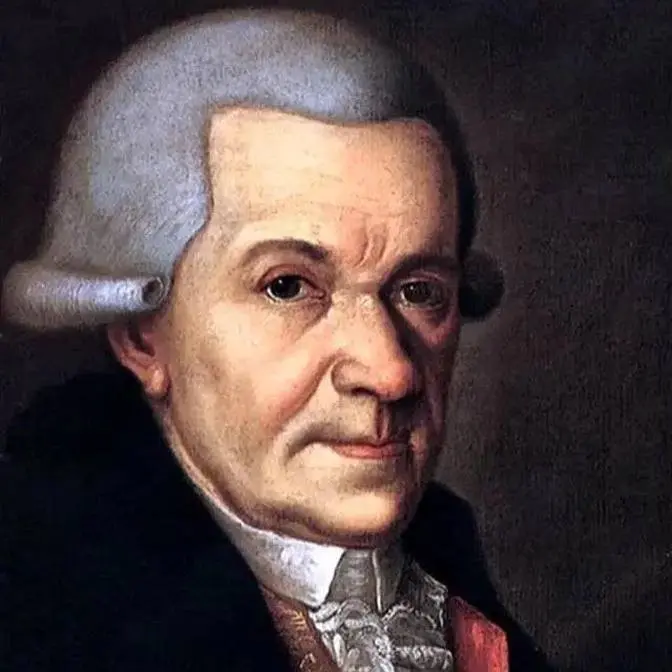
.
Consider to support this project on https://ko-fi.com/michaelhaydn
♫ Recovery project of sheet music by Johann Michael Haydn (1737-1806) and by other neglected composers ♫
Composer: Johann Friedrich Agricola (1720-1774)
Work: Sonata (F-dur) per il cembalo solo (1762)
Software: Sibelius + Instruments samples
World Premiere: No
Real performance: https://youtu.be/XUehAH0xQBg
Sheet music (pdf): https://s9.imslp.org/files/imglnks/usimg/1/18/IMSLP220619-WIMA.cc09-Sonata_f.pdf
Sheet music (xml): https://www.mediafire.com/file/y2p8vi30x8ejyh8/AGRICOLA-SonataCembaloinF.xml/file
Info about sheet music recovering project: https://i.ibb.co/hML4xyJ/HAYDN-M-3.jpg
---
Johann Friedrich Agricola
(Dobitschen, 4 January 1720 - Berlin, 2 December 1774)
German musicographer, composer, organist, singing master and conductor. His father occupied an important post as government agent and jurist in Dobitschen. Burney, who visited the Agricolas in 1772, reported that Johann Friedrich’s mother, born Maria Magdalena Manke, ‘was a near relation of the late Mr Handel, and in correspondence with him till the time of his death’; but later Handel research has failed to substantiate this claim. Agricola began his study of music as a young child. In 1738 he entered the University of Leipzig, where he studied law; during this time he was a pupil of J.S. Bach and visited Dresden, where he heard performances of Passion oratorios and Easter music by Hasse. In 1741 he moved to Berlin, became a pupil of Quantz, made the acquaintance of C.P.E. Bach, C.H. Graun and other musicians, and embarked on a career that touched many aspects of Berlin’s musical life. He became keenly interested in music criticism and theoretical speculation in Berlin, and his work as a musicographer has proved to be his most lasting accomplishment. In 1749 and 1751 he published, under the pseudonym ‘Flavio Anicio Olibrio’, pamphlets on French and Italian taste, taking the part of Italian music against F.W. Marpurg’s advocacy of French music. As a former pupil of J.S. Bach, he collaborated with C.P.E. Bach in writing the obituary of J.S. Bach that appeared in Mizler’s Musikalische Bibliothek in 1754 and became a central source for subsequent biographies.
He published Tosi’s Opinioni de’ cantori antichi e moderni in German translation in 1757, adding notes and comments which caused the translation to be regarded as a landmark in the teaching of singing. He arbitrated the debate that began in 1760 between Marpurg and G.A. Sorge. He also corresponded with Padre Martini and the dramatist G.E. Lessing and assisted in the preparation for publication of Jakob Adlung’s Musica mechanica organoedi (1768), drawing particularly on what he had learnt about the construction of organs and other keyboard instruments from J.S. Bach. From 1765 to 1774 he was a principal contributor of articles about music in C.F. Nicolai’s Allgemeine deutsche Bibliothek. Most of these reflect a conservatism that might be considered typical of north German music critics; the articles written on Gluck’s operas in 1769 and 1771, for example, display a lack of understanding of Gluck’s ‘reforms’. Agricola’s study of melody (1771) remains one of the important writings about a neglected subject; and his biographical sketch of C.H. Graun (1773), like his participation in the Bach obituary, served as a point of departure for later writers on the subject. Agricola was respected by his colleagues as a composer of considerable ability. He was a contributor to most of the lieder collections that formed the ‘First Berlin School’ of song, and his keyboard pieces were published in anthologies of the 1750s and 60s. His sacred works were in demand during his lifetime; copies of many of them survive in European libraries and archives. They show Agricola to have been an excellent craftsman, schooled in the Bach tradition and acquainted with the galant fashions of the mid-century, but prosaic in his treatment of melody. #ClassicalMusic