
NASA image library · The iconic ones
From Apollo 8's "Earthrise" to Webb's "Pillars of Creation" — 20 photographs that changed how humans see themselves and the universe. All NASA / Wikimedia Commons public domain.

Earthrise
William Anders captured this on Christmas Eve from lunar orbit. Later named Photo of the Century by Life magazine.

The Blue Marble
AS17-148-22727 — the most reproduced photograph in human history. The sun was directly behind the spacecraft, illuminating the full Earth evenly.

Buzz Aldrin's bootprint
Still there. No wind, no water, no life. In the Moon's erosion-free environment, this footprint should last at least a few million years.

Saturn V launches Apollo 11
9:32 AM EDT. The Saturn V's flame ran longer than the rocket itself; the pressure wave shook chairs at the press site three miles away.

Eagle in lunar orbit
Photographed from Columbia just after separation, moments before descent. Taken by Michael Collins — the only person on that mission not in the frame.

Apollo 11 prime crew
Pre-flight portrait. Left to right: Neil Armstrong (commander), Michael Collins (CM pilot), Buzz Aldrin (LM pilot).
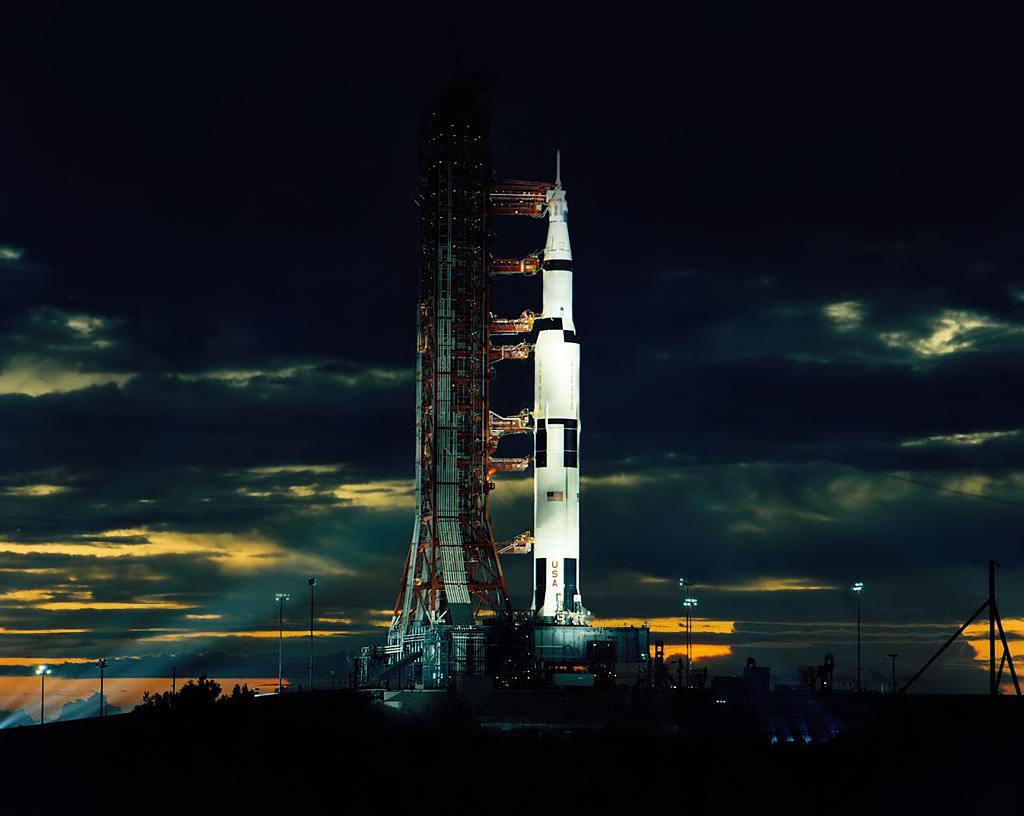
Apollo 17 night launch
12:33 AM EST. The only night launch in the Apollo program. The Saturn V lit up the sky for 500 miles down the coast.

Cernan with the lunar rover
Commander Gene Cernan at the rover before EVA-3. He was the last human to leave the Moon — and still is, 53 years later.

Columbia launches STS-1
Maiden voyage. John Young and Bob Crippen flew an American spacecraft on its first launch — a risk NASA had never taken before and never took again.
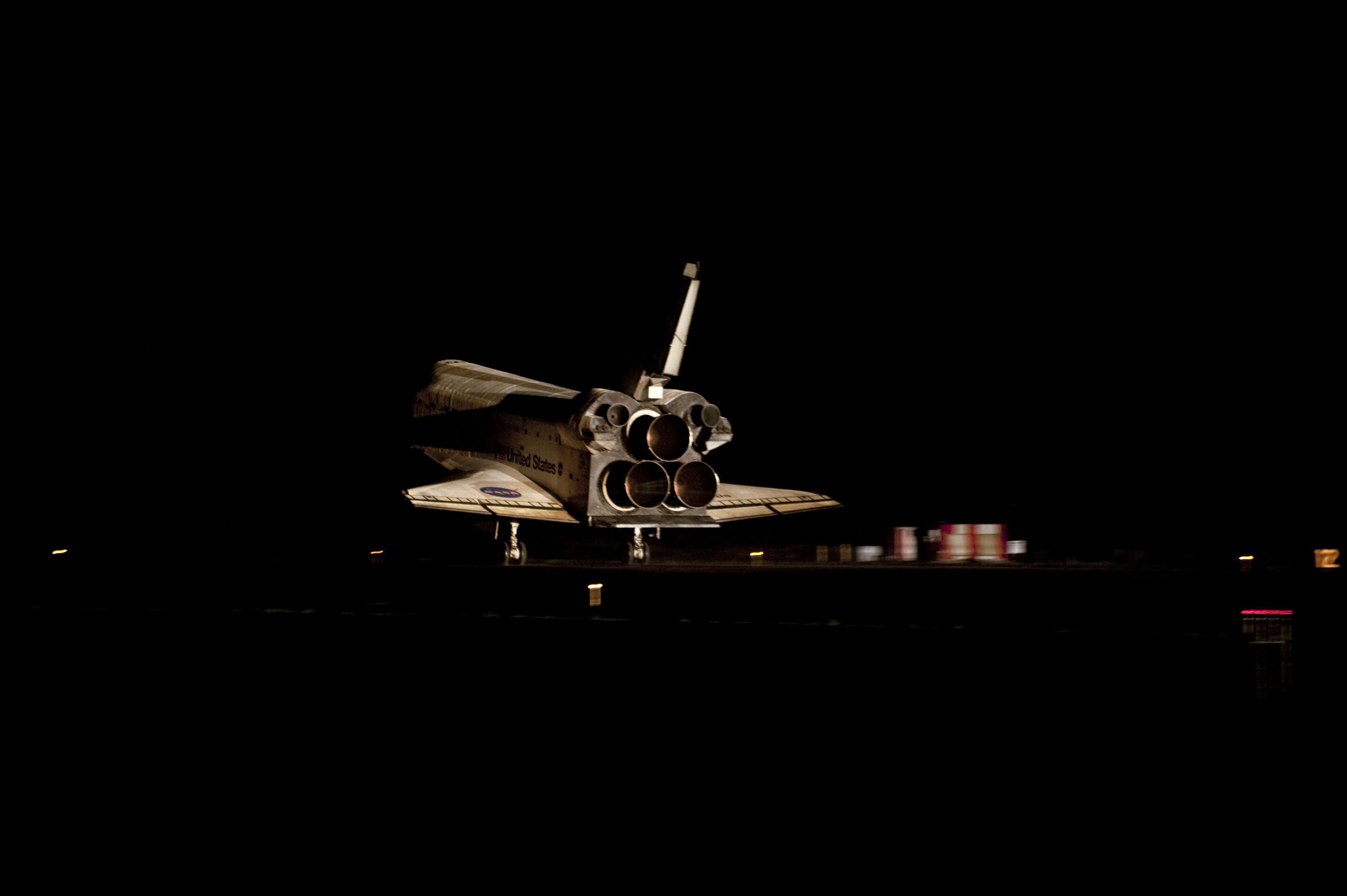
Atlantis' final landing
End of 30 years and 135 Shuttle missions. For the next nine years, American astronauts could only reach orbit aboard Russian Soyuz — until SpaceX Crew-1 in 2020.

Discovery launches Hubble
The most important telescope deployment in history. Discovery carried Hubble to 612 km altitude — opening the modern era of astronomy.

Hubble deployed in orbit
Hubble's solar arrays unfolding after release from Discovery's payload bay. The primary mirror had a 2.2-micrometer figure error — STS-61 would fix it in 1993.

Webb's First Deep Field
The James Webb Space Telescope's first science image. Gravitational lensing bent the light of background galaxies — some of it 13.1 billion years old. President Biden unveiled it 24 hours early.

Pillars of Creation · Webb infrared
In near-infrared, dust that hid everything in the 1995 Hubble version becomes transparent — revealing hundreds of newly-forming protostars inside the columns.

Hubble Ultra Deep Field
The telescope stared at a patch of sky the size of a grain of sand held at arm's length, for 11.3 days. Result: 10,000 galaxies, the most distant 13 billion light-years away.

Pillars of Creation · Hubble 2014
Hydrogen pillars in the Eagle Nebula (M16), 4-5 light-years tall. The nascent stars inside are eroding the pillars with UV — they are nursery and grave at once.

Andromeda galaxy (M31)
Hubble's largest mosaic ever — 2.5 billion pixels. Andromeda is 2.5 million light-years away, and in 4.5 billion years will merge with the Milky Way into "Milkdromeda."
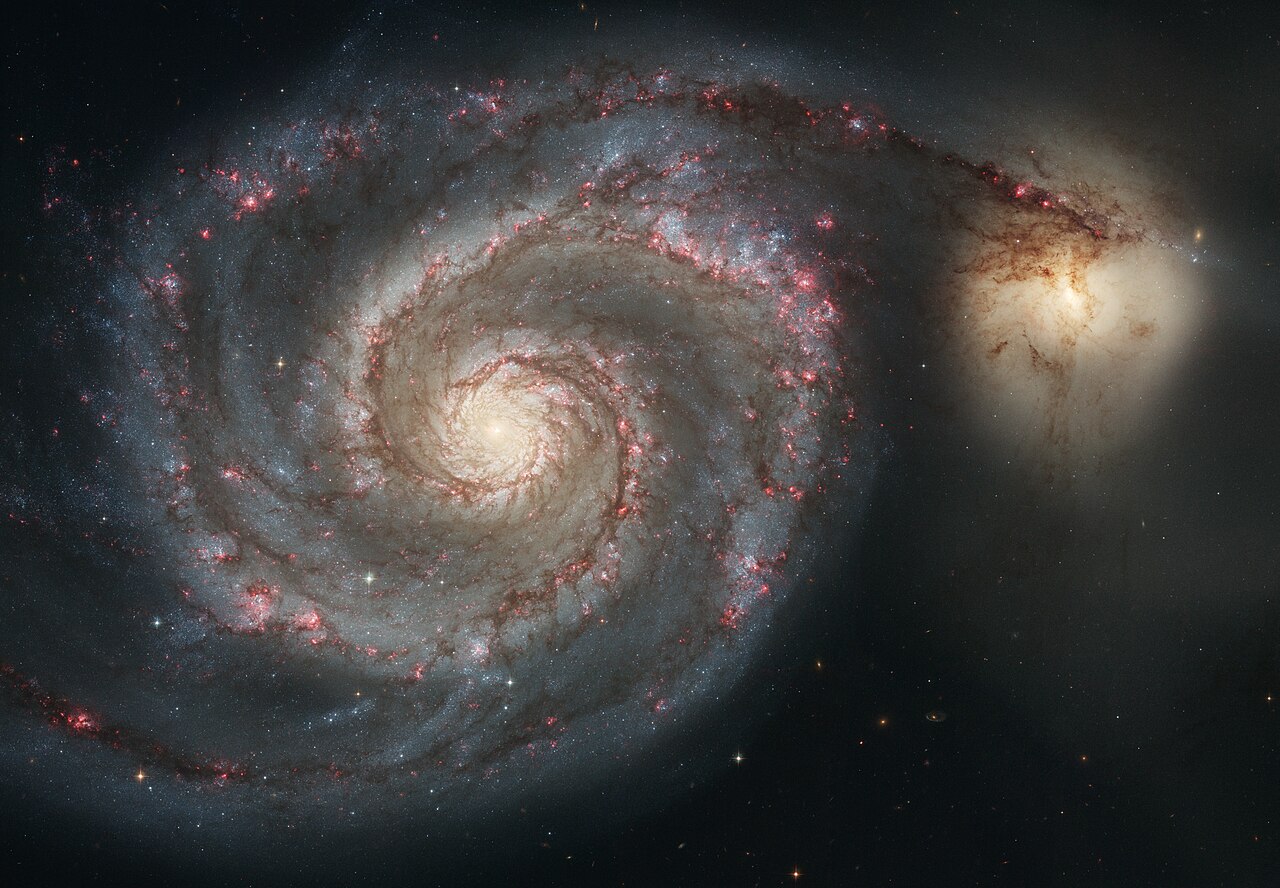
Whirlpool galaxy (M51)
A spiral galaxy 23 million light-years away. It's interacting with its companion NGC 5195 — tidal forces are warping the arms and igniting fresh star formation.

Ed White · first US spacewalk
White floated free for 23 minutes, tethered only by a 25-foot gold-plated umbilical. On return: "It's the saddest moment of my life." He died 19 months later in the Apollo 1 fire.

Saturn during equinox
Saturn's equinox happens every 15 years. With the sun exactly edge-on to the rings, Cassini could capture subtle shadow structures invisible at any other time.
All images on this page are NASA, ESA, JAXA, CNSA, ISRO, or other space-agency public-domain archival materials, sourced via Wikimedia Commons; each image is credited to its specific photographer/institution inline. Fact sources: NASA History Office mission press kits, peer-reviewed journals (Nature, Geophysical Research Letters), space-agency official archives, Wikipedia cross-referenced. All quotes are from the historical record with sources given.