Moon surface · Where we've been and where we're going
Ten points on the lunar surface — Apollo landing sites, iconic craters, the near side's geometric center, the far-side mystery, and Artemis IV's south-pole target. Each has a science story.
Sea of Tranquility (Mare Tranquillitatis)
N 8°35' · E 23°32' · Apollo 11
A basaltic lava mare covering ~420,000 km². Extremely flat — the main reason NASA picked it as Armstrong and Aldrin's landing site. Rocks here are about 3.7 billion years old. On July 20, 1969, humans left their first footprint here.
Photo / NASA
Hadley Rille
N 26°06' · E 3°39' · Apollo 15
Apollo 15's 1971 landing site on the eastern edge of Mare Imbrium. Hadley Rille is a 135-km-long volcanic lava channel, up to 300 meters deep. David Scott and Jim Irwin drove a Lunar Roving Vehicle to the rille's edge for geological sampling — the first use of a vehicle on another world.
Photo / NASA
Shorty Crater (orange-soil discovery)
N 20°06' · E 30°36' · Apollo 17
Apollo 17 EVA-2 station. Geologist Jack Schmitt scuffed his boot at this 110-meter crater's rim and exposed bright orange soil — later confirmed as ~3.5-billion-year-old volcanic glass beads. The single most important geological discovery humans have made on the Moon: proof of past volcanic activity.
Photo / NASA
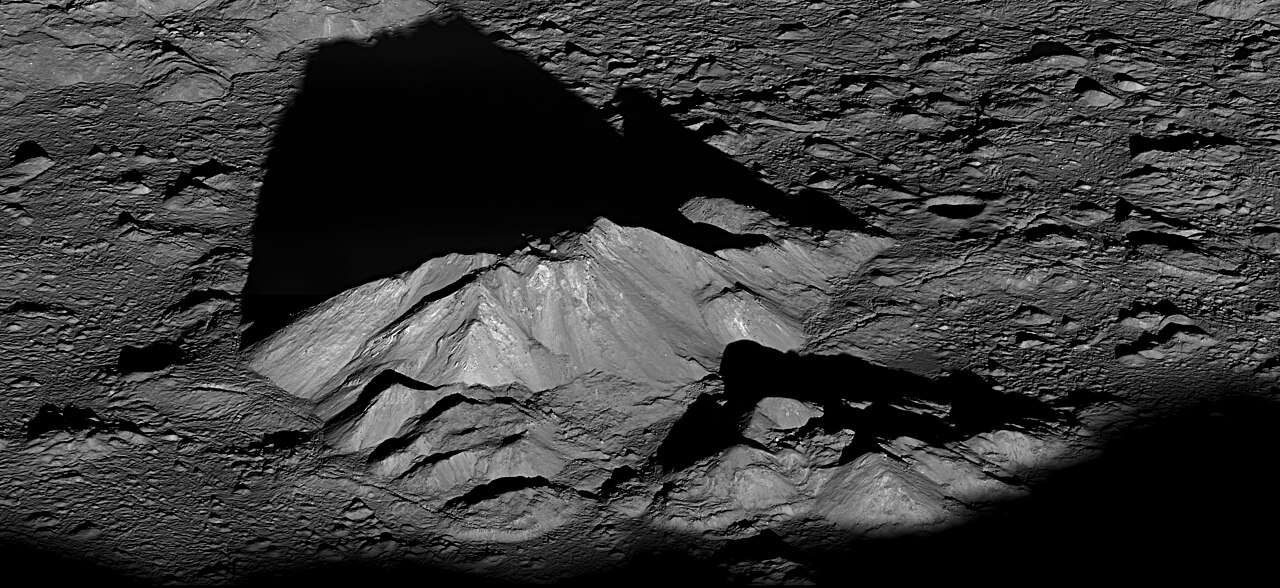
Tycho Crater
S 43°18' · W 11°12' · Young impact
Diameter 85 km, depth 4.8 km. Geologically young at ~108 million years — very fresh by lunar standards. Its radial ejecta rays are visible to the naked eye from Earth at full Moon. The 2-km-tall central peak formed when lava rebounded from the impact. LRO high-resolution imaging revealed its fine structure for the first time.
Photo / NASA / GSFC / ASU
Upcoming
Lunar south pole (Artemis IV target)
Below S 85° · 2028 landing target
Artemis IV will attempt the first crewed landing near the lunar south pole in 2028. (Artemis III, 2027, was revised to an Earth-orbit rendezvous test with the lander.) Permanently shadowed craters here are thought to contain significant water ice — a key resource for future lunar bases. NASA has narrowed the candidate sites to 13, all below S 85°. The first woman and the first person of color to walk on the Moon will leave their footprints here.
Photo / NASA
Sea of Rains (Mare Imbrium)
N 32°48' · W 15°36' · Giant impact basin
1,145-km-wide mare — the Moon's second-largest impact basin. Formed ~3.85 billion years ago in a massive impact that released energy comparable to hundreds of millions of Hiroshima bombs. Apollo 15 and Soviet Luna 17 both landed along its rim. The "rabbit ears" shape people see on the full Moon — that's Mare Imbrium.
Photo / NASA
Copernicus Crater
N 9°37' · W 20°05' · A young 800-My crater
93 km in diameter, 3.8 km deep, formed ~800 million years ago — relatively young on a 4.5-billion-year-old Moon. At full Moon its radial ejecta rays are visible to the naked eye from Earth, extending over 500 kilometers. Copernicus's youth makes it the benchmark of lunar chronology: any surface feature younger than the Copernicus impact is classified as Copernican Period (<800 My).
Photo / NASA / LRO
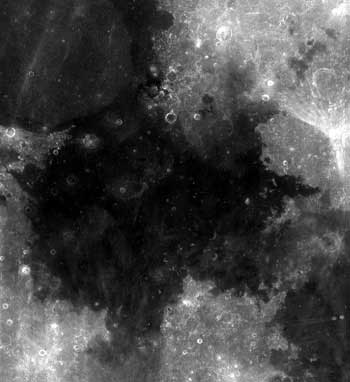
Sea of Serenity (Mare Serenitatis)
N 28° · E 17° · Apollo 17 landing region's SE edge
707-km-wide circular mare — the name means "Sea of Serenity." Apollo 17 landed along its southeastern edge in the Taurus-Littrow valley, one of the most geologically complex landing sites. Mare Serenitatis basalts formed ~3.8 billion years ago, slightly younger than Mare Tranquillitatis (Apollo 11). Its dim surface tone comes from high-titanium basalts — which is why Schmitt's eyes could spot the anomalous orange soil.
Photo / NASA · Apollo 14 trans-Earth coast
Central Bay (Sinus Medii)
N 1.4° · W 1.2° · Dead center of the near side
As the name suggests, this small mare sits at the geometric center of the Moon's near side — it's always in the exact middle when viewed from Earth. Soviet probe Surveyor 6 soft-landed here on November 10, 1967, and then accomplished a first in spaceflight: **it fired its engines to lift 4 meters above the surface and set back down** — validating that rockets could launch from the lunar surface. Every Apollo LEM ascent stage used the same physical principle.
Photo / NASA · Apollo 10 oblique view
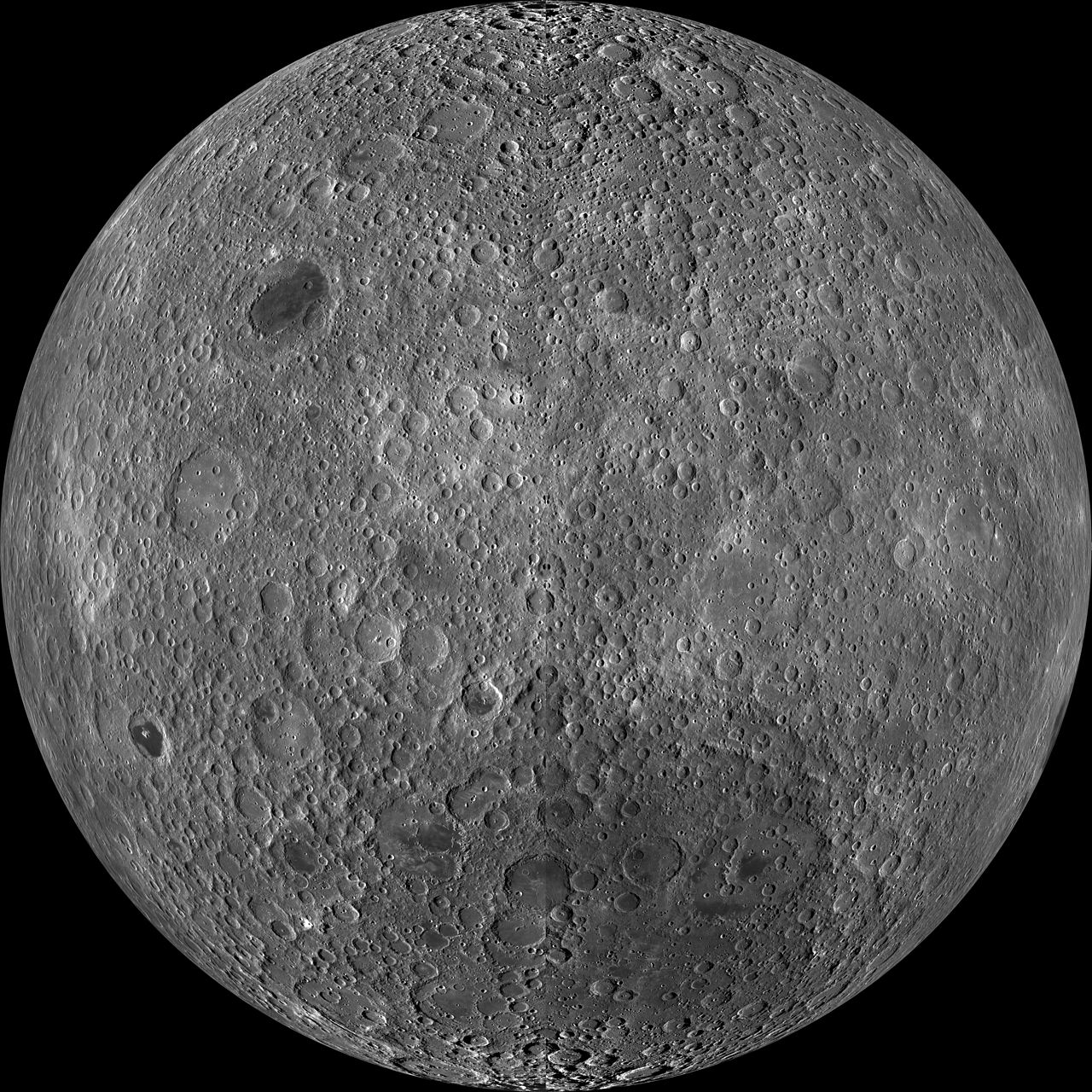
Far side of the Moon
180° longitude · Always faces away from Earth
The Moon is tidally locked to Earth, so **one hemisphere always faces away**. Soviet probe Luna 3 captured the first blurry images in 1959; Apollo 8's crew in 1968 were the first humans to see it with their own eyes. The far side looks geologically different: **no large maria, dense crater fields, crust 10-20 km thicker than the near side**. China's Chang'e 4 became the first to soft-land on the far side (2019), and Chang'e 6 returned the first far-side samples (2024). The mechanism behind the Moon's hemispheric asymmetry remains one of lunar science's biggest open questions.
Photo / NASA / GSFC / Arizona State University · LRO WAC mosaic
All images on this page are NASA, ESA, JAXA, CNSA, ISRO, or other space-agency public-domain archival materials, sourced via Wikimedia Commons; each image is credited to its specific photographer/institution inline. Fact sources: NASA History Office mission press kits, peer-reviewed journals (Nature, Geophysical Research Letters), space-agency official archives, Wikipedia cross-referenced. All quotes are from the historical record with sources given.