Lunar exploration isn't just an American story. From the Soviet Luna program's first soft landing to China returning far-side samples, India planting a flag at the south pole, and Japan's precision "Moon Sniper" — eight non-US missions that reshape who gets to explore the Moon.
Photo / Soviet space program · public domain
February 3, 1966 · Oceanus Procellarum
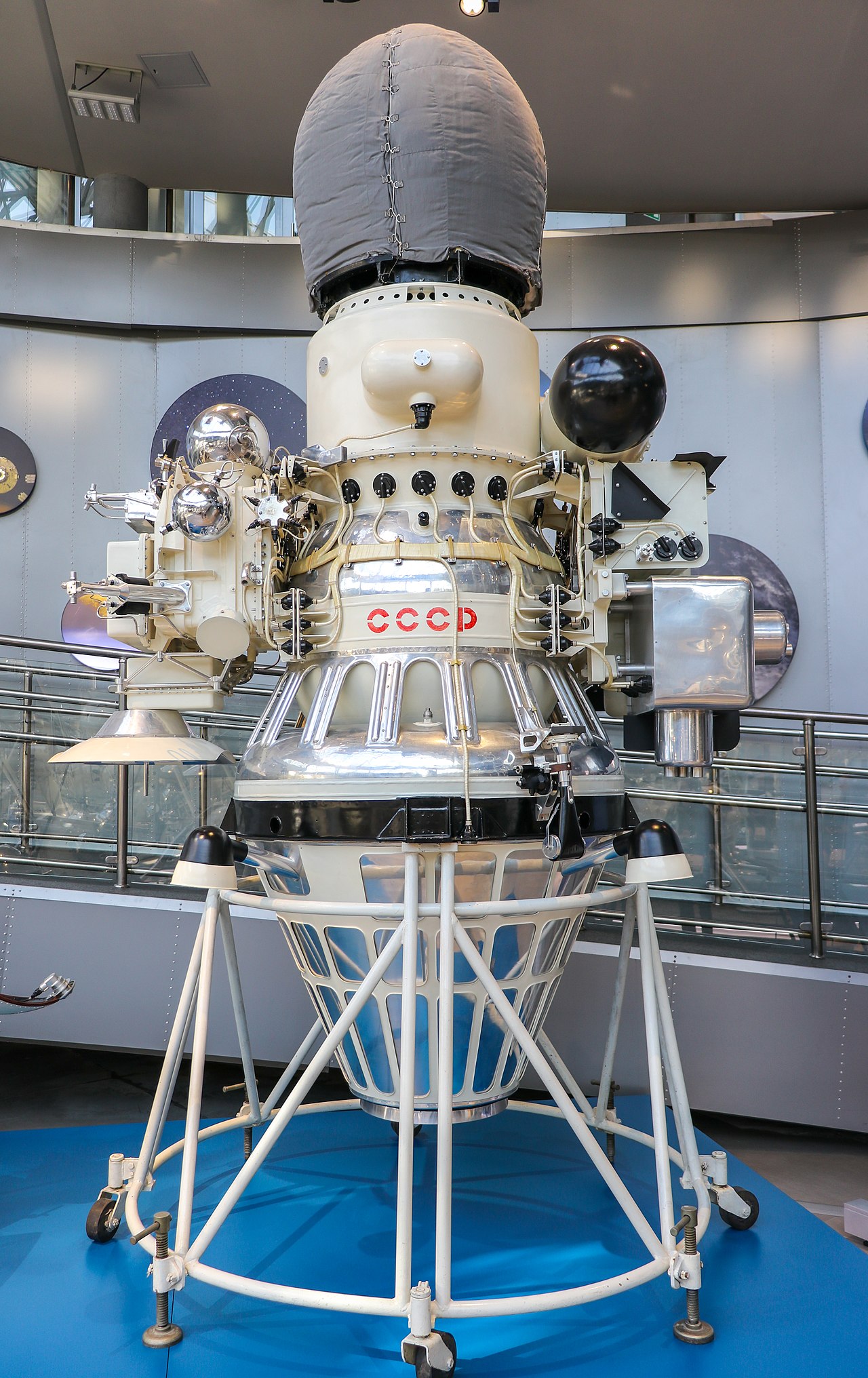
Luna 9 (USSR, 1966): First soft landing ever
Launched January 31, 1966 from Baikonur on a Molniya-M, Luna 9 used a novel airbag-cushioned capsule that separated from the main bus and soft-landed in Oceanus Procellarum on February 3 at 18:45:30 UTC. Its 99 kg lander opened four petals, stabilized on the regolith, and transmitted the **first panoramic images ever taken from the surface of another world** — about 8 h 5 min of broadcasts. The landing also settled a long scientific debate: some feared the lunar surface was deep dust that would swallow a crewed lander. Luna 9 proved the regolith bears weight — clearing the path for Surveyor, Apollo, and every subsequent lander.
Photo / NASA · post-mission model
September 20, 1970 · Mare Fecunditatis · 101 g returned
Luna 16 (USSR, 1970): First robotic sample return
Launched September 12, 1970 and landed in Mare Fecunditatis on September 20, Luna 16 drilled a 35 cm core, sealed **101 g of lunar regolith** into a return capsule, launched the next day, and parachuted to Kazakhstan on September 24. **The first fully robotic sample return from another celestial body** — a miniature, automated mirror of what Apollo was doing with crews, and the template every sample-return mission since (Luna 20/24, Hayabusa, Chang'e 5/6, OSIRIS-REx) has followed.
Photo / NPO Lavochkin · public domain
November 17, 1970 · Mare Imbrium · operated 321 days
Luna 17 / Lunokhod 1 (USSR, 1970): First rover on another world
Launched November 10, 1970 and landed in Mare Imbrium on November 17, Luna 17 deployed Lunokhod 1 — an 840 kg, eight-wheeled, solar-powered rover teleoperated by a five-person team in Simferopol, Crimea. Over **321 Earth days (~11 lunar days)** it drove 10,540 m, returned ~20,000 TV images and 25,000 engineering telemetry frames, and conducted soil-mechanics and X-ray-spectrometry experiments. **Beat America's Apollo 15 LRV by 8 months** — the first-ever rover on another world and the first teleoperated robotic vehicle on an extraterrestrial surface, a template later used by every Mars rover and China's Yutu series.
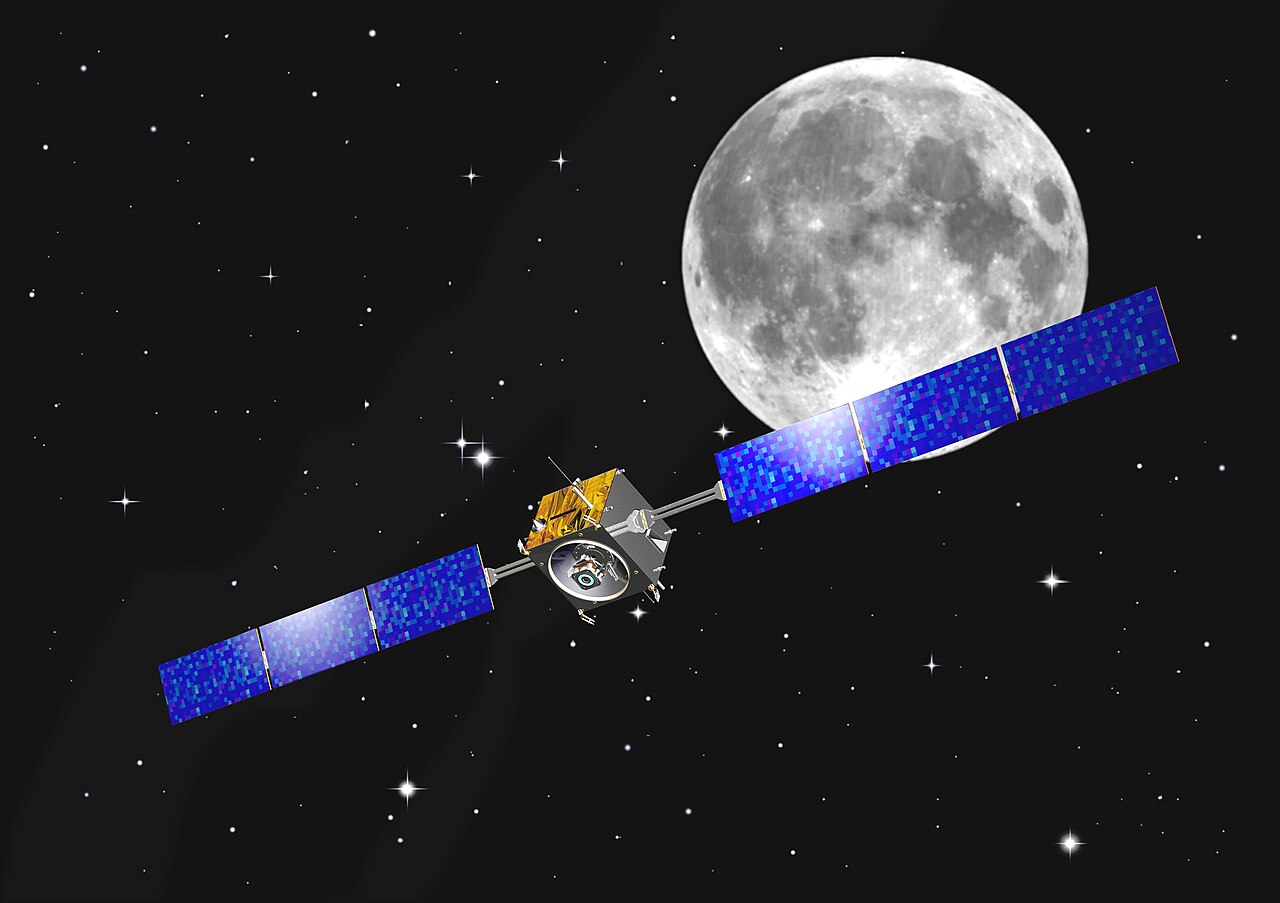
Photo / ESA / AOES Medialab
2003-2006 · Ariane 5 · PPS-1350-G ion thruster
SMART-1 (ESA, 2003-2006): Europe's first lunar orbiter, on ion propulsion
Launched September 27, 2003 as a secondary payload on Ariane 5, the 367 kg SMART-1 was a technology demonstrator that **used a solar-electric Hall-effect ion thruster (PPS-1350-G) to spiral out from Earth to lunar orbit over 13 months**, captured by the Moon on November 15, 2004. Controlled impact at Lacus Excellentiae on September 3, 2006. The first European spacecraft to orbit the Moon, and the first lunar mission to reach its destination using ion propulsion alone — with just 82 kg of total propellant. Validated the SEP techniques now used by Dawn, BepiColombo, and future deep-space missions.
Photo / JAXA / NHK · "Diamond Ring" Earth
2007-2009 · H-IIA launch · HDTV "Earthrise"
Kaguya / SELENE (Japan, 2007-2009): the best Moon map before LRO
Launched September 14, 2007 from Tanegashima, SELENE (nicknamed Kaguya after the Japanese Moon princess) carried a 3-ton main orbiter with two small sub-satellites (Okina, Ouna). From a 100 km polar orbit its instruments — including an NHK HDTV camera — produced **the highest-resolution global topography then achieved, the first Moon-wide element map, and HDTV "Earthrise" sequences that rebroadcast Apollo's 1968 perspective to a new generation**. Kaguya's laser altimetry was the definitive global shape model of the Moon before LRO took over.
Photo / CCTV / CNSA · public domain
December 16, 2020 · Mons Rumker · 1,731 g returned
Chang'e 5 (China, 2020): first lunar sample return in 44 years
Launched November 23, 2020 on a Long March 5, Chang'e 5 comprised an orbiter, lander, ascender, and return capsule. The lander touched down at Mons Rumker in Oceanus Procellarum on December 1, scooped + drilled **1,731 g of surface and subsurface regolith**, launched the ascent stage, rendezvoused and docked in lunar orbit, and returned the capsule to Siziwang Banner, Inner Mongolia on December 16. **The first lunar sample return in 44 years** (since Luna 24, 1976) and the first by any nation other than the USSR or US. The samples — young basalts ~2 billion years old — **extended the Moon's known volcanic timeline by roughly a billion years beyond Apollo**, recalibrating inner-Solar-System impact chronology.
Photo / IAC 2024 · BugWarp via Wikimedia Commons
June 25, 2024 · Apollo Crater, SPA Basin · 1,935 g returned
Chang'e 6 (China, 2024): first sample return from the far side
Launched May 3, 2024, using the Queqiao-2 relay satellite to communicate with the far side. The lander touched down inside Apollo Crater in the **South Pole-Aitken Basin — the oldest and largest preserved impact structure in the Solar System** — on June 1. Collected 1,935 g of regolith, ascended June 3, returned to Inner Mongolia June 25. **First samples ever returned from the lunar far side.** Early lab analysis reported different water content and mantle chemistry from the near side, directly testing the long-suspected lunar hemispheric asymmetry.
Photo / JAXA · SLIM half-scale engineering model
January 19, 2024 · Shioli crater · 55 m from target
SLIM "Moon Sniper" (Japan, 2024): first pinpoint landing
Launched September 6, 2023 on an H-IIA (co-manifested with XRISM), SLIM (Smart Lander for Investigating Moon) landed near Shioli crater at 15:20 UTC on January 19, 2024. A thruster malfunction just above touchdown left it **resting on its nose** — but image-based terrain-relative navigation still put it just **55 m from its aim point**, well inside the 100 m "pinpoint" goal. JAXA's first soft lunar landing and **the first sub-100-meter pinpoint landing on the Moon by any space agency**. Proved that small, low-cost landers can use computer vision to precisely target the tight geological features future resource-prospecting missions need.
All images on this page are NASA, ESA, JAXA, CNSA, ISRO, or other space-agency public-domain archival materials, sourced via Wikimedia Commons; each image is credited to its specific photographer/institution inline. Fact sources: NASA History Office mission press kits, peer-reviewed journals (Nature, Geophysical Research Letters), space-agency official archives, Wikipedia cross-referenced. All quotes are from the historical record with sources given.