From John Glenn (first American in orbit, 1962) to Christina Koch (Artemis II, 2026) — 15 astronauts, their missions, and what became of them.
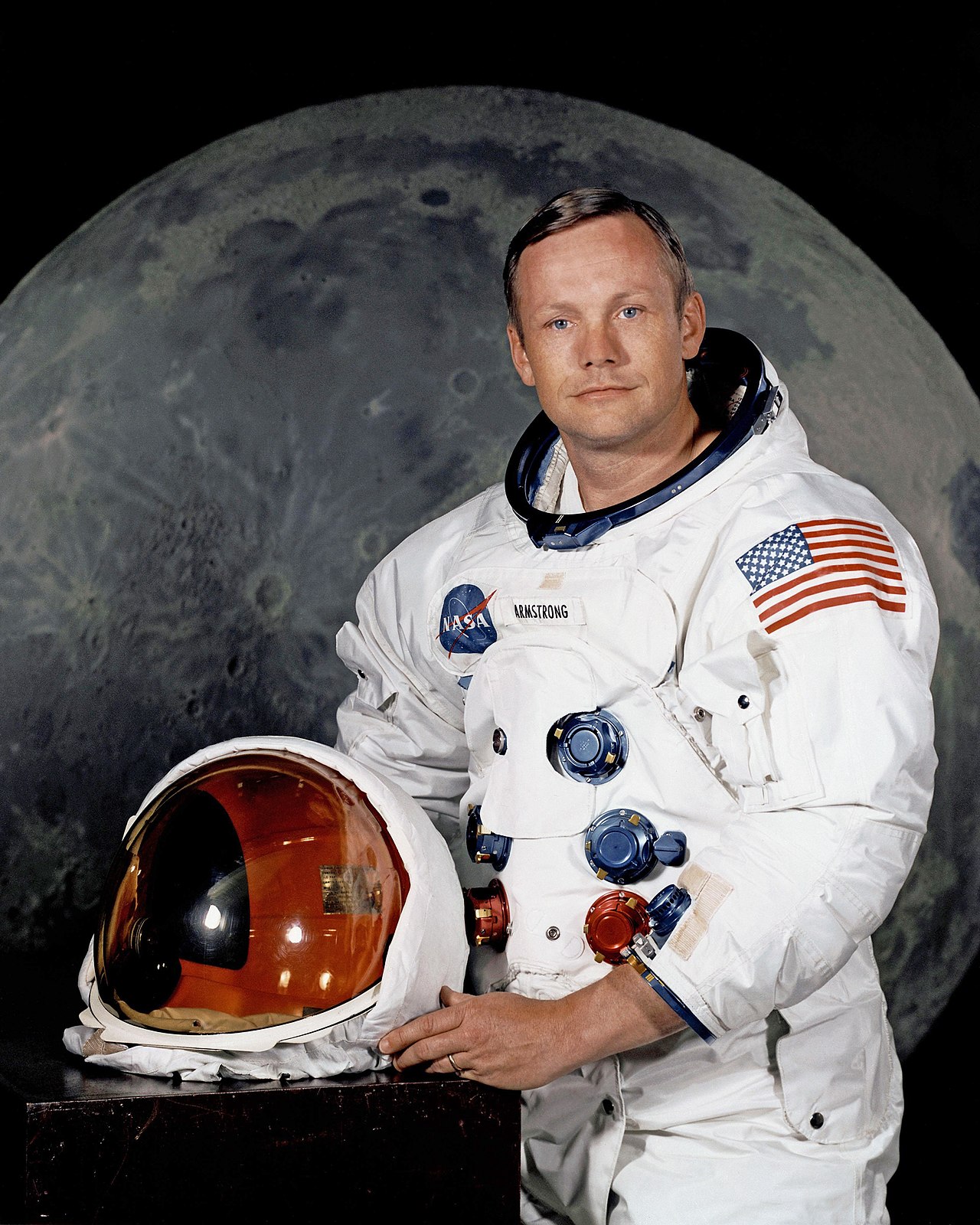
Neil Armstrong
Apollo 11 commander · 1930–2012
Navy aviator — flew 78 combat missions in Korea, later became an X-15 test pilot. July 20, 1969 — first human to step on the Moon. He kept a notoriously low profile about it for the rest of his life, declining most interviews and always crediting the entire team. He took six hours after landing to say the "one small step" line.
Photo / NASA
Buzz Aldrin
Apollo 11 Lunar Module Pilot · 1930–
MIT aerospace PhD — his thesis, on orbital rendezvous techniques, directly enabled lunar-module re-docking on Apollo. He took private Communion on the Moon (NASA did not broadcast those three minutes). His first view out the LEM window: "Magnificent desolation." Post-Apollo, he became a prominent public figure, wrote multiple books, and has long advocated for a crewed Mars mission.
Photo / NASA
Michael Collins
Apollo 11 Command Module Pilot · 1930–2021
While Armstrong and Aldrin walked the Moon, Collins orbited alone for 21 and a half hours. Each pass behind the Moon (48 minutes) cut him off completely from Earth and crewmates — media called him "the loneliest human since Adam." He later said he wasn't lonely: he had three companions — Armstrong, Aldrin, and everyone on Earth.
Photo / NASA
Jim Lovell
Apollo 8, 13 commander · 1928–
Four spaceflights: Gemini 7, Gemini 12, Apollo 8, Apollo 13. On Apollo 8 he became one of the first three humans to orbit the Moon. On Apollo 13 he tried to land there — the oxygen tank explosion turned the mission into 87 hours of survival. He never walked on the Moon: the only person to orbit it twice without ever landing.
Photo / NASA
Gene Cernan
Apollo 17 commander · 1934–2017
Three spaceflights: Gemini 9A, Apollo 10, Apollo 17. On Apollo 10 he piloted the LEM to within 14 kilometers of the lunar surface — closest approach without landing in history. December 14, 1972 — the last human to leave the Moon. He scratched his daughter Tracy's initials into the lunar dust before climbing the ladder. He publicly advocated for a crewed return to the Moon until his death.
Photo / NASA
John Glenn
Mercury-Atlas 6 · 1921–2016
World War II and Korean War Marine Corps fighter pilot — shot down four enemy planes. February 20, 1962 — first American in orbit. Later, U.S. senator (Ohio, 1974-1999). At age 77, he flew again on STS-95 — the oldest astronaut in history. He died at 95.
Photo / NASA
Alan Shepard
Mercury-Redstone 3 / Apollo 14 · 1923–1998
May 5, 1961 — the first American in space (a 15-minute 22-second suborbital hop, 23 days after Gagarin). Ten years later, at age 47, he commanded Apollo 14 — the oldest Moon walker in history. On the lunar surface he hit two golf balls with a modified 6-iron. The second, he said, went "miles and miles."
Photo / NASA
Pete Conrad
Apollo 12 commander · 1930–1999
Four spaceflights: Gemini 5, Gemini 11, Apollo 12, Skylab 2. Apollo 12's LEM "Intrepid" landed in the Ocean of Storms — Conrad stood 5'6" and his first words on the Moon were self-deprecating: "Whoopie! Man, that may have been a small one for Neil, but that's a long one for me." Died in a motorcycle accident, 1999.
Photo / NASA
Harrison "Jack" Schmitt
Apollo 17 Lunar Module Pilot · 1935–
Harvard geology PhD. NASA sent a trained scientist to the Moon for the first and only time on Apollo 17. In December 1972, at Shorty Crater, Schmitt discovered ~3.5-billion-year-old orange volcanic glass beads — rewriting lunar geology. He later served as U.S. senator from New Mexico (1977-1983).
Photo / NASA
Ed White
Gemini 4 · Apollo 1 · 1930–1967
June 3, 1965 — first American to walk in space (Gemini 4, 23 minutes). When ordered back in: "It's the saddest moment of my life." Nineteen months later, on January 27, 1967, he died with Gus Grissom and Roger Chaffee in the pure-oxygen Apollo 1 fire during a plugs-out test. He was 36.
Photo / NASA
Sally Ride
STS-7 · 1951–2012
Stanford physics PhD. June 18, 1983 — launched aboard Challenger as the first American woman in space (and the third woman in space worldwide, after Tereshkova 1963 and Savitskaya 1982). Flew twice (STS-7, STS-41-G). Later served on the Challenger and Columbia accident investigation boards. After her death, her partner disclosed she had been the first openly LGBTQ astronaut.
Photo / NASA
Christa McAuliffe
Teacher in Space · STS-51-L Challenger · 1948–1986
Social studies teacher from Concord, New Hampshire. In 1984, the Teacher in Space program chose her from over 11,000 applicants to broadcast two lessons from orbit. January 28, 1986 — Challenger broke apart at T+73 seconds; all seven crew were lost. She was the first civilian crew member in US history. NASA later founded the Educator Astronaut program in her name; her backup Barbara Morgan flew in 2007. Artemis II carried a ceramic medallion engraved with her name.
Photo / NASA
Reid Wiseman
Artemis II commander · 1975–
U.S. Navy test pilot and systems engineer (Johns Hopkins MS). Flew 165 days on ISS during Expedition 40/41 in 2014. Selected in 2023 as Artemis II commander. On April 1, 2026, he launched with Glover, Koch, and Hansen aboard Orion — humanity's first crewed lunar flyby since Apollo 17.
Photo / NASA
Victor Glover
Artemis II pilot · 1976–
U.S. Navy fighter pilot and test pilot. In 2020, aboard SpaceX Crew-1, became the first African American long-duration ISS crew member (167 days). April 2026 — first African American to fly near the Moon. At the return press conference he used the language of faith: "too big to be in one body."
Photo / NASA
Christina Koch
Artemis II mission specialist · 1979–
NC State electrical engineering MS. In 2019-2020, on Expedition 59/60/61, she flew 328 days — the longest single mission by any woman. In April 2026 she became the first woman to fly near the Moon. At the return press conference she addressed Earth directly: "Planet Earth — you are a crew."
All images on this page are NASA, ESA, JAXA, CNSA, ISRO, or other space-agency public-domain archival materials, sourced via Wikimedia Commons; each image is credited to its specific photographer/institution inline. Fact sources: NASA History Office mission press kits, peer-reviewed journals (Nature, Geophysical Research Letters), space-agency official archives, Wikipedia cross-referenced. All quotes are from the historical record with sources given.