From Apollo 1's tragedy to Apollo 17's final step — 12 key Apollo missions, in one place. First crewed LEM test, Apollo 13 rescue, six successful lunar landings, the final geology expedition — all covered.
Photo / NASA
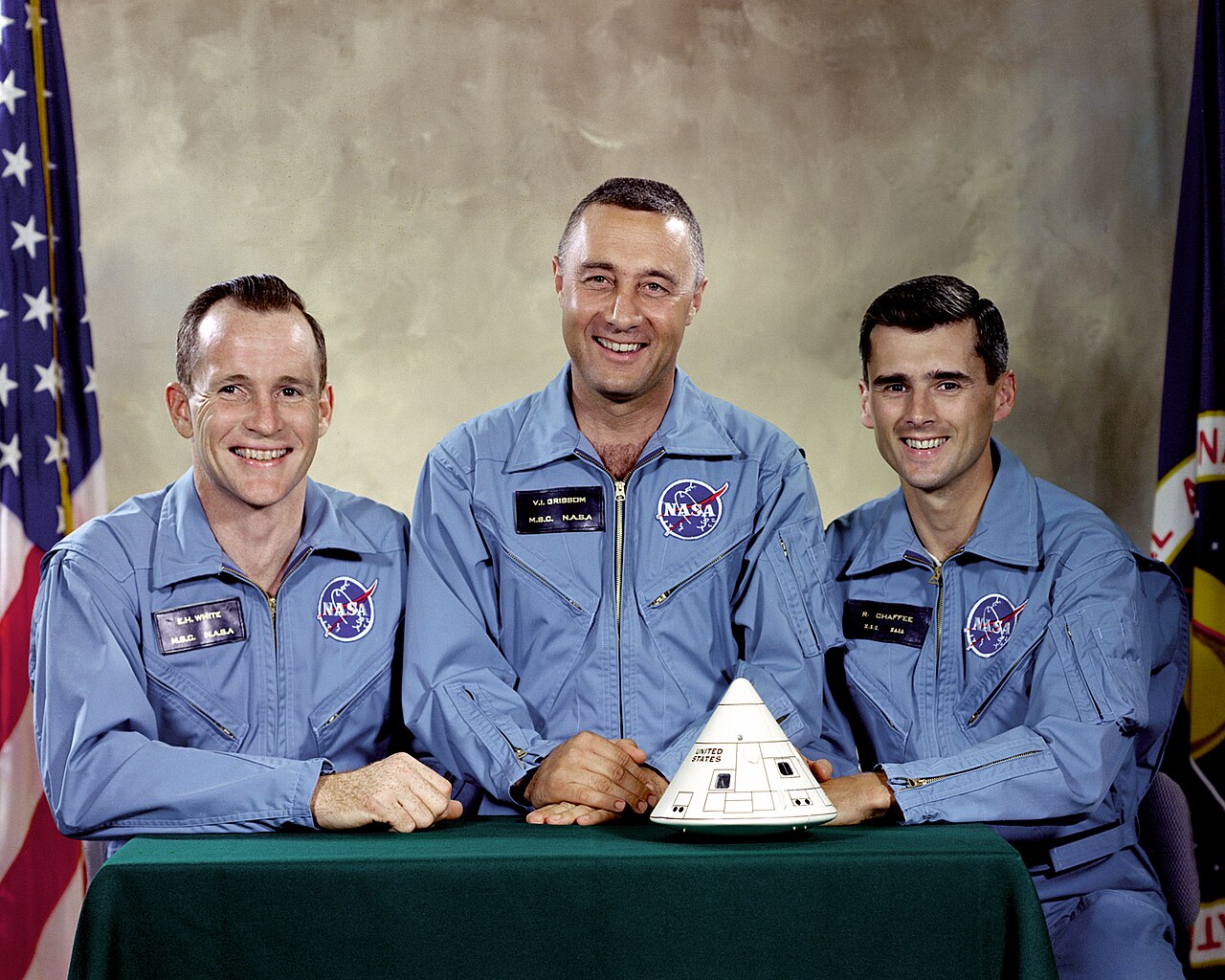
January 27, 1967 · Pad test
Apollo 1: The program's price
Gus Grissom, Ed White, and Roger Chaffee died in 30 seconds when a pure-oxygen fire broke out inside the Command Module during a routine plugs-out test. The tragedy forced NASA to completely redesign the capsule, switch to a nitrogen-oxygen atmosphere, and ban inward-opening hatches forever. Apollo was delayed 21 months — and the engineers learned that any mistake costs lives.
Photo / NASA
October 11, 1968 · First crewed
Apollo 7: Back in space
NASA's first crewed mission after Apollo 1. Walter Schirra, Donn Eisele, and Walter Cunningham flew the redesigned Command Module for 11 days in Earth orbit. It was America's first live TV broadcast from space — global audiences watched the crew float, eat, and field Mission Control's questions with dry humor. The program got back on its feet.
Photo / NASA
December 21-27, 1968 · First to leave Earth
Apollo 8: First humans to lunar orbit
Frank Borman, Jim Lovell, and Bill Anders became the first humans to leave Earth's gravity well. Ten lunar orbits; Genesis reading on Christmas Eve; Earthrise photograph. The mission wasn't originally planned for 1968 — NASA rushed the schedule, swapping it from an Earth-orbit test to a lunar mission, to beat the Soviets to the "first humans to leave Earth" milestone.
Photo / NASA
March 3-13, 1969 · Earth-orbit shakedown
Apollo 9: LEM's first crewed flight
McDivitt, Scott, and Schweickart tested the full Apollo stack in Earth orbit — the first crewed docking of CSM "Gumdrop" with LM "Spider," the first crewed LEM free-flight (Spider flew 111 miles away before redocking), and the first EVA test of the A7L suit + PLSS backpack that later Apollo crews would use on the lunar surface. Without Apollo 9 proving the LEM could fly, Apollo 10 and 11 couldn't have gone anywhere.
Photo / NASA
May 18-26, 1969 · Landing rehearsal
Apollo 10: Dress rehearsal, 14 km above the Moon
Stafford, Young, Cernan. LM "Snoopy" descended to 14.4 km (47,400 ft) above the lunar surface — rehearsing Apollo 11's entire descent path short of final powered descent. Their return set the all-time human speed record: **39,897 km/h (24,791 mph)**, still unbroken. This was also the only Apollo mission to launch from Pad 39B. During LM staging, a switch-setting glitch sent the ascent stage briefly tumbling, triggering Cernan's famously unfiltered live-on-air expletive.
Photo / NASA
July 16-24, 1969 · First landing
Apollo 11: The first footprint
Neil Armstrong, Buzz Aldrin, Michael Collins. On July 20 at UTC 20:17, Eagle landed in the Sea of Tranquility. Six hours later, Armstrong spoke the line: "That's one small step for man, one giant leap for mankind." An estimated 600 million people watched live — nearly 20% of the world's population at the time. First human footprint on another world. End of the Space Race.
Photo / NASA
November 14-24, 1969 · Precision landing
Apollo 12: Lightning strike, pinpoint landing
Pete Conrad, Dick Gordon, Alan Bean. Saturn V was struck by lightning twice within 36.5 seconds of liftoff; fuel cells tripped offline. EECOM John Aaron's calm "Try SCE to Aux" call saved the mission. LM "Intrepid" landed just 163 m (535 ft) from the Surveyor 3 probe that had been sitting on the Moon since April 1967 — the only true pinpoint landing of the Apollo program. Two EVAs deployed the first ALSEP science station (ran until 1977), and the crew returned pieces of Surveyor 3's camera to Earth.
Photo / NASA
April 11-17, 1970 · Aborted landing
Apollo 13: A successful failure
Jim Lovell, Jack Swigert, Fred Haise were 55 hours 54 minutes into a Fra Mauro landing mission when an oxygen tank exploded. Over the next 87 hours, NASA and the crew executed the most improvised rescue in spaceflight history — using the Lunar Module as a lifeboat to bring all three home. Every spacecraft emergency procedure since then traces back to protocols Apollo 13 controllers wrote in real time.
Photo / NASA
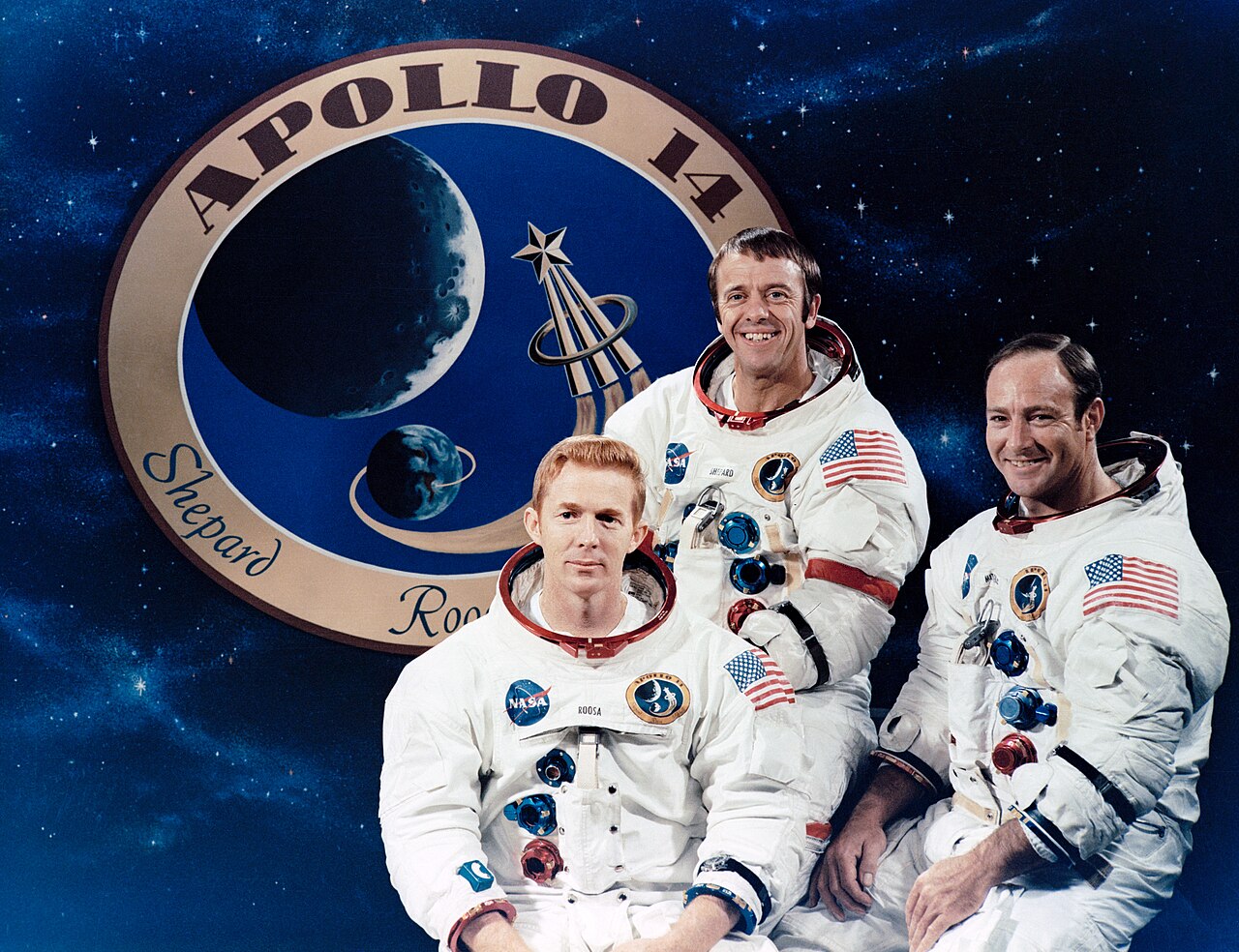
January 31 – February 9, 1971 · Fra Mauro
Apollo 14: Shepard's Moon golf shot
Alan Shepard (America's first astronaut — 10 years later, at 47, the oldest moonwalker), Stuart Roosa, Edgar Mitchell. Landed at Fra Mauro (Apollo 13's original target) after MIT engineers urgently patched guidance software to work around a short in the LM's abort switch. At the end of EVA-2, Shepard strapped a Wilson 6-iron head to a sample-tool handle and one-handed two golf balls — the second, he said, "went miles and miles" (LRO imagery puts it at about 36 m). First samples of Imbrium-basin ejecta, which dated that impact to ~3.9 billion years ago — calibrating impact chronology for every inner Solar System body.
Photo / NASA
July 26 – August 7, 1971 · Hadley-Apennine
Apollo 15: First Lunar Rover, the Genesis Rock
David Scott, Al Worden, James Irwin. First J-class extended-stay mission: 66.5 hours on the Moon (longest to date), first use of the Lunar Roving Vehicle (driven 27.9 km total), three EVAs. Near Spur Crater they collected sample 15415, the "Genesis Rock" — a 4.1-billion-year-old piece of the Moon's primordial anorthositic crust. Scott closed the last EVA with a live-TV Galileo demonstration, dropping a hammer and a falcon feather that hit the regolith simultaneously. On the return coast, Worden performed a 38-minute EVA at ~315,000 km from Earth — still the deepest-space EVA in history.
Photo / NASA
April 16-27, 1972 · Descartes Highlands
Apollo 16: The highlands mystery solved
John Young, Ken Mattingly, Charlie Duke. Geologists expected Descartes to be young volcanic terrain. The samples came back all impact breccias — **the lunar highlands are not volcanic at all, they're a record of bombardment**. Duke found "Big Muley" at North Ray Crater — the largest single Apollo sample, 11.7 kg, another breccia. Young set the lunar speed record on the LRV downhill "Grand Prix" leg: **18 km/h** — still the fastest a crewed vehicle has ever driven on another world.
Photo / NASA
December 7-19, 1972 · Final landing
Apollo 17: The last man on the Moon
Gene Cernan, Ron Evans, Jack Schmitt (the only geologist ever to walk on the Moon). 75 hours on the surface, 22 hours EVA. Schmitt discovered orange volcanic glass beads — proof the Moon was once volcanically active. Cernan's final words: "We leave as we came and, God willing, as we shall return, with peace and hope for all mankind." Fifty-three years and counting — until Artemis IV lands at the south pole in 2028.
All images on this page are NASA, ESA, JAXA, CNSA, ISRO, or other space-agency public-domain archival materials, sourced via Wikimedia Commons; each image is credited to its specific photographer/institution inline. Fact sources: NASA History Office mission press kits, peer-reviewed journals (Nature, Geophysical Research Letters), space-agency official archives, Wikipedia cross-referenced. All quotes are from the historical record with sources given.