
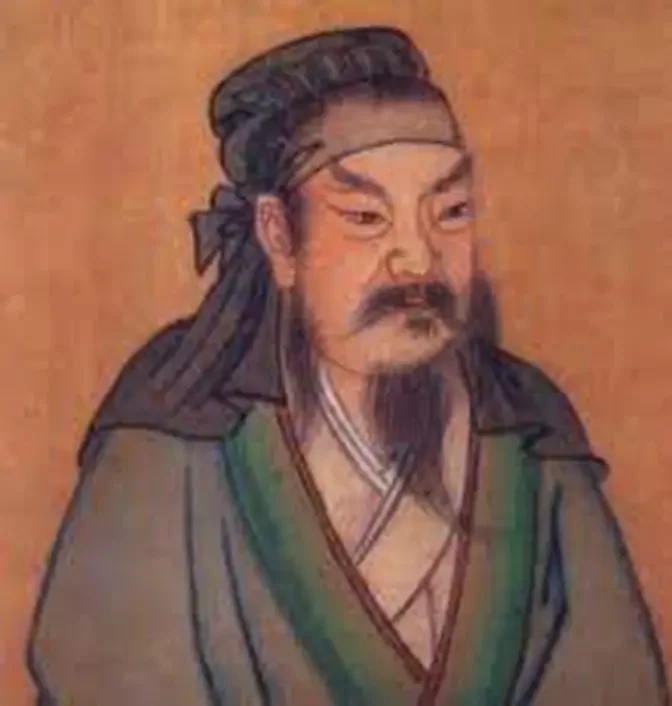
Myths of China 28 – Shun, The Sage King 青帝大舜

Shun is said to have descended from Yellow Emperor through Emperor Zhuan Xu, though by the time of his birth, they were so far removed from the royal line that their branch of the family was living in destitute.
Shun’s father, Gu Sou, was just an elderly blind man with no special deeds to his name. One night, Gu Sou’s wife, Wo Deng, had a strange dream. In the dream a dazzling phoenix came to her and fed her golden grains. Wo Deng found out she was pregnant not long after the strange dream.
Shun was born with two pupils in each eye, and was thus named ‘Chong Hua’, he was renamed ‘Shun’ later in his life.
Shun had a tough childhood, his mother passed away from sickness very early on and Gu Sou remarried soon after. Shun’s stepmother then gave birth to Shun’s half-brother ‘Xiang’ and a half-sister ‘Ke Shou’.
Shun’s stepmother and half-brother treated him terribly and often carried rumours to his father, blaming him for all the bad things that happened around them. The old and blind Gu Sou, doubly blinded by his affection for his new wife and children, would believe all the stories told to him, and treated Shun little better than people would treat their slaves.
Despite the terrible conditions he was living under, Shun never complained, and continued to treat his parents and half-siblings with the respect and obedience of a son, and the kindness of an older brother. His reputation as a filial son and kind brother soon spread throughout the settlement they lived in. Even then, his stepmother still viewed him with contempt and would like nothing better than to get rid of him.
Shun was soon forced to live on his own when his stepmother threw him out of the house when he was barely an adult. He travelled to the foothills of ‘Li’ mountain (today’s south-west face of Zhong Tiao Mountain in Shanxi), and lived as a farmer in a reed hut he built for himself.
Due to his compassionate nature and his natural charisma and leadership skills, the farmers of the area welcomed him and offered him parts of their own land instead of trying to force him out. When Shun went to a fishing village, he stopped the conflicts over fishing grounds and taught them how to share and allocate fishing resources, and soon the village was prosperous settlement. When Shun went to a pottery village to learn to make pottery, he picked up the skill in less than a year and shared with the locals how to make more durable and beautiful earthenware.
Shun treated everyone with respect, and the people all loved him. Therefore, he was able to organize the people, and influence them to be kind to each other and be the best versions of themselves. The people gravitated to him and would follow his lead. The remote farm he lived on became a small village a year after he moved there. By the end of the second year, it was a thriving town. In three years, the area had developed into a prosperous little city.
When Shun turned thirty, Yao had been on the throne for seventy years. Seeing that his own children were incompetent, Yao was distressing over the issue of succession. He asked his officials to propose suitable candidates for the throne and they all suggested Shun as the most suitable person for the job.
Although Yao heard all the accounts of Shun, he did not take them at face value. Instead, Yao decided he would test Shun and see for himself.
Yao married his two daughters, Er Huang and Nu Ying, to Shun, so that they could observe his character in the privacy of his own home. He made Shun the governor of a district and ordered his nine sons to work with Shun to observe his performance and competency. Yao also ordered a new house built for Shun, gave him rich cloths, an exquisite zither, and a herd of goats on top of the generous dowry.
Shun was totally unaffected by his newfound riches and status as a governor and son-in-law of the emperor. If anything, he became even more humble, working harder in the fields when he wasn’t administering to the people. He even convinced the two princesses he married to live humbly and work among the people.
However, Shun’s stepmother and half-brother became extremely jealous of his good fortune and conspired to kill him to take over his riches and beautiful wives.
They hatched a plan to trick Shun onto the roof to repair some damages, then Xiang took away the ladder and set the building on fire, hoping to burn Shun to death. Shun skilfully made a parachute out of his hat and wide robe, he jumped off the roof and landed safely on the ground.
Seeing that their plan failed, they then ordered Shun to dig them a well, planning to bury him alive with rocks and debris. Shun’s half-sister, Ke Shou, who always enjoyed a closer relationship with Shun than her mother and brother was appalled when she found out about their plans. She told Shun’s wives about the scheme which allowed Shun to prepare for them. When Xiang threw down the rocks and debris over Shun in the half-dug well, Shun was able to escape to the surface through another tunnel that he had dug beforehand.
Shun went into hiding for a short period of time after he escaped from the well. When he finally returned home, he found Xiang living in his house and playing with his zither. Xiang was shocked to see his older brother walking in alive but pretended to be overjoyed at seeing his brother back from the dead. Shun did not say anything about the attempts on his life, and continued to treat his stepmother and half-brother with the usual respect and kindness.
When Yao heard his daughters’ reports of Shun’s noble personal character, he was impressed and decided to bring Yao to the capital for his next trials.
Shun was first made the minister of education, and he excelled in the job by influencing the people to be kind and loving to one another, bringing harmony to all relationships based on kindness and respect. He was then made the minister of works where he was able to organise resources and manpower so that productivity of the realm improved by a significant amount. Finally, Shun was made the imperial ambassador to build and maintain relationships with all the tribes and clans of the land. All the tribal leaders and clan chiefs loved Shun for his personable character and they all respected his leadership qualities.
Not only did Shun pass all the trials set by Yao with flying colours, he was also able to influence Yao’s nine incompetent sons into becoming useful contributing members of society. Yao was totally impressed by now and decided that Shun was indeed the best person to be his successor, thus he abdicated the throne to Shun and went into retirement.
After Shun ascended to the throne, he immediately set to re-organizing the imperial court system. Although Yao had many exceptional talents working for him, their duties were not defined and often overlapping with each other. Shun created a more formalised ministerial system and reassigned the talents of his court based on their individual strengths.
Shun also decided that all imperial officials shall be graded for their work done once every three years, rewarding and promoting those who excelled in their jobs, and getting rid of the ones who were incompetent or lacking. Shun’s reforms greatly improved the efficiency of the administration and pushed society into another cycle of growth.
Yao passed away twenty-eight years after abdicating the throne to Shun, and the realm went into three years of mourning for the great former ruler. After the mourning period was over, Shun decided to hand the throne back to Yao’s oldest son, Dan Zhu. However, the officials would not recognise Dan Zhu’s authority and would still come to Shun for his decisions. The people started singing songs in honour of Shun’s reign and beseeched him to lead them again. Seeing that the people really loved him and wanted him to take on the responsibility of leadership, Shun the returned to the capital and took the throne again.
In Shun’s later years, a rebellion broke out in the south of the realm near Jiu Li mountain. Against the advice of his officials, he decided to personally lead the expedition to quell the rebellion. Unfortunately, Shun fell ill along the way and passed away near Cang Wu. He was a hundred years old at the time of his passing.
Hearing the news of his passing, his two wives rushed from home to his body, and wept for days. Their tears turned into blood and stained the reeds. From that day on, the bamboo of that region became red-spotted, which explains the origin of spotted bamboo. Then overcome by grief, both women threw themselves into the river and drowned.
After Shun’s passing, Xiang thought back on all the love and kindness his brother had shown him through the years and deeply regretted the way he plotted and schemed against him in return. The grief consumed him, and he decided to be a grave sentinel at Shun’s tomb.
The people of the area also decided to offer up a piece of land as a sacrificial farm for their beloved leader. It was said that every Spring and Autumn, Xiang would transform into an elephant and work the sacrificial farm in the day before turning back into a human to guard his brother’s tomb at night. When Xiang passed away himself, the people built a pavilion on the ground where he rested as a memorial to Shun’s repentant brother.
Comments