


Tired of writing boring emails? Google's new Help Me Write feature has you covered.
Email can be a lot of fun if you're corresponding with an old friend or a pen pal halfway around the world. It's less fun when you're filing multiple insurance claims or sending hundreds of thank you notes.
Announced at the Google I/O event in May, a new feature from Gmail called Help Me Write can draft those boring emails for you. Powered by the company's proprietary AI, the new Google service can compose automated messages in Gmail, text messages and other Google apps. Starting today, the feature is now available for Gmail on iPhones, iPads and Android devices.
With 1.8 billion active users of Gmail at the last count, Help Me Write is poised to have a major impact on the way that the world communicates via email. Learn more about how Help Me Write works and how you might use it.
For more on Google I/O, learn all about the foldable Pixel phone and the biggest new features announced for Android.
More from Google I/O
- Google I/O's Big Reveals: Pixel Fold, 7A, Android 14, AI and More
- Google Pixel Fold Hands-On: Samsung Has New Competition
- Google Reveals Its AI-Powered Search Engine to Keep Up With Competition
- Android 14: The Biggest Features Announced at Google I/O 2023
How does Help Me Write work in Gmail?
The new Help Me Write feature for generative AI email creation in Gmail expands on the "Smart Compose" feature that Google introduced in 2018, as well as the "Smart Reply" feature added in 2017.
Whereas Smart Reply offers basic automated replies, and Smart Compose provides suggestions as you type, Help Me Write goes well beyond, creating a full email from a basic prompt. A "refine" button can shorten the text, elaborate or make the email more formal. You can then further edit the email manually or send it as is.
In his demo at Google I/O, Pichai used Help Me Write to draft an email asking for a full refund from an airline for a canceled flight. Help Me Write created an email from scratch using information gleaned from the airline's emailed offer of a voucher.
How can I start using Help Me Write in Gmail?
Help Me Write is part of Google's Workspace Labs, and you'll need to join the program if you want to use AI to compose text in Gmail or Google Docs. Visit labs.withgoogle.com, scroll down to the section marked "Unlock new ways of working with AI" and click the blue "Join waitlist" button to sign up. (We were able to join Workspace Labs from a personal Google account today, immediately, without any wait.)
It's worth noting that Google's privacy policy for Workspace Labs is different to its standard Gmail privacy policy. The company takes pains to warn users, "Please do not include sensitive, confidential, or personal information that can be used to identify you or others in your interactions with Workspace Labs features." Your Workspace Labs data may be reviewed by humans and stored by the company for four years.
Once you're into Workspace Labs, a new Help Me Write icon -- a pencil with a star above it -- should show up whenever you draft a new email in Gmail or create a new document in Google Docs. In web-based Gmail, the icon appears to the right of the "Send" button. On your iPhone or Android device, it will show up at the bottom of the email.
Clicking on the Help Me Write button in Gmail will open up a prompt window, where you can describe what you want the AI to write. Provided examples include "A glowing review for a team member" and "Wish my friend a speedy recovery in the hospital."
After you enter a prompt and click "Create," Help Me Write will generate your text and provide you the options of recreating the text or refining it to make it more formal, more elaborate or shorter. Once you're satisfied with the text, hit "Insert" to add it to your email, which you can then edit as you like.
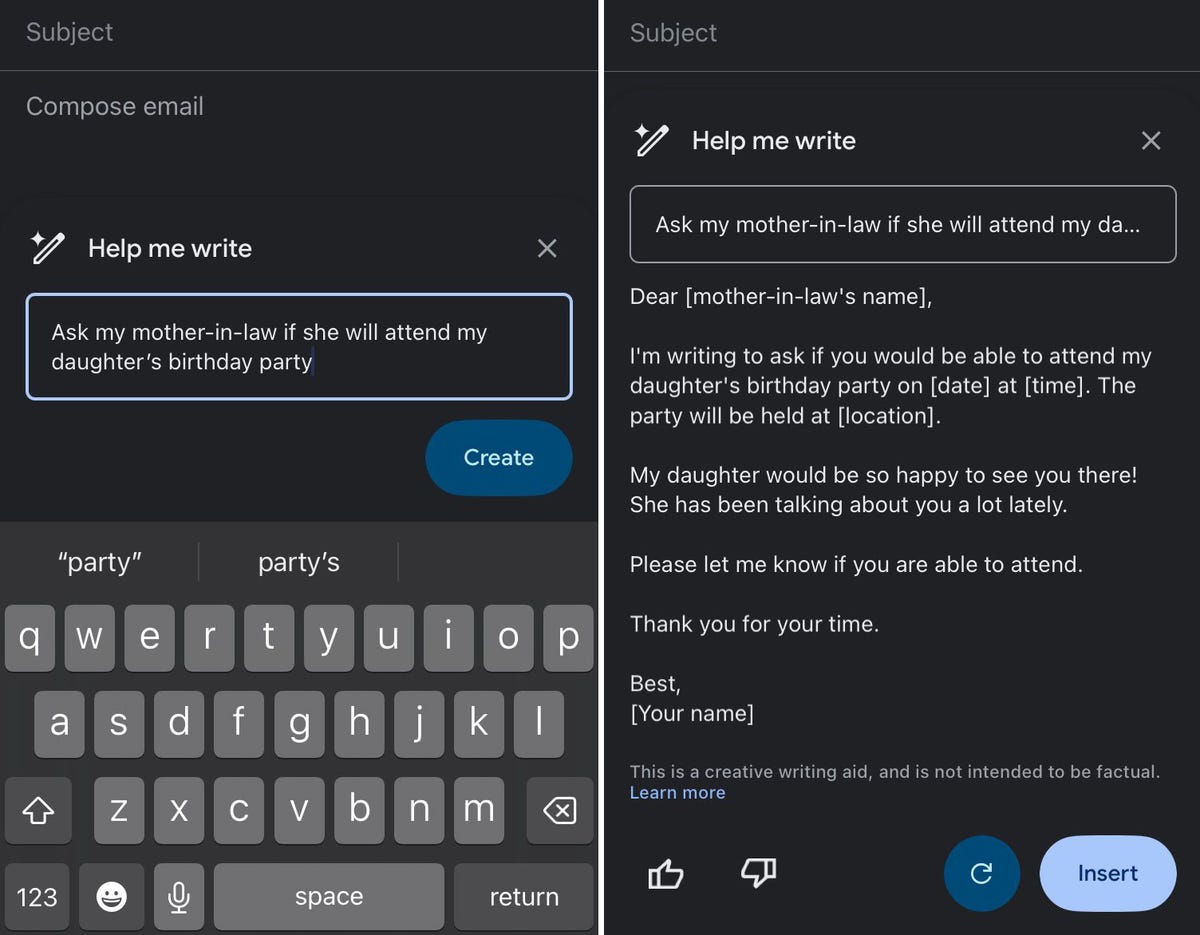
Gmail's Help Me Write feature on iPhone shows up as a button at the bottom of new emails.
Google/Screenshots by CNET
For more, here's what to know about Google's Bard AI and the company's AI-powered search engine.
First published on May 10, 2023 6:48 p.m. PT
Google's AI Search Could Mean Radical Changes for Your Internet Experience
At Google I/O, the company unveiled an experimental version of Search that integrates AI-generated responses. Will it break the balance of the internet?
ReporterImad is a senior reporter covering Google and internet culture. Hailing from Texas, Imad started his journalism career in 2013 and has amassed bylines with The New York Times, The Washington Post, ESPN, Tom's Guide and Wired, among others. He also hosts FTW with Imad Khan, an esports news podcast in association with Dot Esports.ExpertiseGoogle, Internet CultureSee full bioImad KhanMay 21, 2023 5:00 a.m. PT5 min read
Magnifying glass icon at the 2023 edition of Google I/O, the company's yearly developer conference, where this year Google showed off a new AI-driven version of Search.
James Martin/CNET
The future of Google Search is a big green box.
That's exactly what Google showed off this month at Google I/O, the company's yearly developer conference. The theme for 2023 was AI, a term mentioned more than 140 times during the two-hour keynote presentation. Google unveiled AI products that will actually be released to the public, an about-face for the apprehensive internet giant in response to growing competition.
Late last year, OpenAI launched ChatGPT to near-universal adulation. Suddenly, everybody had access to a generative AI engine that could seemingly answer any question with a novel response. It's powered by a large language model, or LLM, that essentially lets it act as "autocomplete on steroids," using massive amounts of text data to figure out what the next best word should be.
The power and ease of ChatGPT helped it become the fastest growing consumer web platform ever. It prompted Microsoft to up its investment into OpenAI and integrate ChatGPT's tech directly into Bing search earlier this year, a move that helped the company see a 16% increase in traffic. The day before Microsoft unveiled Bing AI, Google announced its own generative AI engine, Bard, although it flubbed the launch and lost $100 billion in stock market value in the process. The stock has since rebounded to its highest level so far this year.
In many ways, Google I/O was a referendum on the company's wonky entrance into consumer AI and a clear message to skeptics (and investors) that it's willing to take radical steps to stay at the forefront of internet search, even if that means upending its core product. Google Search has long been the engine for how we all look for product information, find the latest news and otherwise interact with the internet, and for how many businesses make money.
The new Search Generative Experience, or SGE, is an experimental version of Search that deprioritizes the 10 blue links that have defined Google for the past quarter century. Instead, any query, regardless of how specific, gets answered in a mushrooming green box that expands as it fills the screen with a person's answer.
"Now search does the heavy lifting for you," said Cathy Edwards, vice president of engineering at Google, during I/O. She said that in the Search we know today, complex queries have to be broken down into smaller questions where you, the user, have to sift through the information yourself and formulate the answer in your head. SGE can do all of that automatically, even allowing you to ask follow-up questions.
Google Search Generative Experience is an experimental version of Search that integrates AI-generated results, similar to Bing and ChatGPT.
CNET
At the same time, it also means not having to visit multiple sites – clicks that webpages rely on, potentially upending the internet's ad-driven business model.
Google is by far the largest player in online search, with 93% market share, according to Statcounter. Online search engines are also the greatest drivers of traffic for websites, with 68% of online experiences beginning at a search engine, according to a 2019 report by Brightedge Research. Google's dominance in search at one point helped it see a valuation of $2 trillion.
With SGE, Google is potentially thrusting internet users and businesses into a new future, one that'll require a rethinking of how quality information can continue to percolate while also incentivizing people into creating valuable content to feed its AI machine.
Because sign-ups just started for SGE, there isn't any data yet to share regarding user experience. Microsoft, however, has been gathering feedback for Bing AI over the last three months and could provide a lens on how consumers may react with AI-driven Google searches.
"Feedback on the answers generated by the new Bing has been mostly positive, with 71% of those in preview giving the AI-powered answers a thumbs-up, said a Microsoft spokesperson. "We're seeing a healthy engagement on the chat feature, with multiple questions asked during a session to discover new information."
It's unclear how AI-generated news stories will filter into Google's or Bing's AI results. Already, publications, including CNET, are experimenting with AI written articles. Unfortunately, AI itself isn't always accurate and can have "hallucinations," where it confidently says something is correct when it isn't.
If the hallucination problem is eventually solved, generative AI in search could be faster and ultimately better for consumers. But it's still unknown as to how it could affect the digital publishing industry, especially if people forgo clicking links en masse.
"As we experiment with new LLM-powered capabilities in Search, we'll continue to prioritize approaches that send valuable traffic to a wide range of creators and support a healthy, open web," a Google spokesperson said. Though it's true that Google does link to sources prominently in SGE, it's uncertain if SGE will translate to increased or higher quality traffic for sites.
Microsoft didn't answer any questions regarding traffic to sources when using AI search. Google said it doesn't have plans to share about publisher compensation but would "continue to work with the broader ecosystem."
"I think [generative AI] is going to bring down the amount of traffic going out because that's the purpose of it," said Monica Ho, chief marketing officer at SOCi, a digital marketing company. However, she posits that traffic coming in for sites might be higher quality, as people are looking for specific information versus bouncing between sites.
If Google becomes undependable for traffic, there might not be viable alternatives. Social media platforms such as Facebook have proved to be unreliable partners for publications, down-ranking news on a whim, according to Rasmus Kleis Nielsen, director of the Reuters Institute for the Study of Journalism and professor of political communication at the University of Oxford. He added that platforms like Instagram or TikTok "drive comparatively few referrals, and do not really feature links the way search does and social did."
At the moment, search engines "crawl" websites daily to glean new information and index it into results. Websites allow engines to crawl for free because of the traffic conversion. But if AI-search leads to fewer clicks, the search economy may need an entirely new rethinking.
"I expect that original content will be placed behind paywalls and require LLM models to pay in order to read it.," said Don White, CEO of Satisfi Labs, a conversational AI company. In a "Spotify-style compensation model," White sees a future where sites are paid-per-view.
Ultimately, Google will likely need to find a way for revenue to reach creators and publications so that there's still an incentive to create quality content.
"Quality data has to feed the engine, and Google's not creating all of their own unique, authentic original content," said Ho. "It has to come from creators. They know that they're going to have to feed that engine somehow and make it worthwhile for content to keep coming."
Source: CNET