


Market Overview:
The catalyst market is experiencing rapid growth, driven by sustainable catalysis & green chemistry, high-performance catalysts & process intensification, and tailored catalysts & application-specific solutions. According to IMARC Group’s latest research publication, “Catalyst Market Size, Share, Trends and Forecast by Type, Process, Raw Material, Application, and Region, 2025-2033”, The global catalyst market size was valued at USD 41.46 Billion in 2024. Looking forward, IMARC Group estimates the market to reach USD 58.68 Billion by 2033, exhibiting a CAGR of 3.74% during 2025-2033.
This detailed analysis primarily encompasses industry size, business trends, market share, key growth factors, and regional forecasts. The report offers a comprehensive overview and integrates research findings, market assessments, and data from different sources. It also includes pivotal market dynamics like drivers and challenges, while also highlighting growth opportunities, financial insights, technological improvements, emerging trends, and innovations. Besides this, the report provides regional market evaluation, along with a competitive landscape analysis.
Grab a sample PDF of this report: https://www.imarcgroup.com/catalyst-market/requestsample
Our report includes:
- Market Dynamics
- Market Trends And Market Outlook
- Competitive Analysis
- Industry Segmentation
- Strategic Recommendations
Growth Factors in the Catalyst Market:
- Sustainable Catalysis & Green Chemistry
The catalyst market is changing due to a focus on sustainability and green chemistry. Stricter environmental rules and the need to cut the ecological impact of chemical processes are driving this shift. Manufacturers are now favoring catalysts that use renewable feedstocks, reduce waste, and save energy. Asymmetric catalysts, which are easy to separate and recycle, help promote a circular economy. Bio-based and enzyme-inspired catalysts allow chemical production under milder conditions, cutting down on hazardous solvents and reagents. There is also a rising demand for catalysts that aid in carbon capture and utilization (CCU), sparking innovation in materials science and catalytic engineering. Computational modeling and high-throughput screening speed up finding catalysts with better activity and selectivity. Focus on life cycle assessments and sustainability metrics ensures that catalytic processes are environmentally friendly. This change isn’t just about greener materials; it’s about redesigning chemical processes for a more sustainable industry.
- High-Performance Catalysts & Process Intensification
The catalyst market is seeing a rise in demand for high-performance catalysts. This surge is due to the need for better efficiency, lower costs, and improved product quality. These catalysts show great activity, selectivity, and stability in tough reaction conditions. Manufacturers are focusing on customizing catalyst structures and optimizing surface areas for better performance. Advanced techniques, like transmission electron microscopy (TEM) and X-ray photoelectron spectroscopy (XPS), give us deeper insights into how catalysts work. Microreactor technologies and continuous-flow processes allow for more intense catalytic reactions. This results in higher yields and better process control. Catalysts designed for regeneration and longer lifespans help cut operational costs. The growing demand for high-purity chemicals and specialty materials is driving innovation in catalyst design and synthesis. Additionally, process simulation and integrated reaction units help develop efficient and cost-effective catalytic systems. This trend aims to create catalyst solutions for more streamlined and sustainable chemical production.
- Tailored Catalysts & Application-Specific Solutions
The catalyst market is focusing more on tailored catalysts and specific solutions. This shift responds to the complex needs of various industries. Manufacturers are creating custom catalysts for petrochemical refining, polymer synthesis, and pharmaceutical production. Computational modeling and combinatorial chemistry speed up the development of catalysts with specific properties. Optimized stabilization and support materials improve durability and recyclability for targeted uses. The demand for catalysts that create high-value specialty and fine chemicals is driving innovation in design. Some catalysts operate under mild conditions, making them ideal for sensitive chemicals and biomolecules. Advanced process control and real-time monitoring enhance catalytic performance in specific situations. This trend aims to provide solutions that meet the exact needs of different industries and applications.
Key Trends in the Catalyst Market:
- Growing Use of Zeolites and Enzyme Catalysts
A key trend in the catalyst market is the growing use of zeolites and enzyme-based catalysts. Zeolites are popular for refining and petrochemical applications because they have a high surface area and thermal stability. Enzyme catalysts are also rising in popularity, especially in food processing, pharmaceuticals, and biofuel production. They are known for their specificity and environmental benefits. These catalysts allow reactions at lower temperatures and produce less hazardous waste, promoting sustainability. Companies are investing in research to create custom enzyme catalysts for specific industrial needs. This reinforces their importance in modern catalysis.
- Shift Toward Renewable Feedstocks
The move from fossil-based to renewable feedstocks is changing catalyst development in many industries. As the bio-economy grows, catalysts are being created to convert biomass into fuels, chemicals, and polymers. For example, solid acid catalysts are being studied for converting lignocellulosic biomass. At the same time, new metal catalysts are being developed for hydrogenation and fermentation processes. This shift is leading to partnerships between chemical manufacturers and biotech firms. Together, they aim to create next-generation catalysts that work well with natural feedstocks. As environmental and economic pressures rise, this trend will be key in changing how catalysts are used.
- Integration of Nanotechnology
Nanotechnology is changing how we design catalysts. It provides higher surface-to-volume ratios, better reaction rates, and improved selectivity. Nanoscale catalysts are used in many areas, like fuel cells, automotive exhaust treatment, and fine chemical synthesis. These materials often have better thermal and chemical stability. This leads to longer-lasting and more efficient performance. Researchers are looking into hybrid nanocatalysts. These combine multiple functions in one structure, creating new opportunities in multifunctional catalysis. This advancement makes catalytic processes more efficient and broadens their use in growing fields like renewable energy and carbon capture.
Leading Companies Operating in the Global Catalyst Industry:
- Albemarle Corporation
- Arkema S.A.
- Axens SA
- BASF SE
- Chevron Phillips Chemical Company LLC
- Clariant AG
- Dow Inc.
- Evonik Industries AG
- Exxon Mobil Corporation
- Honeywell International Inc.
- Johnson Matthey
- Shell plc
- W. R. Grace and Co. (Standard Industries Inc.)
- Zeolyst International Inc.
Catalyst Market Report Segmentation:
By Type:
- Heterogeneous Catalyst
- Homogeneous Catalyst
Heterogeneous catalyst represents the largest segment due to their ability to be easily separated from the reaction mixture and reused, enhancing process efficiency and cost-effectiveness.
By Process:
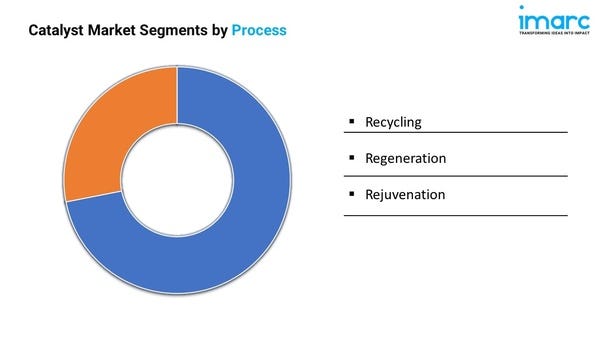
- Recycling
- Regeneration
- Rejuvenation
Recycling exhibits a clear dominance in the market because catalysts play a crucial role in enabling efficient and sustainable recovery and reuse of valuable materials, meeting increasing environmental regulations and resource conservation needs.
By Raw Material:
- Chemical Compounds
- Peroxides
- Acids
- Amines
- Others
- Metals
- Precious Metals
- Base Metals
- Zeolites
- Others
Chemical compounds (peroxides, acids, amines, and others) account for the majority of the market share as they are essential in manufacturing various types of catalysts used across multiple industrial processes, ensuring consistent performance and high reactivity.
By Application:
- Chemical Synthesis
- Chemical Catalysts
- Adsorbents
- Syngas Production
- Others
- Petroleum Refining
- Fluid Catalytic Cracking (FCC)
- Alkylation
- Hydrotreating
- Catalytic Reforming
- Purification
- Bed Grading
- Others
- Polymers and Petrochemicals
- Ziegler Natta
- Reaction Initiator
- Chromium
- Urethane
- Solid Phosphorous Acid Catalyst
- Others
- Environmental
- Light-duty Vehicles
- Motorcycles
- Heavy-duty Vehicles
- Others
Chemical synthesis (chemical catalysts, adsorbents, syngas production, and others) holds the biggest market share owing to the extensive use of catalysts in producing pharmaceuticals, polymers, and other fine chemicals, driving demand through continuous innovation and industrial growth.
Regional Insights:
- North America (United States, Canada)
- Asia Pacific (China, Japan, India, South Korea, Australia, Indonesia, Others)
- Europe (Germany, France, United Kingdom, Italy, Spain, Russia, Others)
- Latin America (Brazil, Mexico, Others)
- Middle East and Africa
Asia Pacific’s dominance in the catalyst market is attributed to rapid industrialization, significant investments in chemical and petrochemical industries, and a strong manufacturing base in various countries.
Research Methodology:
The report employs a comprehensive research methodology, combining primary and secondary data sources to validate findings. It includes market assessments, surveys, expert opinions, and data triangulation techniques to ensure accuracy and reliability.
Note: If you require specific details, data, or insights that are not currently included in the scope of this report, we are happy to accommodate your request. As part of our customization service, we will gather and provide the additional information you need, tailored to your specific requirements. Please let us know your exact needs, and we will ensure the report is updated accordingly to meet your expectations.
About Us:
IMARC Group is a global management consulting firm that helps the world’s most ambitious changemakers to create a lasting impact. The company provide a comprehensive suite of market entry and expansion services. IMARC offerings include thorough market assessment, feasibility studies, company incorporation assistance, factory setup support, regulatory approvals and licensing navigation, branding, marketing and sales strategies, competitive landscape and benchmarking analyses, pricing and cost research, and procurement research.
Contact Us:
IMARC Group
134 N 4th St. Brooklyn, NY 11249, USA
Email: [email protected]
Tel No:(D) +91 120 433 0800
United States: +1–631–791–1145