


Global Data Center Liquid Cooling Industry: Key Statistics and Insights in 2025-2033
Summary:
- The global data center liquid cooling market size reached USD 3.5 Billion in 2024.
- The market is expected to reach USD 16.5 Billion by 2033, exhibiting a growth rate (CAGR) of 18.56% during 2025-2033.
- North America leads the market, accounting for the largest data center liquid cooling market share.
- Solution accounts for the majority of the market share in the component segment, as data center operators are seeking to streamline operations and reduce energy consumption.
- Large data centers hold the largest share in the data center liquid cooling industry.
- Enterprises remain a dominant segment in the market, as these organizations require efficient cooling solutions to manage the high heat output of their expanding server networks.
- IT and telecom represent the leading application segment.
- The rising data center power density is a primary driver of the data center liquid cooling market.
- The increasing demand for energy efficiency is reshaping the data center liquid cooling market.
Industry Trends and Drivers:
- Increasing data center power density:
The combination of advanced servers and processors with AI technologies along with ML and high-performance computing (HPC) has led to increased power density measurements expressed as kilowatts (kW). Air-cooling technologies used for data center applications have persisted unsuccessfully despite their inability to remove heat from dense racks throughout the years. Fluid-based direct equipment cooling provides superior performance than traditional air-based approaches for managing heat produced by dense computer systems. The market demands liquid cooling solutions because it provides effective heat transfer in packed computing facilities. The increasing power density makes air-based cooling approaches light and energy-intensive which renders them inefficient. High energy costs and operating expenses emerge from air cooling systems because these setups need lower temperatures combined with swift airflow.
- Rising demand for energy efficiency:
Massive data centers require excessive energy to operate convection-based cooling systems because they require powerful air circulation fans and air conditioning systems. The rising workloads in data centers will make existing systems insufficient for operations. Compared to other cooling methods liquid cooling proves efficient because liquids transfer heat with superior acceleration and heat-storage potential relative to air. As an excellent insulator the materials facilitate heat and steam management in buildings which leads to reduced air conditioning and cooling needs. The data center efficiency measurement relies on Power usage effectiveness also known as PUE. Beneath a lower PUE rating proves high efficiency of power usage. High-energy efficiency becomes attainable through liquid cooling technology because this method follows a cooling process that requires minimal server power consumption. The technology leads to higher energy efficiency together with lower operational expenses while considering increased energy prices since data center operators must manage their budget adequately.
- Technological advancements:
The efficiency of heat removal undergoes continuous improvement through recent developments in liquid cooling methods including immersion cooling as well as direct-to-chip cooling and cold plate systems. Server thermal management improves through immersion cooling methods since servers rest in non-conductive fluids that enable direct heat absorption from computer parts. Modern technologies enable data centers to achieve maximum authorized power capacity without heat-related failure. Liquid cooling systems merged with Internet of Things (IoT) and artificial intelligence (AI) technology enable better supervision of cooling management operations. Smart liquid cooling systems actively modify their flow rates and temperatures and pressure for real-time server workload and heat production monitoring to achieve peak performance and minimized energy consumption.
Request for a sample copy of this report: https://www.imarcgroup.com/data-center-liquid-cooling-market/requestsample
Data Center Liquid Cooling Market Report Segmentation:
Breakup By Component:
- Solution
- Direct Liquid Cooling
- Indirect Liquid Cooling
- Services
- Design and Consulting
- Installation and Deployment
- Support and Maintenance
Solution represents the largest segment. Solutions encompass a wide range of integrated systems and technologies essential for effective liquid cooling, making them the predominant choice among data center operators seeking comprehensive cooling strategies.
Breakup By Data Center Type:
- Large Data Centers
- Small and Medium-sized Data Centers
- Enterprise Data Centers
Large data centers account for the majority of the market share as large data centers have higher power densities and cooling requirements.
Breakup By End Use:
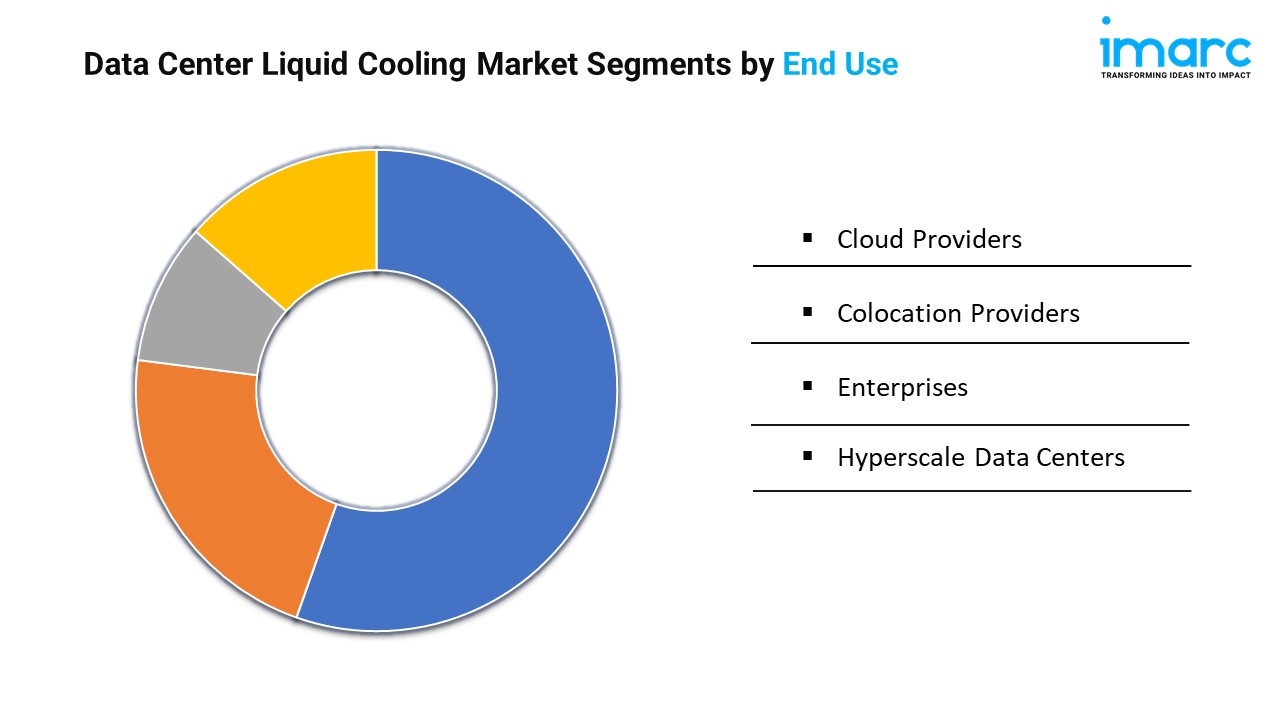
- Cloud Providers
- Colocation Providers
- Enterprises
- Hyperscale Data Centers
Enterprises exhibit a clear dominance in the market. Enterprises, with their significant investments in IT infrastructure and reliance on data-intensive applications, prioritize advanced cooling solutions to ensure optimal performance and operational efficiency.
Breakup By Application:
- BFSI
- IT and Telecom
- Media and Entertainment
- Healthcare
- Government and Defense
- Retail
- Research and Academic
- Others
IT and telecom hold the biggest market share. The IT and Telecom sectors are characterized by high data traffic and power demands, necessitating efficient cooling solutions to manage the heat generated by their extensive hardware setups.
Breakup By Region:
- North America (United States, Canada)
- Asia Pacific (China, Japan, India, South Korea, Australia, Indonesia, Others)
- Europe (Germany, France, United Kingdom, Italy, Spain, Russia, Others)
- Latin America (Brazil, Mexico, Others)
- Middle East and Africa
North America enjoys the leading position in the data center liquid cooling market. North America is home to a large number of hyperscale data centers and tech giants that are early adopters of innovative cooling technologies, driving significant growth in the liquid cooling market.
Top Data Center Liquid Cooling Market Leaders:
The data center liquid cooling market research report outlines a detailed analysis of the competitive landscape, offering in-depth profiles of major companies. Some of the key players in the market are:
- Alfa Laval AB
- Asetek A/S
- Asperitas
- Chilldyne
- CoolIT Systems Inc.
- Fujitsu Limited
- Green Revolution Cooling Inc.
- Iceotope
- Lenovo Group Limited
- Rittal GmbH & Co. KG
- Schneider Electric SE
- Vertiv Group Corp.
Note: If you need specific information that is not currently within the scope of the report, we will provide it to you as a part of the customization.
About Us
IMARC Group is a global management consulting firm that helps the world’s most ambitious changemakers to create a lasting impact. The company provide a comprehensive suite of market entry and expansion services. IMARC offerings include thorough market assessment, feasibility studies, company incorporation assistance, factory setup support, regulatory approvals and licensing navigation, branding, marketing and sales strategies, competitive landscape and benchmarking analyses, pricing and cost research, and procurement research.
Contact US
IMARC Group
134 N 4th St. Brooklyn, NY 11249, USA
Email: [email protected]
Tel No:(D) +91 120 433 0800
United States: +1-631-791-1145