


Poland, situated in Central Europe, boasts a rich and diverse cultural heritage that spans centuries of history. From its tumultuous past to its vibrant present, Poland's culture and traditions have evolved and intertwined with various influences, resulting in a unique and fascinating tapestry of customs, arts, cuisine, and celebrations. This article discusses various aspects of Poland's culture, including its history, art, music, dance, food, festivals, and more.
1. Historical Roots
Early Slavic Origins
The origins of the Polish people can be traced to the early Slavic tribes that inhabited the region of present-day Poland as early as the 5th century. These Slavic tribes, including the Polans, Mazovians, and Silesians, lived in a loose federation of tribes with their own customs and languages. The Polans eventually emerged as one of the dominant tribes in the area. The name Poland is derived from the name of the West Slavic tribe of Polans (Polanie). The tribe’s name means “field dwellers” or “people living in the open fields”.
Formation of a Medieval Kingdom
The crucial turning point in Polish history occurred in the 10th century when the Polans, led by Duke Mieszko I, united various Slavic tribes into a single political entity. In 966 AD, Mieszko I converted to Christianity, marking the official adoption of Christianity as the state religion. This event is seen as the birth of the Polish state.
Piast Dynasty
The Piast dynasty, founded by Mieszko I, ruled Poland for over five centuries. Under the Piast rulers, Poland expanded its territory, including the incorporation of the region of Silesia, and developed its institutions, laying the groundwork for a stable medieval kingdom.
Golden Age of the Polish-Lithuanian Commonwealth
In the 14th century, Poland entered into a union with the Grand Duchy of Lithuania, forming the Polish-Lithuanian Commonwealth. This union, established in 1569 by the Union of Lublin, created one of the largest and most powerful states in Europe at the time. The Commonwealth was a multi-ethnic and multi-religious federation, known for its religious tolerance and cultural diversity.
During the Commonwealth's golden age, Poland experienced remarkable growth in trade, arts, and sciences. It became a center of Renaissance and Baroque culture, attracting scholars, artists, and merchants from across Europe.
However, the 18th century brought challenges, with Poland experiencing internal strife and external threats. The Polish-Lithuanian Commonwealth eventually succumbed to partition and ceased to exist as an independent state in the late 18th century, divided among neighboring powers.

2. Language and Literature
The Polish language is the heartbeat of the nation, uniting the people across regions and generations. It is an ancient Slavic language with a rich literary tradition that spans back to the Middle Ages. Renowned Polish writers and poets, such as Adam Mickiewicz, Juliusz Słowacki, and Wisława Szymborska, have left an indelible mark on world literature, with their works resonating with universal themes of love, freedom, and national identity.
3. Folk Music and Dance
Polish folk music is diverse and varies across different regions of the country. It is characterized by its lively and energetic rhythms, often accompanied by traditional instruments like the accordion, fiddle, clarinet, and dulcimer. The melodies are both captivating and melancholic, reflecting the joys and sorrows of everyday life in rural Poland. The lyrics typically touch upon themes such as love, nature, work, and historical events. Notably, Poland has a rich tradition of religious folk music, including hymns and carols, associated with various religious celebrations.
Polish traditional dances are a cherished part of the country's cultural identity, reflecting its history and regional diversity. These dances have been preserved through generations and are still performed on various occasions. Some of the most famous are:
Polonaise (Polonez): An elegant processional dance with deep cultural significance, often seen at formal events like weddings and official ceremonies.
Mazurka (Mazur): A lively dance performed in pairs, characterized by intricate footwork and rhythmic patterns.
Kujawiak: A graceful couple's dance from the Kujawy region, known for its flowing movements and performed at festive gatherings.

Oberek: A fast and dynamic dance from the Mazovia region, featuring acrobatic moves and spirited spins.
Krakowiak: A spirited couple's dance from the Kraków region, known for its lively steps and colorful costumes.

Góralski (Highlander Dance): An energetic group dance performed by highlanders in the Tatra Mountains, accompanied by lively folk music.
Polka: A lively and popular dance widely enjoyed at weddings, festivals, and social gatherings.
Traditional costumes play a vital role in Polish folk dance performances, representing the cultural heritage of specific regions. The outfits are adorned with colorful embroidery and accessories, making the dance performances visually captivating and culturally significant.
4. Crafts
Polish folk art is particularly renowned for its vibrant colors, intricate patterns, and deep symbolism. It is commonly seen in paintings, embroidery, and decorative objects. Additionally, Poland is famous for its delicate and beautiful pottery, especially from regions like Bolesławiec and Bunzlau.

Woodcarving is another significant craft in Polish culture, producing stunning sculptures, furniture, and religious icons. The art of woodcarving has been passed down through generations, preserving its authenticity and cultural significance.
Textile work, including weaving and embroidery, also plays a crucial role in Polish traditions. Intricate designs and patterns can be found in traditional clothing, such as the well-known folk costume called the "krakowiak."
5. Cuisine
Poland's cuisine reflects its agricultural history and a blend of regional influences. Traditional Polish dishes are hearty and flavorful, often incorporating staples like potatoes, cabbage, and beets. Pierogi, a type of dumpling filled with various ingredients like meat, cheese, or fruits, is perhaps the most famous Polish culinary creation, cherished by locals and tourists alike.
Bigos, a rich hunter's stew, and Żurek, a sour rye soup made of rye flour with smoked sausage and eggs served in a bread bowl, are other staples that have become synonymous with Polish comfort food. Additionally, no Polish meal is complete without a selection of delicious pastries like Pączki (Polish doughnuts) or Szarlotka (apple pie).
The cultural significance of meals is evident in the ritual of Wigilia, the traditional Christmas Eve supper, where families gather to break bread and share symbolic dishes.
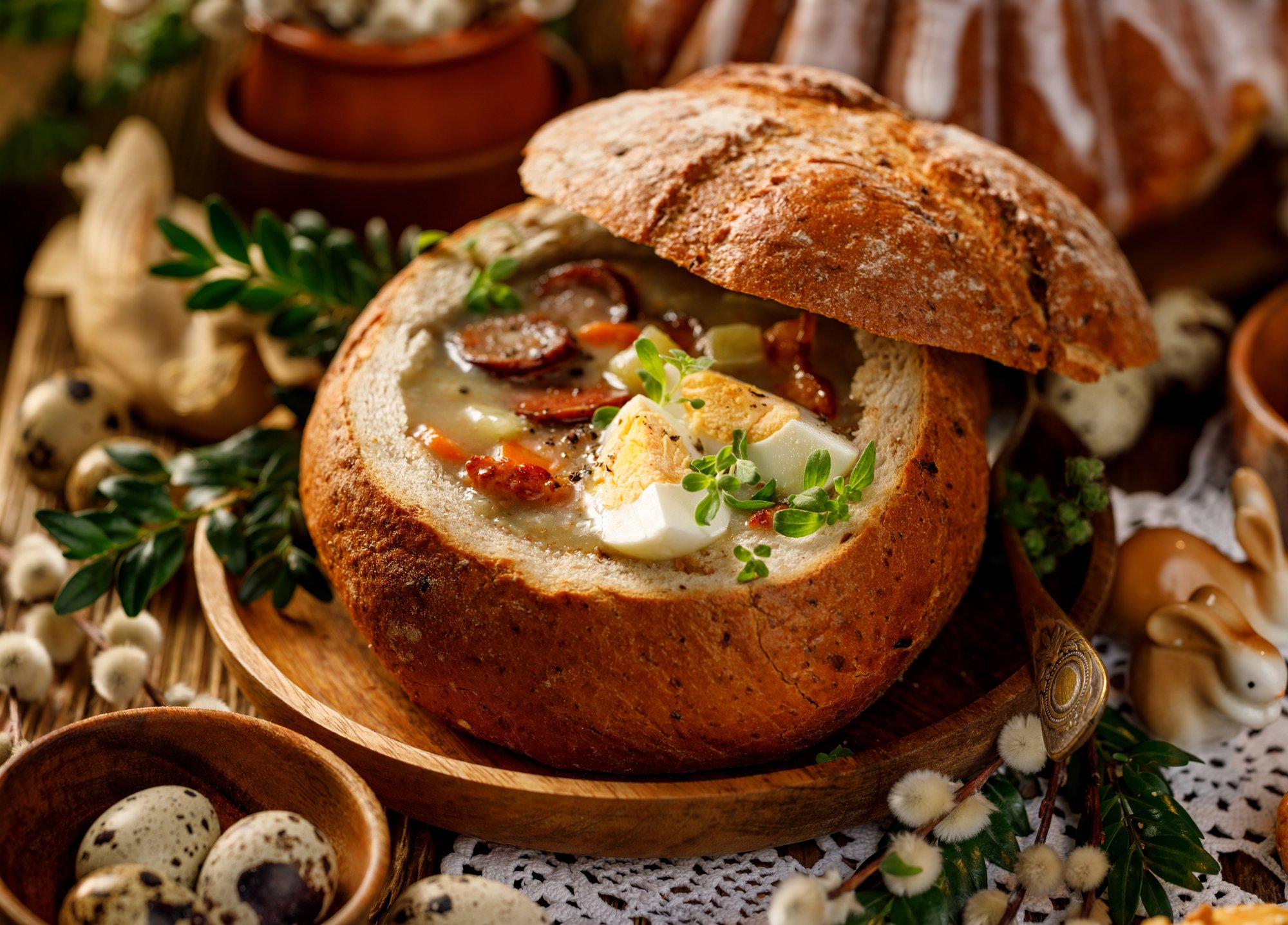 Żurek, a sour rye soup. Photo: Adobe Stock
6. Architecture and Art
Architecture
Poland's architecture showcases a diverse range of styles, from medieval castles and Gothic cathedrals to Baroque palaces and Renaissance buildings. The historic centers of Krakow and Warsaw, along with other cities, boast UNESCO World Heritage sites that preserve the nation's architectural splendor.
Poland's architecture reflects its diverse history and cultural influences. Gothic cathedrals, like Wawel Cathedral and St. Mary's Basilica, showcase medieval craftsmanship. The Renaissance era brought palaces and manor houses, with Wilanów Palace as a prime example. Baroque architecture flourished during the Polish-Lithuanian Commonwealth, leaving grand structures adorned with intricate details.
Contemporary architecture blends traditional elements with modern design, seen in the Warsaw skyline's skyscrapers and innovative urban planning. The preservation of historical buildings remains a priority, maintaining Poland's unique architectural identity.

Art
Polish art has a long and illustrious history, encompassing various styles and periods. Renaissance painters, such as Jan Matejko, depicted historical events, while Stanisław Wyspiański's works embodied the Art Nouveau movement.
The Polish School of Posters gained international acclaim with its innovative designs. The 20th century saw the emergence of avant-garde artists like Władysław Strzemiński and Tadeusz Kantor, who pushed artistic boundaries.
Modern Polish artists continue to contribute to the global art scene, with diverse mediums, themes, and styles. Art galleries and museums across the country celebrate the nation's creative spirit, preserving and showcasing its artistic heritage.
7. Religious Traditions
Poland is predominantly a Catholic nation, and religious traditions hold immense importance in the lives of its people. Many festivals and holidays, such as Easter and All Saints' Day, are marked by vibrant rituals, family gatherings, and visits to cemeteries to honor the departed. The religious devotion of the Polish people has played a significant role in shaping their cultural and historical identity.

8. Festivals and Celebrations
Easter (Wielkanoc): Easter is one of the most significant religious celebrations in Poland. It is marked by a combination of Christian traditions and folk customs. Families gather for a special Easter breakfast, during which a basket filled with blessed food, such as painted eggs (pisanki), sausages, and bread, is shared among family members.

Andrzejki: Celebrated on the night of November 29th, Andrzejki (St. Andrew's Day) is a unique event that blends ancient pagan rituals with Christian customs. It involves fortune-telling games, such as pouring hot wax into cold water and interpreting the shapes that form.
Corpus Christi (Boże Ciało): Corpus Christi is an important religious holiday, commemorating the Body and Blood of Christ. On this day, elaborate processions take place, with people walking through streets adorned with flower petals and greenery while carrying the Blessed Sacrament.
Noc Kupały (Midsummer's Eve): Celebrated on the night of the summer solstice, Noc Kupały is a pagan-inspired festival focused on nature, love, and fertility. People gather around bonfires, sing traditional songs, and participate in rituals, such as jumping over the bonfire for good luck.

Independence Day: On November 11th, Poles celebrate their independence, commemorating the restoration of Poland's sovereignty in 1918. Parades, concerts, and patriotic events take place throughout the country.
International Chopin Piano Competition: Held every five years in Warsaw, this prestigious competition attracts top pianists from around the world who showcase their talent by performing the works of the renowned Polish composer Fryderyk Chopin.
Kraków Christmas Market: The Christmas market in Kraków is a magical event that draws locals and tourists alike. Traditional wooden stalls offer handmade crafts, ornaments, and delicious Polish treats, creating a festive atmosphere.
Polish Film Festivals: Poland hosts various film festivals, such as the Gdynia Film Festival, where filmmakers showcase their work, and film enthusiasts come together to celebrate the art of cinema.

Poland's culture and traditions are a tapestry of historical influences, artistic brilliance, and heartfelt customs that have been passed down through generations. The Polish people's deep-rooted connection to their heritage is evident in their celebrations, cuisine, and artistic expressions. By preserving and cherishing these elements, Poland continues to thrive as a nation with a vibrant and enduring cultural identity. As we explore the richness of Poland's past, we also gain a deeper appreciation for the diverse and dynamic nation it is today.
Please watch the video below to learn more about 22 Interesting Facts About Poland That You Should Know.