


Report Overview
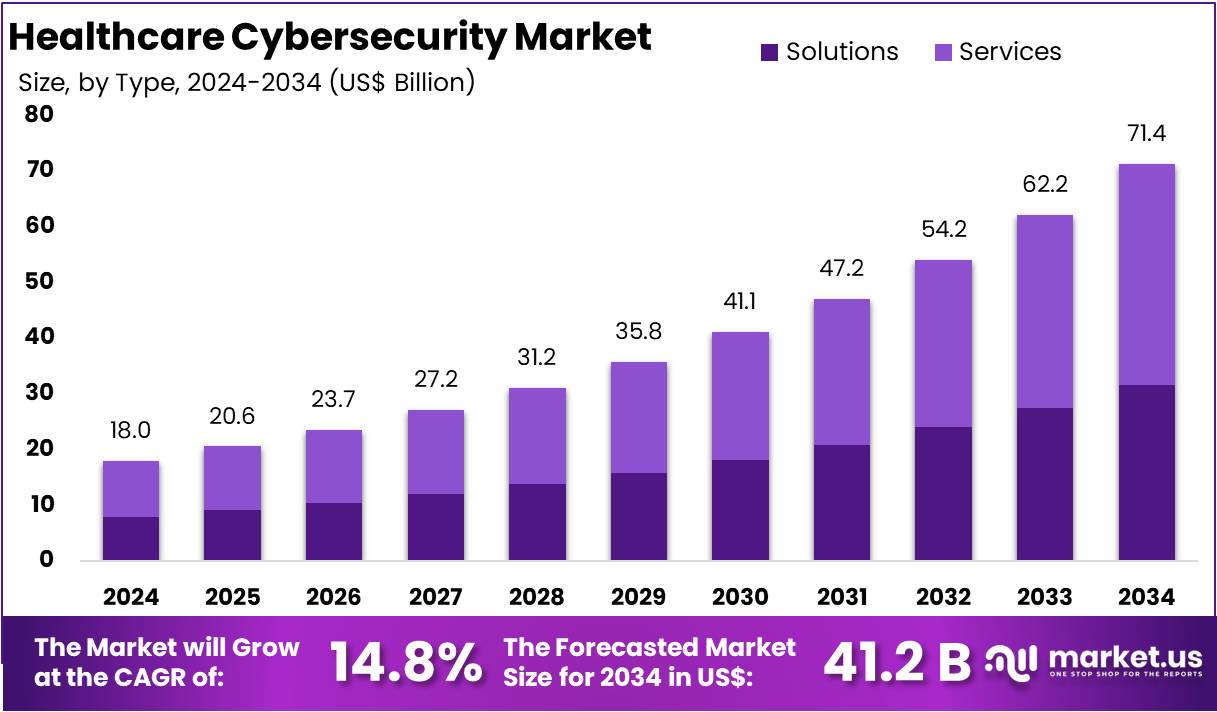
The Healthcare Cybersecurity Market size is expected to be worth around US$ 71.36 billion by 2034 from US$ 17.95 billion in 2024, growing at a CAGR of 14.8% during the forecast period 2025 to 2034.
The Global Healthcare Cybersecurity Market is experiencing rapid growth as healthcare organizations strengthen their defenses against increasingly sophisticated cyber threats targeting sensitive patient data and critical healthcare infrastructure. Healthcare cybersecurity includes solutions and services designed to protect electronic health records (EHRs), hospital networks, connected medical devices, cloud platforms, and digital healthcare systems from ransomware, malware, phishing, data breaches, and other cyberattacks.
The growing adoption of telehealth, cloud computing, Internet of Medical Things (IoMT) devices, artificial intelligence, and digital health platforms has significantly expanded the healthcare sector’s digital ecosystem, increasing the need for robust cybersecurity measures. Rising regulatory requirements for patient data privacy, expanding investments in healthcare IT infrastructure, and greater awareness of cyber resilience are further driving market growth.
Healthcare providers are increasingly implementing advanced technologies such as identity and access management, endpoint protection, network security, encryption, and cloud security solutions to safeguard critical information and ensure uninterrupted clinical operations. According to market estimates, the Healthcare Cybersecurity Market is projected to grow from US$ 17.95 billion in 2024 to approximately US$ 71.36 billion by 2034, registering a compound annual growth rate (CAGR) of 14.8% during the forecast period from 2025 to 2034. As digital transformation accelerates across healthcare, cybersecurity will remain a fundamental pillar of secure, connected, and patient-centric healthcare delivery
Click here for more information: https://market.us/report/alternative-and-complementary-medicine-market/
Key Takeaways
- The global Healthcare Cybersecurity Market generated US$ 9.5 billion in revenue in 2024 and is projected to reach US$ 71.36 billion by 2034, expanding at a CAGR of 14.8% during the forecast period. (Note: The original figure of US$ 95 billion appears inconsistent with the projected value of US$ 71.36 billion. This rewrite assumes the intended value is US$ 9.5 billion.)
- By type, the market is segmented into solutions and services. The services segment dominated the market in 2024, accounting for 55.6% of the total market share.
- Based on solution type, the market is categorized into Identity and Access Management (IAM), Data Loss Prevention (DLP), Antivirus and Antimalware, Log Management and SIEM, Firewall, Encryption and Tokenization, Compliance and Policy Management, Patch Management, and Others. Among these, Identity and Access Management (IAM) led the market with a 19.7% share.
- By threat, the market is segmented into Malware, Advanced Persistent Threats (APT), Distributed Denial of Service (DDoS), Spyware, Phishing, Ransomware, and Others. The Malware segment held the largest market share of 25.9%.
- In terms of security, the market is divided into Network Security, Endpoint Security, Cloud Security, and Application Security. The Network Security segment accounted for the largest share, representing 30.5% of the market in 2024.
- Based on deployment mode, the market is bifurcated into On-Premises and Cloud-Based. The On-Premises segment dominated the market in 2024, capturing 56.8% of the total market share.
- By end user, the market includes Hospitals and other healthcare organizations. The Hospitals segment led the market, accounting for 40.2% of the total revenue share.
- North America dominated the global healthcare cybersecurity market, securing a 30.0% market share in 2023.
Key Market Segments
By Type
- Solutions
- Services
By Solution Type
- Identity and Access Management (IAM)
- Data Loss Prevention (DLP)
- Antivirus and Antimalware
- Log Management and SIEM
- Firewall
- Encryption and Tokenization
- Compliance and Policy Management
- Patch Management
- Others
By Threat
- Malware
- Advanced Persistent Threats (APT)
- Distributed Denial of Service (DDoS)
- Spyware
- Phishing
- Ransomware
- Others
By Security
- Network Security
- Endpoint Security
- Cloud Security
- Application Security
By Deployment Mode
- On-Premises
- Cloud-Based
By End-User
- Hospitals
- Pharmaceutical Companies
- Health Insurance Providers
- Clinical Laboratories
- Government Healthcare Agencies
- Research Institutions
- Telehealth and Digital Health Providers
Market Key Players
- Symantec
- Kaspersky
- Northrop Grumman
- Palo Alto Networks
- Fortinet
- McAfee
- Cisco Systems
- Check Point Software Technologies
- IBM
- Trend Micro
- CrowdStrike
- FireEye
- NortonLifeLock
- Barracuda Networks
- Proofpoint
- Sophos
- Cloudflare
- Microsoft
- Other Prominent Players
Market Dynamics
Driver
The increasing number of cyberattacks targeting healthcare organizations is a major driver of the healthcare cybersecurity market. Hospitals, insurers, laboratories, and pharmaceutical companies manage vast amounts of sensitive patient information, making them attractive targets for cybercriminals. According to the U.S. Department of Health and Human Services (HHS) Office for Civil Rights, healthcare data breaches affecting 500 or more individuals have continued to occur at high levels each year, exposing millions of patient records. The Federal Bureau of Investigation (FBI) and the Cybersecurity and Infrastructure Security Agency (CISA) have repeatedly warned that ransomware attacks against healthcare facilities can disrupt patient care and critical medical operations. Increasing adoption of electronic health records (EHRs), connected medical devices, cloud computing, and telehealth services has expanded the digital attack surface. The World Health Organization (WHO) has also emphasized the need for stronger cybersecurity in digital health systems as healthcare becomes increasingly connected. These factors are driving healthcare providers to invest in advanced security technologies, identity management, threat detection, encryption, and incident response solutions to protect patient information and maintain uninterrupted clinical services.
Trend
A significant trend shaping the healthcare cybersecurity market is the adoption of Zero Trust Architecture (ZTA) and artificial intelligence (AI)-powered cybersecurity solutions. The U.S. Cybersecurity and Infrastructure Security Agency (CISA) and the National Institute of Standards and Technology (NIST) recommend Zero Trust principles that require continuous identity verification, least-privilege access, and ongoing monitoring rather than assuming users or devices are trustworthy. Healthcare organizations are implementing multi-factor authentication, identity and access management (IAM), endpoint detection, and cloud security platforms to reduce cyber risks. AI and machine learning are increasingly being used to detect unusual network behavior, identify malware, automate threat analysis, and accelerate incident response. According to IBM's Cost of a Data Breach Report, organizations using AI-enabled security and automation generally experience faster breach identification and lower response costs. As hospitals continue adopting cloud-based electronic health records, Internet of Medical Things (IoMT) devices, and remote healthcare services, AI-driven cybersecurity and Zero Trust frameworks are becoming essential components of modern healthcare IT infrastructure.
Restraint
One of the primary restraints affecting the healthcare cybersecurity market is the high cost of implementing comprehensive security infrastructure and the global shortage of qualified cybersecurity professionals. Healthcare providers, particularly small hospitals and rural clinics, often operate under limited IT budgets while managing increasingly sophisticated cyber threats. According to the National Institute of Standards and Technology (NIST), effective cybersecurity requires continuous investment in risk assessments, employee training, security monitoring, encryption, software updates, and incident response capabilities. The International Information System Security Certification Consortium (ISC2) has reported a global cybersecurity workforce shortage involving millions of professionals, making recruitment and retention increasingly difficult across healthcare organizations. Legacy healthcare information systems and outdated medical devices also complicate cybersecurity upgrades because many were not originally designed with modern security features. Integrating new cybersecurity technologies with existing hospital infrastructure often requires substantial financial investment and specialized technical expertise. These challenges can delay cybersecurity modernization projects, increase operational complexity, and limit adoption among smaller healthcare providers despite growing regulatory expectations and rising cyber threats.
Opportunity
Expanding government investment in healthcare cybersecurity presents significant opportunities for market growth. Governments worldwide are strengthening cybersecurity regulations and funding initiatives to protect healthcare infrastructure from evolving cyber threats. In the United States, the U.S. Department of Health and Human Services (HHS) introduced the Healthcare and Public Health Sector Cybersecurity Performance Goals (CPGs) to encourage healthcare organizations to adopt essential cybersecurity practices such as multi-factor authentication, regular backups, vulnerability management, and network segmentation. The Cybersecurity and Infrastructure Security Agency (CISA) also provides cybersecurity assessments, threat intelligence, and incident response resources for healthcare providers. The European Union's NIS2 Directive further strengthens cybersecurity requirements for essential sectors, including healthcare, encouraging greater investment in cyber resilience. Growing adoption of cloud computing, telemedicine, wearable devices, and Internet of Medical Things (IoMT) technologies is increasing demand for advanced security solutions. As governments continue funding digital health transformation and strengthening cybersecurity standards, opportunities will expand for providers of cloud security, endpoint protection, identity management, security operations centers, managed detection and response services, and healthcare-specific cybersecurity platforms.
Conclusion
The Healthcare Cybersecurity Market is poised for strong growth as healthcare organizations continue to prioritize the protection of sensitive patient data and critical digital infrastructure against evolving cyber threats. The market is projected to expand from US$ 17.95 billion in 2024 to approximately US$ 71.36 billion by 2034, registering a robust CAGR of 14.8% during the forecast period. Rising adoption of electronic health records (EHRs), cloud computing, telehealth platforms, connected medical devices, and artificial intelligence is increasing the need for advanced cybersecurity solutions across the healthcare sector. Additionally, stricter regulatory requirements, growing investments in healthcare IT, and the increasing frequency of ransomware and data breach incidents are expected to further accelerate market growth. As healthcare systems worldwide continue their digital transformation, demand for identity and access management, network security, cloud protection, endpoint security, and threat detection solutions will remain strong. The healthcare cybersecurity market is therefore expected to play a critical role in ensuring secure, resilient, and compliant healthcare operations while supporting the continued advancement of digital healthcare services globally.