


Report Overview
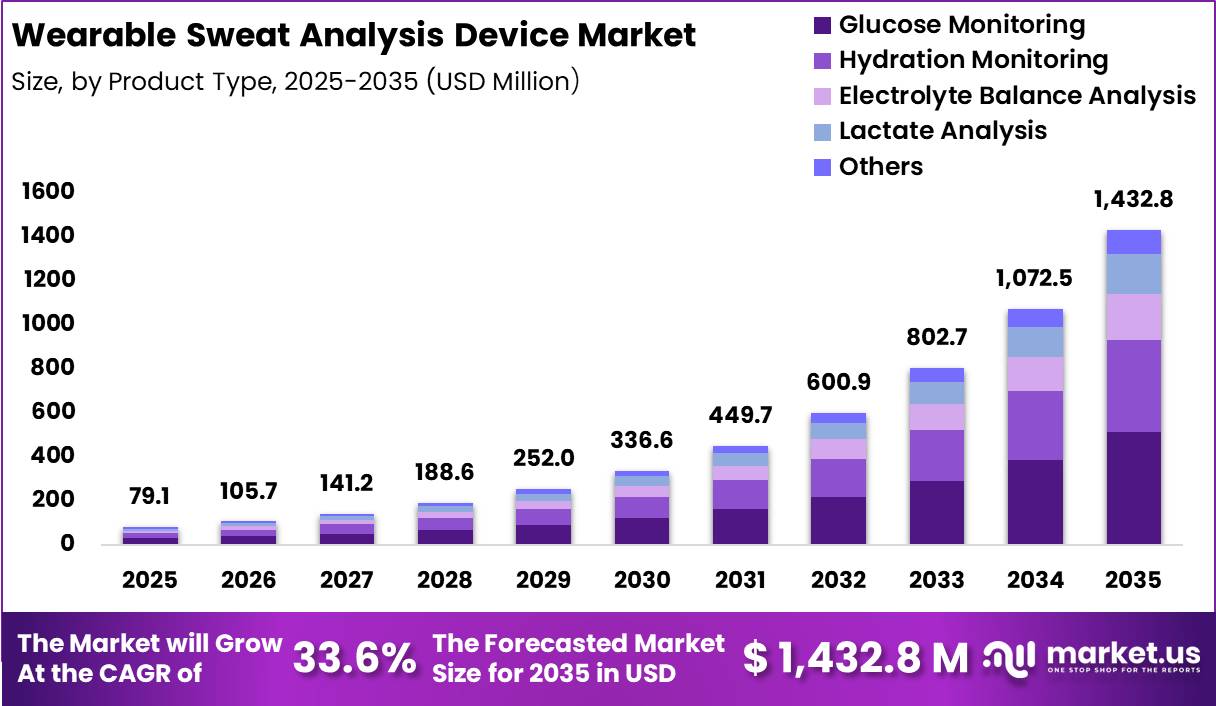
Global Wearable Sweat Analysis Device Market size is expected to be worth around US$ 1432.8 Million by 2035 from US$ 79.1 Million in 2025, growing at a CAGR of 33.6% during the forecast period from 2026 to 2035. In 2025, North America led the market, achieving over 42.2% share with a revenue of US$ 33.4 Million.
The global Wearable Sweat Analysis Device Market is gaining strong momentum as demand for continuous, non-invasive health monitoring continues to rise. Wearable sweat analysis devices use advanced biosensors to measure biomarkers such as electrolytes, glucose, lactate, pH, and hydration levels through perspiration, providing real-time physiological insights without the need for blood sampling. These devices are increasingly being adopted in healthcare, sports medicine, fitness, military, and research applications to monitor hydration, metabolic health, and physical performance. Growing awareness of preventive healthcare, the expansion of wearable medical technologies, and advances in flexible electronics and wireless connectivity are driving market growth. Manufacturers are developing lightweight, skin-friendly, and highly accurate sensor platforms that integrate with smartphones and cloud-based health monitoring systems, enabling personalized health tracking and remote patient management. Rising investments in digital health, biosensor innovation, and personalized medicine are further supporting market expansion. North America holds a significant share of the market due to its advanced healthcare ecosystem, strong research activities, and early adoption of wearable technologies, while Asia-Pacific is expected to witness rapid growth driven by increasing healthcare spending, expanding consumer adoption of smart wearables, and ongoing technological innovation. The market is poised for sustained growth as demand for real-time, data-driven health monitoring continues to increase worldwide.
Click here for more information: https://market.us/report/wearable-sweat-analysis-device-market/
Key Takeaways
- Market Size: The global Wearable Sweat Analysis Device Market is projected to grow from US$ 79.1 million in 2025 to approximately US$ 1,432.8 million by 2035.
- Market Growth: The market is anticipated to expand at a robust CAGR of 33.6% during the forecast period from 2026 to 2035.
- Product Type Analysis: Patches emerged as the leading product segment, accounting for 48.3% of the global market share in 2025.
- Analysis Type Analysis: Glucose monitoring dominated the market by analysis type, capturing 35.8% of the total market share in 2025.
- Application Analysis: Chronic disease diagnosis and monitoring represented the largest application segment, holding 35.7% of the market share in 2025.
- End User Analysis: Individual users led the end-user segment with a 42.8% market share in 2025, reflecting growing adoption of wearable health monitoring technologies.
- Regional Analysis: North America held the dominant regional position in 2025, accounting for over 42.2% of the global market and generating approximately US$ 33.4 million in revenue.
Key Market Segments
By Product Type
- Patches
- Wristbands
- Headbands
- Smartwatches
By Analysis Type
- Glucose Monitoring
- Hydration Monitoring
- Electrolyte Balance Analysis
- Lactate Analysis
- Others
By Application
- Drug Abuse Testing
- Athletic Quality and Performance Monitoring
- Chronic Disease Diagnosis and Monitoring
- Clinical Trials
- Others
By End User
- Hospitals
- Clinics
- Sports and Fitness Centers
- Individual Users
- Others
Market Key Players
- Abbott Laboratories
- Dexcom, Inc.
- Epicore Biosystems, Inc.
- Enfucell Oy
- Gatorade (Kenvue Inc.)
- Nanjing Ocean Optics Technology Co., Ltd.
- Life Science Biosensor Diagnostics S.L.
- Siren Care, Inc.
- Mio Global
- Novelda AS
- Nanshan Group
- Shandong Yuyan Electronic Technology
- Prism Materials
- Eccrine Systems, Inc.
- The Procter & Gamble Company
- Others
Market Dynamics
Driver
The increasing focus on continuous health monitoring and preventive healthcare is a major driver of the wearable sweat analysis device market. Sweat contains important biomarkers such as sodium, potassium, chloride, glucose, lactate, cortisol, and pH, enabling non-invasive monitoring of hydration, electrolyte balance, stress, and metabolic health. According to the U.S. Centers for Disease Control and Prevention (CDC), approximately 38.4 million Americans are living with diabetes, while the World Health Organization (WHO) estimates that over 1.28 billion adults aged 30–79 years have hypertension. These chronic conditions require regular monitoring, encouraging demand for wearable biosensors. Additionally, the WHO reports that 31% of adults worldwide do not achieve recommended physical activity levels, increasing the need for wearable technologies that support fitness and health management. Advances in flexible electronics, microfluidics, and biosensor technology have improved the accuracy and comfort of sweat-monitoring devices. Government initiatives promoting digital health and remote patient monitoring further strengthen market growth. The growing elderly population and increasing adoption of personalized healthcare solutions are expected to support sustained demand for wearable sweat analysis devices across medical, sports, and wellness applications.
Trend
A significant trend in the wearable sweat analysis device market is the integration of artificial intelligence (AI), wireless connectivity, and digital health platforms. Modern sweat analysis devices increasingly transmit real-time physiological data to smartphones, cloud platforms, and healthcare providers, enabling continuous monitoring and personalized health insights. The U.S. Food and Drug Administration (FDA) has expanded guidance for digital health technologies and Software as a Medical Device (SaMD), supporting innovation in connected healthcare. According to the Office of the National Coordinator for Health Information Technology (ONC), digital health adoption continues to expand as healthcare providers increasingly utilize electronic health information systems. Researchers are also developing wearable patches capable of simultaneously measuring multiple biomarkers, including glucose, lactate, cortisol, and electrolytes. Integration with AI algorithms enables predictive analysis, early detection of dehydration, fatigue, and metabolic disorders. Sports organizations, military agencies, and healthcare institutions are actively evaluating wearable biosensors for performance optimization and patient monitoring. These technological advancements are improving clinical utility while supporting the broader transition toward personalized, data-driven healthcare and remote monitoring systems worldwide.
Restraint
Despite promising technological advances, the wearable sweat analysis device market faces challenges related to sensor accuracy, biomarker variability, and limited clinical validation. Sweat composition varies considerably depending on temperature, exercise intensity, hydration status, age, and individual physiology, making standardized interpretation difficult. According to the National Institutes of Health (NIH), additional clinical studies are required to establish reliable correlations between sweat biomarkers and blood-based diagnostic measurements for many diseases. Device calibration, contamination from skin surfaces, and inconsistent sweat production can also reduce measurement reliability. Furthermore, many wearable sweat sensors remain in research or early commercialization stages and require extensive regulatory evaluation before widespread medical adoption. Regulatory agencies such as the FDA require evidence demonstrating safety, analytical performance, and clinical effectiveness before approving diagnostic devices. High manufacturing costs for advanced biosensors, flexible electronics, and microfluidic systems further limit accessibility, particularly in low- and middle-income countries. These scientific, regulatory, and cost-related barriers may slow commercialization and delay broader integration of wearable sweat analysis devices into routine clinical practice despite increasing research activity.
Opportunity
The wearable sweat analysis device market presents substantial opportunities through expanding applications in sports medicine, remote healthcare, occupational safety, and chronic disease management. According to the World Health Organization (WHO), the global population aged 60 years and older will reach approximately 2.1 billion by 2050, increasing demand for remote monitoring technologies that reduce hospital visits. The CDC reports that 6 in 10 adults in the United States have at least one chronic disease, highlighting the need for convenient, continuous physiological monitoring. Sweat-based wearable devices can help assess hydration, electrolyte balance, medication response, and physiological stress without invasive blood sampling. Government investments in telehealth infrastructure and digital health transformation are supporting broader adoption of connected medical devices. Researchers are also exploring sweat biomarkers for monitoring kidney disease, cystic fibrosis, infectious diseases, and cardiovascular health. Emerging partnerships between medical device manufacturers, universities, and healthcare institutions are accelerating product development. As sensor sensitivity improves and clinical validation expands, wearable sweat analysis devices are expected to become valuable tools for personalized medicine, preventive healthcare, athletic performance monitoring, and decentralized healthcare delivery worldwide.
Conclusion
The global Wearable Sweat Analysis Device Market is poised for steady growth as healthcare systems increasingly adopt non-invasive, real-time monitoring technologies. Rising demand for personalized healthcare, chronic disease management, sports performance tracking, and remote patient monitoring continues to drive innovation in wearable biosensors. Advances in flexible electronics, AI integration, and digital health platforms are expanding the clinical and consumer applications of sweat analysis devices. Although challenges such as sensor accuracy, clinical validation, and regulatory approvals remain, ongoing research and government support for digital health are expected to strengthen market adoption. As technology matures and healthcare providers seek more convenient diagnostic solutions, wearable sweat analysis devices are likely to play an increasingly important role in preventive healthcare and continuous physiological monitoring.