


Overview
The Chemical Bonded Nonwoven Market is gaining momentum due to increasing industrial and consumer applications. The market was valued at USD 52.4 billion in 2025 and is expected to reach USD 83.5 billion by 2035, growing at a CAGR of 4.8%. Asia Pacific led the market in 2025 with a 40.1% share and USD 20.99 billion revenue. Expanding demand for hygiene, medical, and filtration applications is supporting future market development.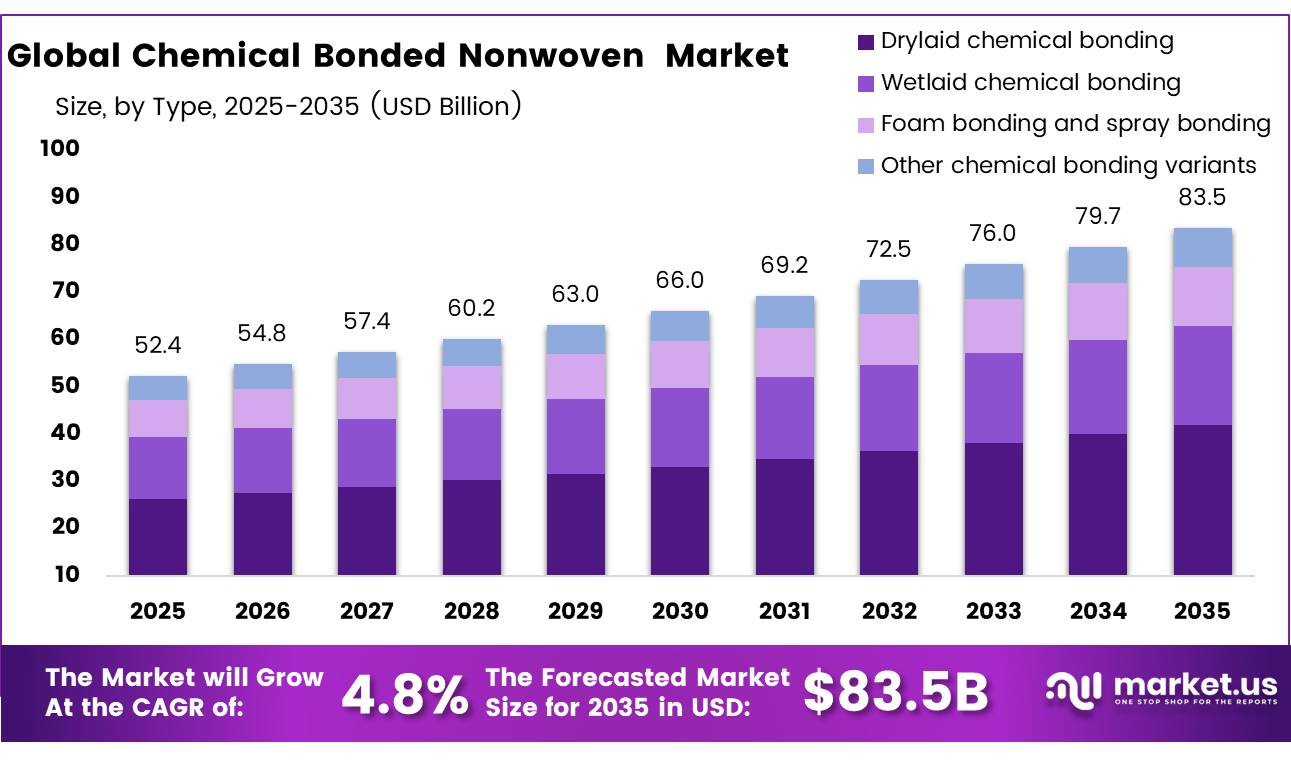
Key Takeaways
- The Chemical Bonded Nonwoven Market was valued at USD 52.4 billion in 2025.
- The market is projected to grow at a CAGR of 4.8% and reach USD 83.5 billion by 2035.
- Based on type, Drylaid Chemical Bonding dominated the market with a 50.1% share.
- Based on material, Polypropylene dominated the market with around 45.1% share.
- Among applications, Hygiene Products held the largest share with 40.2% of the market.
- Among end uses, Hygiene and Personal Care accounted for around 40.3% of revenue.
- In 2025, Asia Pacific was the leading region, accounting for 40.1% of global consumption.
- Increasing demand for disposable hygiene products, medical-grade nonwovens, and filtration materials continues to support market expansion.
Type Analysis
Drylaid Chemical Bonding represents the dominant segment in the Chemical Bonded Nonwoven Market, accounting for 50.1% market share and reaching around USD 26.2 billion by 2025. The segment benefits from established airlaid and carding lines, high-speed binder saturation, and latex application technologies. Around 65% of global disposable hygiene nonwovens are produced using drylaid chemical bonding due to its flexibility in fiber mixing and efficient processing speeds. Major companies including Berry Global, Kimberly-Clark, and Avgol Nonwovens operate large-scale drylaid production lines with speeds exceeding 800 m/min. The maturity of drylaid processes and availability of cost-effective polypropylene and polyester fibers support continued dominance through 2035.
Material Analysis
Polypropylene dominates the material category in the Chemical Bonded Nonwoven Market, holding approximately 45.1% share. Its popularity is attributed to its low density, moisture resistance, compatibility with drylaid and wetlaid processes, and lower cost compared with polyester and specialty fibers.
Global polypropylene fiber production exceeded 8.3 million metric tons in 2024, ensuring sufficient raw material availability for nonwoven manufacturers. The hydrophobic properties of polypropylene make it suitable for outer layers and acquisition layers in diaper cores, feminine hygiene pads, and adult incontinence disposables.
Application Analysis
Hygiene Products represent the largest application segment in the Chemical Bonded Nonwoven Market, capturing 40.2% share. This dominance is supported by consistent demand for disposable diapers, feminine hygiene pads, adult incontinence products, and wet wipes across developed and emerging markets. Medical Products represent the fastest-growing application segment due to rising demand for surgical drapes, isolation gowns, wound dressings, and hospital bed linen. Filtration Media maintains a significant share through applications in industrial air filtration and water treatment. Automotive Interiors and Components continue expanding with increasing vehicle production and soundproofing requirements.
End Use Analysis
Hygiene and Personal Care represent the leading end-use segment in the Chemical Bonded Nonwoven Market, accounting for 40.3% of revenue. Growth is supported by continuous demand for diapers, feminine care pads, adult incontinence products, and wet wipes. The estimated birth population in Africa and South Asia aged between 0-4 years is projected to reach 750 million by 2030, while premiumization trends in urban Asia Pacific markets after 2028 further support demand.
Key Market Segments
By Type
- Drylaid Chemical Bonding
- Wetlaid Chemical Bonding
- Foam Bonding and Spray Bonding
- Other Chemical Bonding Variants
By Material
- Polypropylene
- Polyester
- Polyethylene
- Rayon or Viscose
- Other fibers such as cotton or blends
By Application
- Hygiene Products
- Medical Products
- Filtration Media
- Automotive Interiors and Components
- Construction and Industrial Uses
By End Use
- Hygiene and Personal Care
- Medical and Healthcare
- Automotive
- Building and Construction
- Industrial and Household Products
Driving Factors
The major growth driver for the Chemical Bonded Nonwoven Market is the increasing demand for disposable personal hygiene products, including baby diapers, adult incontinence pads, sanitary napkins, and wipes. These materials play important roles as acquisition-distribution layers (ADL), coverstock, and absorbent cores. The hygiene nonwoven segment is projected to grow at a CAGR of over 6% through 2028, while India’s nonwoven market generated USD 1.5 billion in 2024 and is expected to reach USD 2.3 billion by 2030 at a 7.6% CAGR.
Other significant drivers include expanding healthcare and medical nonwoven applications, increasing demand for industrial filtration, stricter air quality regulations, infrastructure development, sustainability initiatives, and rising adoption of lightweight materials in automotive applications.
Restraining Factors
The Chemical Bonded Nonwoven Market faces challenges from increasing VOC and chemical emission regulations, particularly across Europe, North America, and China. Compliance requirements related to binder chemistries and emission control systems increase operational costs for manufacturers.
Additional restraints include petrochemical binder price volatility, including PP, SB Latex, and Acrylic, which impacts production costs globally. Rising trade tariffs, low-cost overcapacity in Asia Pacific, biodegradable bonding technology substitution, and high capital requirements for modernization also create pressure on manufacturers. Regulatory compliance and emission control investments may delay expansion activities and innovation cycles, affecting market growth between 2026 and 2030.
Growth Opportunity
The development of bio-based and sustainable binder platforms represents a major opportunity in the Chemical Bonded Nonwoven Market. Bio-binder penetration remains below 8% of total binder volume, creating an estimated market opportunity gap of approximately USD 600–900 million by 2030. Regulatory developments such as EU PPWR and REACH SVHC restrictions are increasing demand for sustainable alternatives. Bio-acrylic and PLA-compatible binders, which can command 25–40% premiums over petroleum-based equivalents, provide opportunities for manufacturers to establish long-term supply agreements and expand sustainable product offerings.