


Overview
Power Transformer Market is experiencing steady growth, supported by infrastructure investments and energy transition initiatives. The market stood at USD 26.5 billion in 2025 and is expected to reach USD 47.0 billion by 2035, progressing at a 5.9% CAGR. Asia Pacific remained the leading regional market with a 41.8% share and USD 11.05 billion revenue. Demand is increasing due to transmission upgrades and renewable energy integration requirements.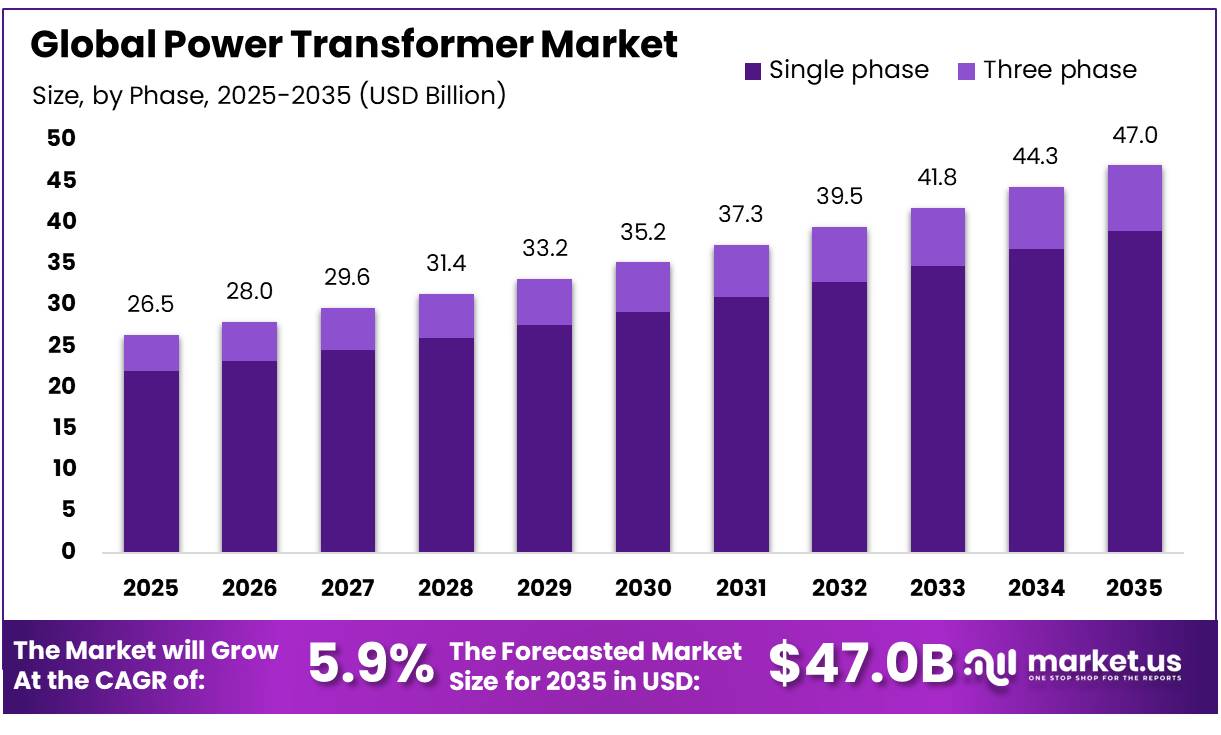
Key Takeaways
- The global Power Transformer Market was valued at USD 26.5 billion in 2025.
- The market is expected to expand at a CAGR of 5.9% and reach USD 47.0 billion by 2035.
- Medium power transformers held the leading position with a 50.1% market share.
- Oil cooled transformers dominated the cooling segment, accounting for 75.2% of the market.
- Single phase transformers represented the largest phase category with an 83.1% share.
- Utilities transmission and distribution led end-use demand, capturing 50.5% of the market.
- Asia Pacific remained the largest regional market with a 41.8% share.
Power Rating Analysis
Medium power transformers represented the dominant segment of the Power Transformer Market, accounting for 50.1% of global demand. These transformers are extensively deployed in regional substations and primary distribution networks where transmission voltages ranging from 66 kV to 220 kV are reduced for sub-transmission applications. Their ability to balance power-handling capacity with cost efficiency has strengthened their market leadership.
Small power transformers, typically rated up to 60 MVA, are emerging as a significant growth area. Their adoption is increasing alongside distributed renewable energy projects, battery energy storage installations, and localized microgrid modernization efforts. However, supply-chain disruptions and shortages of grain-oriented electrical steel (GOES) continue to create short-term challenges for manufacturers and utilities.
Cooling Type Analysis
Oil cooled transformers accounted for 75.2% of the market and maintained leadership due to superior thermal dissipation and dielectric insulation performance under high-voltage operating conditions. Mineral and synthetic oils provide both cooling and electrical insulation, making these systems highly suitable for outdoor substations and high-capacity transmission applications.
Air cooled or dry type transformers are expected to record the fastest growth. Demand is being supported by stricter fire safety regulations, expanding urban infrastructure, underground transportation systems, high-rise buildings, and industrial facilities. Interest in environmentally responsible transformer solutions is also increasing through the adoption of biodegradable ester fluids and smart monitoring technologies that provide real-time operational and health data.
Phase Analysis
Single phase transformers held an overwhelming 83.1% market share, making them the dominant phase configuration in the industry. Their widespread deployment is supported by extensive rural electrification programs, residential power distribution systems, and suburban electricity networks. These transformers remain a cost-effective solution for local voltage transformation where large-scale industrial infrastructure is not required.
Their continued adoption reflects the importance of dependable low-voltage power delivery across residential and light-commercial applications.
End Use Analysis
Utilities transmission and distribution emerged as the leading end-use segment with a 50.5% market share. Utility operators play a central role in transmitting electricity from generation sources to consumption centers while maintaining grid reliability and stability. Significant investments are being directed toward replacing aging infrastructure, upgrading substations, and developing long-distance high-voltage transmission networks.
Growth is also supported by the integration of large-scale renewable energy projects, including wind and solar farms, which require substantial deployment of high-capacity transformer systems.
The industrial sector is anticipated to be the fastest-growing application area. Industries such as manufacturing, mining, and heavy processing increasingly require medium- and high-voltage transformers to support automation initiatives, electrification programs, and the expansion of domestic production facilities.
Key Market Segments
By Power Rating
- Medium power transformers
- Small power transformers
- Large power transformers
By Cooling Type
- Oil cooled
- Air cooled or dry type
By Phase
- Single phase
- Three phase
By End User
- Utilities transmission and distribution
- Industrial
- Commercial and residential
- Power generation and renewable projects
- Data centers and other specialized loads
Driving Factors
A major growth driver for the market is the expansion of renewable energy evacuation infrastructure and HVDC corridors. Large-scale wind and solar projects are increasingly located far from consumption centers, creating demand for new transmission networks and advanced transformer systems. The International Energy Agency (IEA) has emphasized the need for significant grid reinforcement to support energy transitions, while European Union grid initiatives continue to address infrastructure bottlenecks that restrict renewable integration.
In India, transmission capital expenditure planned through 2032 is estimated at nearly ₹9 trillion. Projects such as Hitachi Energy’s 950 km, 6 GW HVDC project connecting Rajasthan and Uttar Pradesh highlight the growing scale of transmission investments. These developments are driving demand for high-voltage and ultra-high-voltage transformers, advanced insulation technologies, cooling systems, and specialized engineering services.
Additional support comes from accelerating transmission and distribution investments, aging transformer replacement programs, increasing electricity demand from data centers and electric vehicle charging infrastructure, grid resilience projects, and the adoption of digital monitoring technologies.
Restraining Factors
One of the primary restraints affecting the market is the cost and complexity associated with efficiency-compliance redesign requirements. Regulatory standards require manufacturers to redesign products, conduct testing programs, modify sourcing strategies, and upgrade production facilities before achieving long-term benefits from improved efficiency.
The new United States efficiency rule scheduled to take effect in 2029 includes a five-year transition period and requires loss reductions of approximately 10–30% depending on transformer type and capacity. Compliance activities increase engineering workloads and certification requirements, creating challenges for smaller manufacturers.
Additional constraints include extended OEM lead times, limited availability of GOES/CRGO steel, inflation in copper, aluminum, and oil prices, permitting delays, and utility funding uncertainties that can affect project execution schedules.
Growth Opportunity
A significant opportunity exists within HVDC and offshore transmission specialization. While traditional grid expansion supports baseline market growth, higher-value opportunities are emerging in converter transformers, offshore platform installations, and hybrid interconnection projects that require advanced engineering, extensive testing, and strict qualification standards.
The IEA has highlighted rising global transmission investments across Europe, the United States, China, India, and parts of Latin America. Europe has established offshore renewable energy targets of 86–89 GW by 2030 and significantly larger ambitions extending to 2050. Projects such as HansaLink demonstrate growing demand for specialized offshore-HVDC transformer packages, creating opportunities for manufacturers capable of delivering advanced and highly engineered transformer solutions.