


Overview
Valued at USD 2.7 billion in 2025, the ROV Market is expected to achieve approximately USD 5.7 billion by 2035, growing at a 7.8% CAGR. The market benefits from growing deepwater operations, offshore renewable projects, and rising requirements for underwater inspection and maintenance. Europe accounted for more than 30.1% of the global market in 2025, generating USD 0.80 Billion in revenue.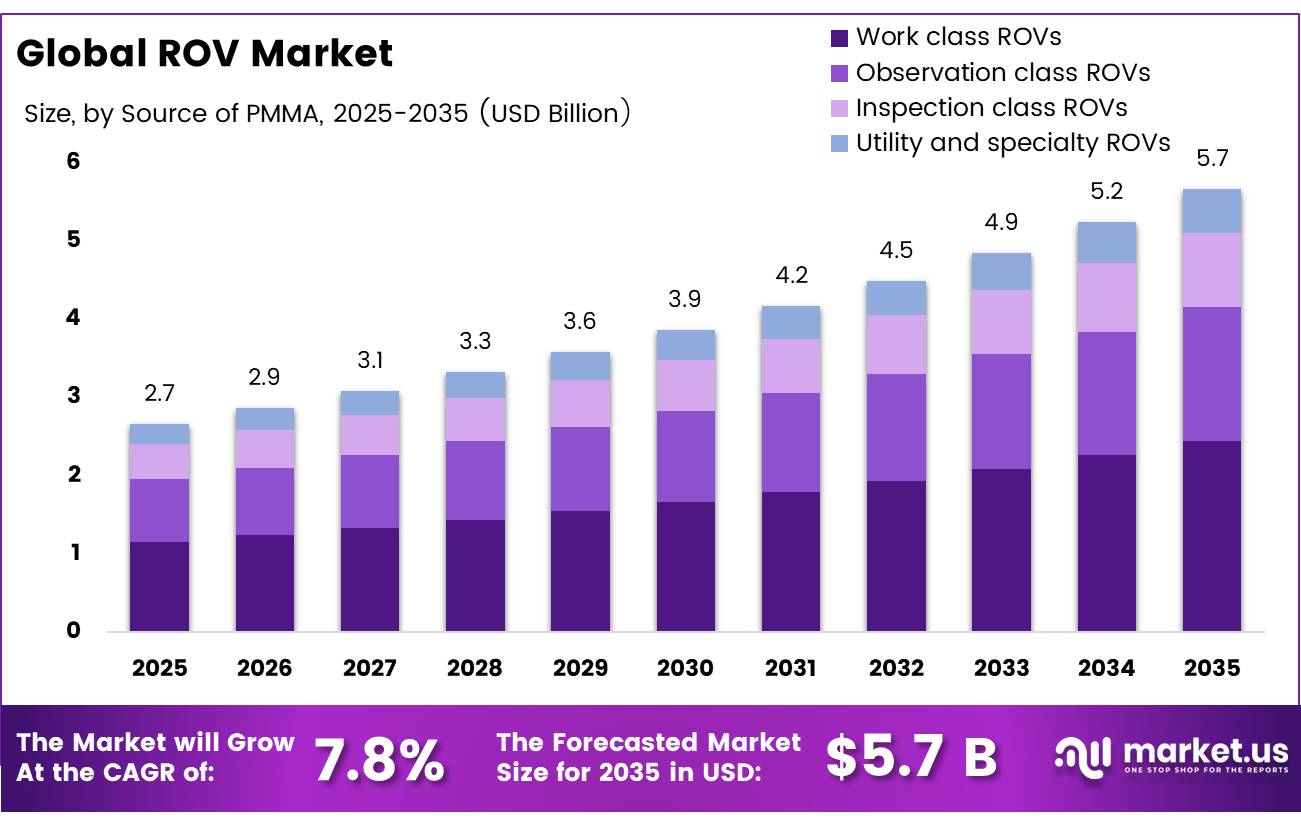 Click to explore more: https://market.us/reports/energy/
Key Takeaways
- The global ROV Market was valued at USD 2.7 billion in 2025.
- The market is forecast to reach USD 5.7 billion by 2035.
- The market is expected to expand at a CAGR of 7.8% during 2026–2035.
- Europe held the leading position in 2025, accounting for more than 30.1% of the market and generating USD 0.80 Billion in revenue.
- Work class ROVs accounted for 43.1% of the market by source type.
- Deep water ROVs represented 45.1% of the market by depth rating.
- Oil and gas remained the leading application segment with 48.7% market share.
- Vehicle control and navigation systems held 28.4% revenue share among packaging segments.
Analysis Sections
Source of PMMA Analysis
Work class ROVs held the largest market share of 43.1%, supported by their critical role in deepwater drilling, subsea intervention, and offshore asset maintenance. According to BOEM, offshore federal production reached approximately 668 million barrels of oil and 700 billion cubic feet of natural gas during FY 2024. As of April 2025, approximately 2,227 active OCS oil and gas leases covered 12.1 million acres, creating substantial demand for advanced subsea operations and heavy-duty ROV deployment.
Observation class ROVs are emerging as the fastest-growing category due to increasing offshore wind inspection activities. In 2024, BSEE conducted the first inspection of offshore wind turbines at the South Fork Wind project, the first commercial offshore wind facility in the United States with 130-megawatt capacity. This development established a framework for future visual inspection activities and increased demand for observation-class systems.
Depth Rating Analysis
Deep water ROVs accounted for 45.1% of the market, supported by growing subsea activities across major offshore production regions. According to the U.S. Energy Information Administration, crude oil production from the Federal Offshore Gulf of America averaged 1.77 million barrels per day in 2024 and is projected to reach 1.80 million b/d in 2025 and 1.81 million b/d in 2026. Additionally, 13 new field developments are expected between 2025 and 2026, supporting demand for deepwater ROV services.
Ultra deepwater ROVs represent the fastest-growing depth segment. The Whale field, operating in water depths exceeding 8,600 feet, began production in January 2025. Such developments are increasing the need for highly capable ROV systems designed for extreme subsea environments, inspection, intervention, and surveillance applications.
Application Analysis
The oil and gas segment dominated the market with a share of 48.7%. Offshore production infrastructure requires continuous inspection, maintenance, and intervention support. According to BOEM, offshore federal production reached approximately 668 million barrels of oil and 700 billion cubic feet of natural gas in FY 2024, supported by approximately 2,227 operational leases covering 12.1 million acres of the OCS. Offshore leasing activities generated more than USD 7 billion for the U.S. Treasury during FY 2024, while at least 30 lease sales are planned in the Gulf of America between 2025 and 2040.
Offshore wind and renewables represent the fastest-growing application segment. According to IRENA, global offshore wind capacity reached approximately 83 GW by 2024. The Global Offshore Wind Alliance has established a target of 2,000 GW of offshore wind capacity by 2050. Growing offshore renewable infrastructure requires extensive inspection, monitoring, and maintenance services, supporting increased deployment of ROV systems.
Packaging Analysis
Vehicle control and navigation systems accounted for the largest revenue share of 28.4%. These systems play a critical role in positioning, navigation accuracy, station-keeping, and operational efficiency during deepwater inspections and intervention activities. According to the U.S. Department of Energy, the offshore wind development pipeline in the United States reached 80,523 MW in 2024, representing growth of 53% compared with the previous year. Global offshore wind capacity also increased to 68,258 MW across 319 operating projects.
Vehicle cameras and lighting systems are expected to experience the fastest growth. Increasing demand for subsea inspection, environmental monitoring, offshore wind surveys, and underwater asset assessment is driving adoption of high-definition imaging and real-time monitoring technologies. Continued investments by organizations such as NOAA and BOEM further support growth in this segment.
Key Market Segments
By Source of PMMA
- Work class ROVs
- Observation class ROVs
- Inspection class ROVs
- Utility and specialty ROVs
By Depth Rating
- Deep water ROVs
- Ultra deepwater ROVs
- Shallow water ROVs
By Application Type
- Oil and gas
- Offshore wind and renewables
- Defense and security
- Scientific research and oceanography
- Subsea telecoms and utilities
- Other industrial uses
By Packaging
- Vehicle cameras and lighting systems
- Vehicle control and navigation systems
- Hydraulic tool control systems and manipulators
- Tether management systems
- Launch and recovery systems
- Other onboard sensors and payload
Driving Factors
Growing demand for subsea telecom and power cable inspection and repair services is supporting market expansion. Multiple cable disruptions across West Africa during March 2024 required repair vessel deployment, with restoration extending into April and May. Similarly, submarine cable outages in East Africa during May 2024 were restored by 3 June 2024, requiring nearly three weeks of repair operations.
Additional growth drivers include deepwater oilfield tiebacks and brownfield subsea IRM demand contributing approximately 2.10% to CAGR, offshore wind build-out and cable inspection activities contributing 1.70%, well-control and inspection compliance requirements contributing 1.20%, naval mine countermeasure and infrastructure protection spending contributing 1.40%, subsea telecom and power cable fault response expansion contributing 0.90%, and AI-enabled remote piloting and digital twin inspection technologies contributing 1.10%.
Restraining Factors
A shortage of skilled personnel remains a significant challenge for the market. Advanced offshore operations require highly trained pilot-technicians, survey engineers, supervisors, and offshore specialists. In 2026, published hiring benchmarks showed ROV pilot and technician day rates ranging from USD 350–600, while North Sea contract rates reached approximately GBP 300–700 per day. Obtaining DP certification may require 12–18 months, limiting workforce expansion and increasing operational costs.
Other restraints include vessel day-rate inflation with an estimated impact of -2.00% on CAGR, long-lead subsea components at -1.60%, skilled pilot shortages at -1.30%, compliance and certification requirements at -1.10%, offshore wind project delays at -1.40%, and tariff and electronics cost pass-through effects at -0.90%.
Growth Opportunity
Offshore Carbon Capture and Storage (CCS) monitoring is emerging as a significant future opportunity for the ROV Market. By February 2025, the Global CCS Institute reported 65 operational CCS facilities worldwide with 57 Mtpa capture capacity. An additional 42 projects under construction are expected to contribute 44 Mtpa. Europe alone had 13 facilities under development, supported by the EU Net-Zero Industry Act target of 50 million tonnes of CO₂ injection capacity annually by 2030. These projects are expected to generate demand for ROV-enabled baseline surveys, integrity monitoring, anomaly detection, and recurring offshore inspection services.