


Report Overview
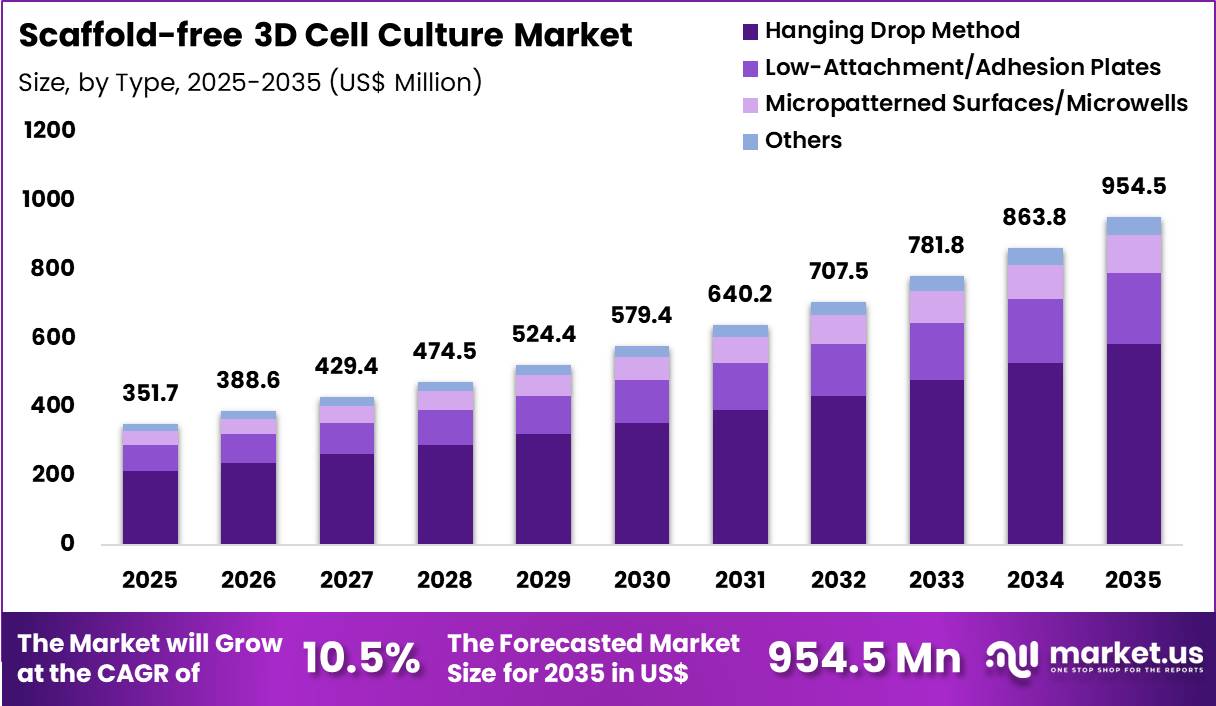
The Global Scaffold-free 3D Cell Culture Market size is expected to be worth around US$ 954.5 Million by 2035 from US$ 351.7 Million in 2025, growing at a CAGR of 10.5% during the forecast period 2026-2035. In 2025, North America led the market, achieving over 39.6% share with a revenue of US$ 139.3 Million.
Scaffold-free 3D Cell Culture is an advanced in vitro technology that enables cells to grow and interact in three-dimensional structures without the use of artificial support materials or scaffolds. By allowing cells to self-assemble into spheroids, organoids, and tissue-like aggregates, this approach more closely replicates the natural cellular environment found in living organisms compared to conventional two-dimensional (2D) cell culture methods.
The technology supports enhanced cell-to-cell communication, realistic nutrient and oxygen gradients, and physiologically relevant biological responses. As a result, scaffold-free 3D cultures provide improved predictive value for drug discovery, toxicity testing, cancer research, stem cell studies, and regenerative medicine applications.
Researchers increasingly rely on scaffold-free systems because they can better mimic tissue architecture and disease progression, leading to more reliable experimental outcomes. These models help bridge the gap between traditional laboratory studies and clinical research by generating data that is more representative of human biology.
Common scaffold-free techniques include hanging drop methods, low-adhesion culture plates, magnetic levitation, and bioreactor-based systems. These methods facilitate the formation of uniform cellular structures while reducing the influence of external materials on cellular behavior.
As demand grows for more accurate and ethical research models, scaffold-free 3D cell culture continues to gain momentum across the biotechnology, pharmaceutical, and academic sectors, supporting innovation in precision medicine and next-generation therapeutic development worldwide.
Click here for more information: https://market.us/report/global-scaffold-free-3d-cell-culture-market/
Key Takeaways
• The scaffold-free 3D cell culture market was valued at US$ 351.7 million in 2025 and is expected to reach US$ 954.5 million by 2035, growing at a CAGR of 10.5%.
• The hanging drop method dominated the type segment, holding a 61.3% market share in 2025.
• Stem cell research & tissue engineering led the application segment, accounting for 34.6% of the market.
• Biotechnology & pharmaceutical companies were the largest end-user segment, contributing 49.6% of total market revenue.
• North America emerged as the leading regional market, capturing 39.6% of the global market share.
Key Market Segments
By Type
- Hanging Drop Method
- Low-Attachment/Adhesion Plates
- Micropatterned Surfaces/Microwells
- Others (Magnetic Levitation, etc.)
By Application
- Stem Cell Research & Tissue Engineering
- Cancer Research
- Drug Development & Toxicity Testing
- Others
By End Use
- Biotechnology & Pharmaceutical Companies
- Academic & Research Institutes
- Hospitals
- Others
Market Key Players
- Thermo Fisher Scientific Inc.
- Merck KGaA
- Corning Incorporated
- InSphero AG
- Lonza Group AG
- Greiner Bio‑One International GmbH
- PromoCell GmbH
- Tecan Trading AG
Emerging Trends in the Scaffold-free 3D Cell Culture Market
• Researchers are increasingly using organoid-based scaffold-free 3D cultures to mimic human organs. The Human Cancer Models Initiative (HCMI) aims to develop up to 1,000 patient-derived cancer models, improving disease research and personalized treatment development.
• Regulatory agencies are encouraging alternatives to animal testing. In 2026, the U.S. FDA released draft guidance supporting New Approach Methodologies (NAMs), including organoids and 3D cell culture systems, to generate more human-relevant drug safety data.
• Advanced vascularized organoids are emerging as a major innovation. NIH-supported researchers recently developed mini-lung and intestinal organoids with functional blood vessels, helping scientists create more realistic tissue models for disease studies and drug screening.
• Integration of artificial intelligence with organoid research is expanding rapidly. New standardized organoid platforms are being designed to analyze more than 100,000 samples daily, improving scalability, reproducibility, and automated biological data analysis.
• Cancer research is shifting toward patient-derived organoids. The NCI Patient-Derived Models Repository has already developed over 220 matched model sets, enabling researchers to study tumor biology and treatment responses with higher clinical relevance.
Major Use Cases of Scaffold-free 3D Cell Culture
• Cancer drug development is a leading application. Patient-derived organoids preserve tumor heterogeneity and genomic stability, allowing researchers to evaluate treatment effectiveness more accurately before advancing therapies into clinical trials.
• Precision medicine programs use scaffold-free organoids to test individual patient responses to therapies. These models help identify effective treatment options and support the growing demand for personalized healthcare solutions.
• Stem cell and regenerative medicine research extensively rely on scaffold-free 3D cultures. Scientists use organoids to study tissue development, organ formation, and disease progression under conditions that closely resemble the human body.
• Drug toxicity testing is increasingly performed using 3D organoid systems. Studies show these models can remain viable for at least 28 days and detect toxic effects that traditional 2D cultures may fail to identify.
• Immunotherapy research is benefiting from advanced cancer organoids. Recent studies report more than 32,000 article accesses and over 235 citations for organoid-based tumor microenvironment research, highlighting strong scientific interest in this application.
conclusion: The Scaffold-free 3D Cell Culture Market is poised for significant growth, driven by increasing demand for advanced research models in drug discovery, cancer research, stem cell studies, and regenerative medicine. The technology’s ability to closely mimic human tissue environments makes it a valuable alternative to conventional 2D cultures and animal testing. With the market projected to grow from US$ 351.7 million in 2025 to US$ 954.5 million by 2035 at a CAGR of 10.5%, opportunities are expanding across biotechnology, pharmaceutical, and academic sectors. Continued innovation in organoids, AI-driven analysis, and precision medicine is expected to further accelerate market adoption worldwide.