


Report Overview
The Global 3D Neuroscience Market size is expected to be worth around US$ 65.5 Billion by 2035 from US$ 35.2 Billion in 2025, growing at a CAGR of 6.4% during the forecast period 2026-2035. In 2025, North America led the market, achieving over 38.5% share with a revenue of US$ 13.6 Billion.
3D Neuroscience is an emerging field that combines neuroscience, advanced imaging, artificial intelligence, and three-dimensional modeling to better understand the structure and function of the human brain. By creating detailed 3D visualizations of neural networks, researchers and medical professionals can study brain activity with greater accuracy and precision than traditional two-dimensional methods.
The technology supports breakthroughs in neurological research, medical education, brain disorder diagnosis, and treatment planning. Scientists use 3D neuroscience tools to explore conditions such as Alzheimer’s disease, Parkinson’s disease, epilepsy, traumatic brain injuries, and mental health disorders. These advanced models help improve patient outcomes by enabling earlier diagnosis and more personalized treatment strategies.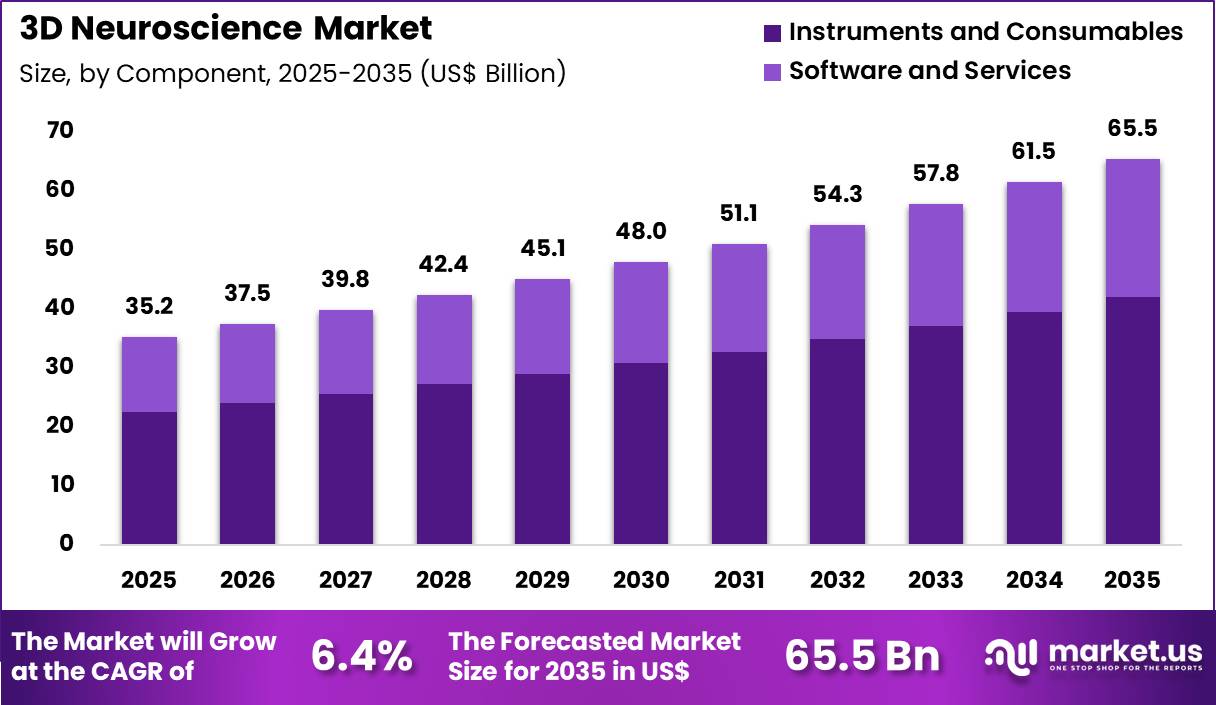
In addition to healthcare applications, 3D neuroscience contributes to innovation in virtual reality, robotics, neuroengineering, and cognitive science. Interactive 3D brain mapping also enhances academic training by providing students and healthcare professionals with realistic learning experiences.
As demand for precision medicine and advanced healthcare technologies continues to grow, 3D neuroscience is expected to play a significant role in the future of medical research and clinical practice. Experts believe the integration of digital neuroscience platforms will accelerate discoveries and transform the understanding of the human brain worldwide.
Click here for more information: https://market.us/report/3d-neuroscience-market/
Key Market Segments
By Component
Instruments & Consumables
Software & Services
By Technology
Brain Imaging
Neuro-Microscopy
Electrophysiology
Neuroproteomic Analysis
By Application
Drug Discovery & Lead Screening
Neurotoxicity & Safety Assessment
Disease Modelling
Others
By End-User
Hospitals
Diagnostic Laboratories
Research & Academic Institutes
Market Key Players
GE HealthCare
Thermo Fisher Scientific Inc.
Merck KGaA
Corning Incorporated
Doric Lenses Inc.
Neuronnexus Technologies Inc.
Axion BioSystems Inc.
STEMCELL Technologies Inc.
Emerging Trends in 3D Neuroscience
Growing Use of 3D Brain Imaging Technologies: Hospitals and research institutes are increasingly using 3D MRI and CT imaging to study brain structure and neurological disorders. According to WHO, neurological conditions affect more than 3 billion people globally, increasing demand for advanced brain imaging technologies and accurate diagnostics.
Integration of Artificial Intelligence in Neuroscience: lysis and disease detection speed. The U.S. FDA reported more than 1,000 AI-enabled medical devices approved for healthcare applications, with imaging and neurology among the fastest-growing areas in medical technology adoption.
Rising Focus on Early Detection of Brain Disorders: Healthcare providers are using 3D neuroscience tools for earlier diagnosis of Alzheimer’s disease, epilepsy, Parkinson’s disease, and stroke. WHO estimates neurological disorders cause nearly 11 million deaths annually, encouraging governments and hospitals to invest in advanced neurodiagnostic systems.
Expansion of Brain Mapping and Digital Brain Models: Research organizations are developing detailed 3D brain maps to better understand neural connections and brain functions. New studies using fMRI-based 3D reconstruction technologies are helping scientists analyze visual processing and damaged brain regions more accurately than traditional methods.
Increasing Investment in Neuroscience Research Infrastructure: Governments and academic institutes are expanding neuroscience research programs and neuroimaging facilities. WHO reports that neurological diseases are now the leading cause of disability worldwide, creating higher demand for advanced laboratories, neuroimaging equipment, and digital neuroscience platforms.
Key Use Cases of 3D Neuroscience
Brain Disorder Diagnosis and Monitoring: 3D neuroscience technologies are widely used to diagnose epilepsy, stroke, dementia, and traumatic brain injuries. Advanced imaging allows doctors to visualize affected brain regions in detail, improving treatment planning and patient monitoring in hospitals and diagnostic centers.
Drug Discovery and Neurological Research: Pharmaceutical companies use 3D brain models and neuroimaging tools to study how drugs affect brain activity. These technologies help researchers identify treatment targets faster and improve the development process for neurological and mental health therapies.
Neurosurgical Planning and Precision Treatment: Surgeons use 3D brain mapping before complex brain surgeries to identify critical neural pathways. This reduces surgical risks and improves accuracy during procedures involving tumors, epilepsy treatment, and deep brain stimulation therapies.
Medical Education and Training: Universities and healthcare institutions use interactive 3D brain visualization platforms for training students and neurologists. These tools provide realistic brain anatomy simulations, helping improve understanding of neurological structures and clinical decision-making skills.
Brain-Computer Interface and Cognitive Research: Researchers are using 3D neuroscience technologies to develop brain-computer interfaces for patients with disabilities. Advanced neural decoding and imaging systems support communication technologies, robotic control systems, and rehabilitation solutions for neurological patients.
Conclusion: The global 3D Neuroscience market is expected to witness strong growth due to rising demand for advanced brain imaging, neurological disease diagnosis, and precision medicine solutions. Increasing adoption of artificial intelligence, digital brain mapping, and neuroimaging technologies is supporting innovation across healthcare and research sectors. The growing prevalence of neurological disorders such as Alzheimer’s disease, epilepsy, and Parkinson’s disease is further accelerating market expansion. In addition, investments in neuroscience research infrastructure and medical education are creating new growth opportunities. With continuous technological advancements and increasing clinical applications, 3D neuroscience is expected to play a crucial role in transforming neurological research, diagnosis, and patient care worldwide.