


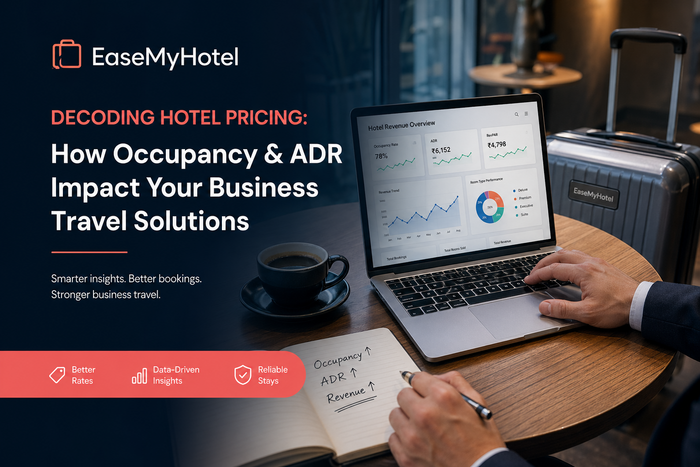
In today’s fast-evolving hospitality landscape, understanding hotel revenue management is no longer optional—it’s essential. For corporate travelers, travel managers, and hospitality professionals alike, decoding hotel pricing can unlock smarter decisions, optimized budgets, and better travel experiences.
At Ease My Hotel, we believe that mastering the dynamics behind pricing—especially occupancy rates and Average Daily Rate (ADR)—can transform the way businesses approach travel planning. This guide breaks down these concepts in a clear, actionable way while exploring how they directly impact your business travel solutions.
What is Hotel Revenue Management?
At its core, hotel revenue management is the strategic process of selling the right room to the right customer at the right time for the right price. It relies heavily on data analysis, demand forecasting, and pricing optimization.
This discipline integrates multiple factors such as dynamic pricing, demand forecasting, and market segmentation to maximize revenue while maintaining occupancy.
For business travelers, this means that the price you see today may not be the same tomorrow—and there’s a reason behind it.
Understanding Occupancy Rate: The Demand Driver
Occupancy rate refers to the percentage of available rooms that are actually sold during a given period. It is one of the most critical indicators in hotel revenue management.
Why Occupancy Matters
A high occupancy rate indicates strong demand, which often leads to higher room rates. Conversely, low occupancy pushes hotels to offer discounts or promotions.
For example:
During peak business seasons, hotels experience higher occupancy and increased rates.
During off-peak periods, hotels may lower prices to attract guests.
This is where yield management strategies come into play—balancing occupancy and pricing to achieve optimal revenue.
Impact on Business Travel
For companies managing travel budgets, understanding occupancy trends can help:
Predict price fluctuations
Book at optimal times
Avoid unnecessary expenses
Using booking optimization techniques can significantly reduce travel costs while maintaining quality.
Decoding ADR (Average Daily Rate)
ADR, or Average Daily Rate, measures the average rental income per paid occupied room. It is a key metric in hotel revenue management and directly influences pricing strategies.
How ADR Works
ADR is calculated by dividing total room revenue by the number of rooms sold. It reflects how well a hotel is monetizing its rooms.
A rising ADR typically indicates:
Strong demand
Premium positioning
Effective pricing strategies
A declining ADR may signal:
Oversupply
Weak demand
Aggressive discounting
The Relationship Between Occupancy and ADR
Occupancy and ADR are deeply interconnected. Together, they determine a hotel’s revenue performance.
High occupancy + High ADR = Maximum revenue
High occupancy + Low ADR = Missed revenue opportunities
Low occupancy + High ADR = Limited demand
Low occupancy + Low ADR = Revenue decline
Hotels constantly adjust these metrics using revenue optimization tools and predictive analytics.
For business travelers, this interplay explains why:
Prices spike during conferences or events
Last-minute bookings can be expensive
Early bookings sometimes offer better value
The Role of Dynamic Pricing in Hotel Revenue Management
Dynamic pricing is a cornerstone of hotel revenue management. It allows hotels to adjust room rates in real time based on demand, competition, and market conditions.
Key Factors Influencing Dynamic Pricing
Seasonality
Local events
Competitor pricing
Booking patterns
These adjustments rely on real-time data analysis and automated pricing systems.
What This Means for Business Travelers
Dynamic pricing can work both ways:
Early bookings can secure lower rates
Last-minute deals may appear during low occupancy
Using corporate travel management solutions like Ease My Hotel helps businesses navigate these fluctuations efficiently.
Market Segmentation: Targeting the Right Traveler
Another crucial aspect of hotel revenue management is market segmentation. Hotels categorize guests into different segments such as:
Corporate travelers
Leisure travelers
Group bookings
Each segment has different pricing sensitivities and booking behaviors.
Why It Matters
Business travelers often fall into a high-value segment, leading to:
Premium pricing during weekdays
Special corporate rates
Customized travel packages
With Ease My Hotel, businesses can leverage negotiated corporate rates and tailored travel solutions to manage costs effectively.
Demand Forecasting: Predicting the Future
Demand forecasting is the backbone of hotel revenue management. By analyzing historical data and market trends, hotels predict future demand and adjust pricing accordingly.
Tools Used in Forecasting
AI-driven analytics
Historical booking data
Market trend analysis
These tools enable hotels to implement advanced forecasting models and data-driven decision making.
Benefits for Business Travel
For companies, understanding demand forecasting can help:
Plan trips during low-demand periods
Avoid peak pricing
Optimize travel budgets
Revenue Per Available Room (RevPAR): The Bigger Picture
RevPAR combines occupancy and ADR to provide a complete view of a hotel’s performance.
Why RevPAR Matters
It reflects how effectively a hotel is filling rooms and generating revenue. High RevPAR indicates strong revenue management strategies.
For business travelers, RevPAR trends can signal:
When to book
Which locations offer better value
How pricing may change
Technology’s Role in Hotel Revenue Management
Modern hotel revenue management relies heavily on technology. From AI-driven pricing engines to cloud-based booking platforms, technology has transformed the industry.
Key Innovations
Revenue management systems (RMS)
Automated pricing algorithms
Real-time booking platforms
Ease My Hotel integrates these technologies to provide seamless and cost-effective business travel solutions.
How Ease My Hotel Simplifies Business Travel
Navigating hotel pricing can be complex, but Ease My Hotel makes it simple.
Key Benefits
Access to competitive corporate rates
Insights into pricing trends and demand patterns
Streamlined booking process
Cost optimization through smart travel planning tools
By leveraging hotel revenue management insights, Ease My Hotel ensures businesses get the best value without compromising on quality.
Practical Tips for Business Travelers
To make the most of hotel revenue management, consider these strategies:
1. Book Early, But Stay Flexible
Early bookings often secure lower rates, but flexibility can help you take advantage of last-minute deals.
2. Monitor Demand Trends
Understanding occupancy patterns helps you avoid peak pricing.
3. Use Corporate Travel Platforms
Platforms like Ease My Hotel offer exclusive business travel deals and centralized booking management.
4. Leverage Data Insights
Use travel analytics tools to track spending and optimize future bookings.
5. Negotiate Corporate Rates
Frequent travelers can benefit from long-term pricing agreements.
The Future of Hotel Revenue Management
The future of hotel revenue management lies in automation and personalization. AI and machine learning are enabling:
Hyper-personalized pricing
Real-time demand adjustments
Enhanced guest experiences
For business travel, this means smarter, faster, and more efficient booking processes.
Conclusion
Understanding hotel revenue management is the key to unlocking smarter business travel decisions. By decoding the relationship between occupancy and ADR, businesses can optimize costs, improve travel experiences, and make data-driven choices.
With Ease My Hotel, navigating this complex landscape becomes effortless. From dynamic pricing insights to corporate travel solutions, the platform empowers businesses to stay ahead in an ever-changing market.
In a world where every rupee counts, mastering hotel pricing isn’t just an advantage—it’s a necessity.
By integrating insights from demand forecasting, pricing optimization, and revenue analytics, businesses can transform their travel strategies and achieve maximum value from every booking.
Ease My Hotel is here to make that journey simpler, smarter, and more efficient.