


Wild camping kitchen: essential gear
You don’t have to eat hot food on a wild camp – there are people who go backpacking and wild camping without a stove and rely only on no-cook camping food. But that’s not my style. Hot food expands your options and, perhaps more importantly, is hugely important for morale. If poor weather comes in, you’ve put your tent up in the wind and rain, feel exhausted and hungry from a trying day, the best thing in the world is to curl up in the tent with something hot to eat. Even a hot beverage at the beginning of the day or mid-afternoon can provide a welcome boost that can turn a potentially arduous day into something you can even look forward to. Yes, backpacking stoves add weight and bulk to your pack, but I hope I’ve convinced you that it’s the way forward (if you weren’t convinced already).
The bare essentials:
Stove: There are loads of ultralight compact backpacking stoves on the market of different weights, sizes, and fuel types (see below). I’ve become a big fan of the Jetboil Flash Cooking System which has an integrated cooking pot and small bowl. It’s about £120 but you can save money on other cookware if you’re happy to eat out of the integrated pot (which is also insulated, keeping food hotter for longer). A bonus with the Jetboil Flash is that you can get a french press adapter for the lid, turning the Jetboil into a cafetière! A less expensive option that I’ve enjoyed is the MSR Pocket Rocket which is light and tiny. Update: I broke my old Jetboil stove (a foolish story for another time) and replaced it with a Jetboil Minimo – the shorter pot feels more stable and is more pleasant to eat from. That said, it’s really expensive, and the quality doesn’t feel as good as my old stove. Alpkit make a similar stove for half the cost – I’d be interested to know if anyone’s tried it! See also GearLab’s reviews of backpacking stoves.
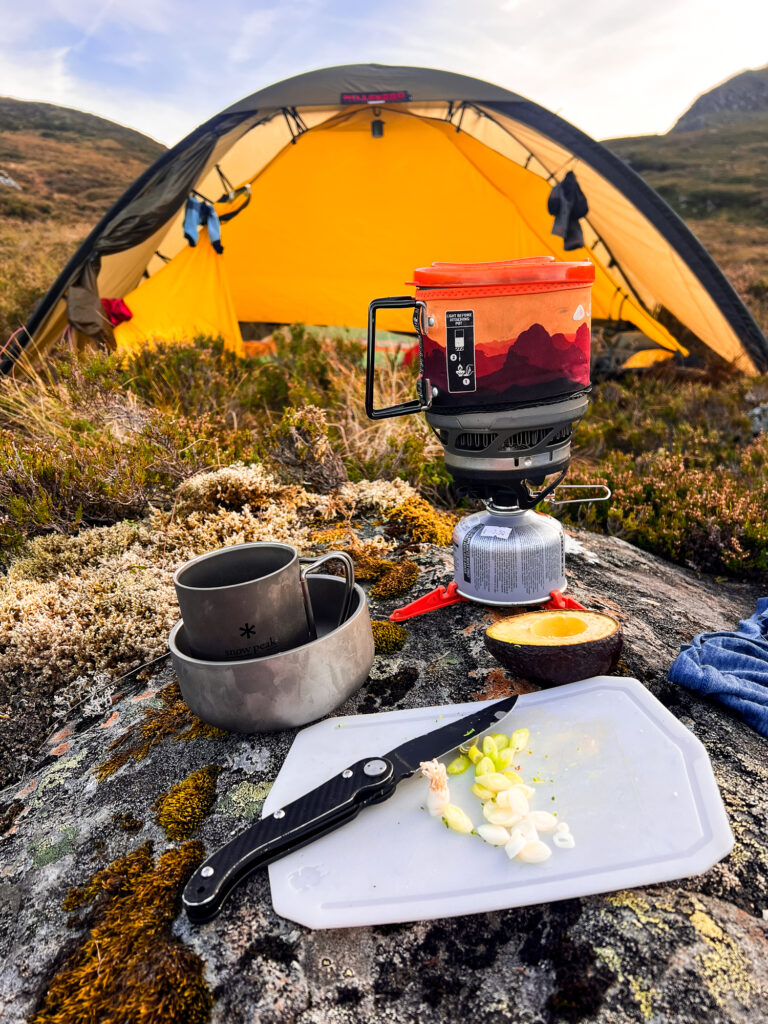 My essential wild camp kitchen includes: Jetboil Minimo, ultralight cutting board, a good folding knife, titanium bowl, and titanium mug. And an avocado, apparently.
Fuel: If you’re using a camping stove then you’re going to need fuel. The stoves mentioned above are canister stoves which use screw-on threaded canisters that contain two pre-pressurized gasses: isobutane and propane. Liquid-fuel stoves are another option which run on white gas and can be messier but easier to restock on international trips. See this article on how to choose a backpacking stove. Whatever type of stove you have, the message is the same: remember to bring fuel for it!
Pot for boiling water: Many drinks and meals can be prepared using just boiling water, and indeed, many people go for this approach to keep things simple. This is where a Jetboil or similar system with integrated pot can ease the simplicity. If you’re using a standalone stove, you’ll need a pot to boil water (and possibly eat from). Titanium pots have the big benefit of being lightweight, but they’re walls are very thin so they’re mostly only good for boiling water (even warming milk in a titanium pot is difficult). I have found my MSR Titan Kettle to be a nice all-arounder holding 0.85 liters and weighing just 118g.
Mug: For your coffee, tea, wine, beer, or other beverage of choice! I used to use enamel mugs but eventually came to my senses – they are heavy, don’t retain heat, and are can burn your mouth! A couple light-weight insulating mugs I’ve used and liked include: (1) Snow Peak double wall titanium mug and (2) this 100g GSI Insulated mug (which is also a good size for soups).
Spork: Need I say more? I have this Titanium Spork but really anything will do. You could also go for one of these fork / spoon / knife combos. Or whatever you have in your kitchen!
Knife or Multi-Tool: Useful for all manner of things, not just food. I have a Buck Knife with a partially serrated blade that comes in handy for slicing bread. Here’s a similar folding knife on Amazon for less than £10!
Hydration: In addition to a 3 litre hydration bladder I always carry a Sigg Bottle. Both are useful for transporting and storing water, and you can use the Sigg Bottle as a hot water bottle if the weather is cold!
Bonus extras:
 Blissful dinner al fresco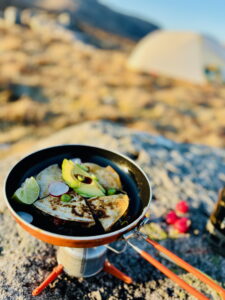



Thermos. I often take this Thermos King Food Flask on cold weather adventures which is awesome for soups and stews. Esbit is another excellent brand I can vouch for.
Portable egg storage box. We have a couple of these two-egg containers which has enabled us to enjoy fresh eggs on our trip. (Barring that, freeze dried powdered eggs are surprisingly good!)
Skillet. For fancier food (especially if you’ve packed those eggs!). Anything will do, but my personal choice is the Jetboil Summit Skillet.
Reusable wraps / food bags / beeswax wraps. Yes you could use baggies but reusable options are more environmentally friendly. We love these Boc’n’Roll food wraps. If you do use plastic baggies, consider washing and reusing them!
Mini cheese grater. Yes, it’s a thing. Well how else are you going to grate cheese over your veggie chilli and your spaghetti bolognese??
Extra pots, bowls, and/or plates. We like Snow Peak’s double wall titanium bowls for hot soups and cereals as they are lightweight and don’t get hot when you hold them (you can get similar products on Amazon for less).
Leak-proof food containers. Bulky, but handy for packing sandwiches, salads, and anything you don’t want to get battered in your pack. I’m a fan of these lunch box tins with wooden lid that doubles as a cutting board!
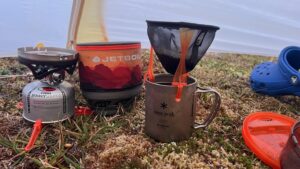
Coffee making kit. I used to always take a 1-cup plastic V60 coffee dripper which is lightweight and makes delicious coffee! I started to find it’s a bit bulky so have recently been using the Jetboil coffee press which packs easy and also makes a great brew.
Ultralight cutting board. Yes, this also is a thing. I have this one which cost just £3.50 and weighs next to nothing (OK, 23g). Great little extra!
Where can you get all this gear? You can see that the cost of a wild camping kitchen can add up, nevermind the cost of the rest of your backpacking kit! You can sometimes find good deals on pre-owned kit on eBay, Facebook Marketplace, and even charity shops. For new stuff I usually look to Cotswold Outdoor, REI (when visiting the USA), Ultralight Outdoor Gear, and sometimes Amazon.