


Agentic architecture is the shift from "chatbots that talk" to "systems that act." Unlike static LLM implementations, agentic systems utilize iterative reasoning loops, incorporating perception, planning, and tool execution, to solve complex, open-ended problems without human intervention. At Agix Technologies, we define this as the transition from generative output to autonomous outcome.
The End of the Prompt: Why Architecture Trumps Inference
Stop thinking about prompts. Start thinking about loops.
In the early days of generative AI, success was measured by the quality of a single response. For a 50-person operational team, that is a toy, not a tool. Production-grade agentic AI systems require a structural framework that allows an AI to observe its environment, reason through a series of steps, and execute actions via APIs.
Static LLMs are restricted by their training cutoff and linear processing. Agentic architecture breaks this ceiling by wrapping the LLM in a "Cognitive Module" that interacts with external memory, tools, and feedback sensors.
The Result: 82% reduction in manual oversight. 99% faster task completion. Real-world systems. Proven scale.
The Anatomy of an Autonomous Agent
An autonomous agent is not a single model. It is a four-part system designed for reliability and goal-alignment.
1. The Perception Module (The Sensors)
Before an agent can reason, it must perceive. This module ingest raw data, emails, database triggers, sensor logs, or Slack messages, and normalizes it.
- Role: Cleaning, filtering, and feature extraction.
- Engineering Note: Without a robust perception layer, your agent suffers from "garbage in, garbage out." We utilize advanced AI computer vision and OCR pipelines to ensure high-fidelity inputs.
2. The Cognitive Module (The Brain)
This is where the Large Language Model (LLM) resides, but it’s governed by a Reasoning Engine. This engine evaluates the perception data against explicit goals and guardrails.
- Reasoning Strategies: Chain-of-Thought (CoT), ReAct (Reason + Act), and Self-Reflection.
- Logic: It decides what needs to be done and which tool is required.
3. The Action Module (The Hands)
This module translates a cognitive decision into a system call. Whether it’s updating a CRM, triggering an n8n workflow, or deploying code, the action module handles the execution and monitors for success or failure.
4. The Orchestration Layer (The Executive)
The orchestrator manages the data flow between the brain and the hands. It handles error catching, retries, and task prioritization. It ensures that if a tool fails, the agent re-plans instead of crashing.
Mastering the Reasoning Loop: CoT vs. ReAct
To build high-performance autonomous agentic AI, you must choose the right reasoning loop.
| Loop Type | Logic Pattern | Best Use Case |
|---|---|---|
| Chain-of-Thought (CoT) | Steps: A -> B -> C | Complex math, logic puzzles, internal reasoning. |
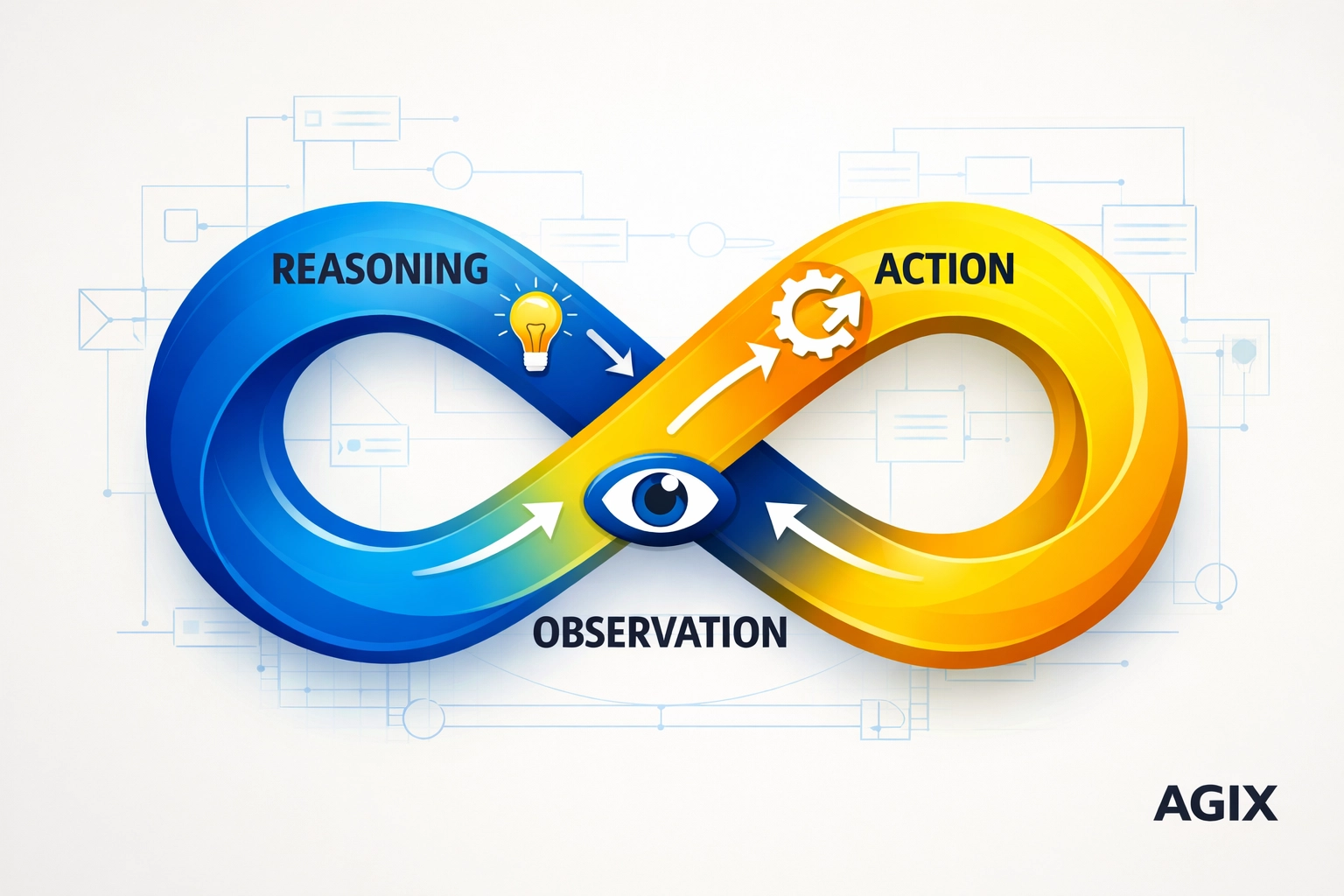
| ReAct | Reason -> Act -> Observe -> Repeat | Tool-use, web searching, API interactions. |
| Self-Refine | Draft -> Critique -> Edit | Coding, content creation, high-precision reporting. |
At Agix, we frequently implement the ReAct pattern. By forcing the agent to "observe" the outcome of its action before the next reasoning step, we eliminate the hallucination risks common in linear workflows.
Production-Grade Tech Stacks for Agentic AI
You cannot run an autonomous enterprise on a playground UI. You need an engineering stack built for agents.
- Frameworks: While LangChain is popular for prototyping, we recommend comparing AutoGPT, CrewAI, and LangGraph for production-grade state management.
- Memory/Storage: High-speed retrieval is non-negotiable. See our vector DB comparison between Chroma, Milvus, and Qdrant to understand where to store your agent's long-term memory.
- Knowledge Base: Implementing RAG knowledge AI ensures your agent has access to your company's private SOPs and data.
Implementation Insight: The HouseCanary Model
In our HouseCanary case study, we demonstrated how complex data retrieval loops could be automated to provide real estate insights at scale. The key was a tightly coupled reasoning-action loop that validated every data point before moving to the next calculation.
Scaling to Multi-Agent Systems (MAS)
Single agents are great for narrow tasks. For complex business processes, like end-to-end AI automation of a supply chain, you need a Multi-Agent System.
In a MAS, different agents take on specialized roles (e.g., a "Researcher Agent," an "Editor Agent," and a "Compliance Agent"). They communicate via a shared blackboard or direct messaging, overseen by a Manager Agent.
- Benefit: Specialization reduces the "cognitive load" on a single LLM, increasing accuracy.
- Challenge: Coordination overhead. High-latency loops can kill ROI.
Security and Observability: The Production Guardrails
Autonomy without oversight is a liability. Your agentic architecture must include:
- Tool Sandboxing: Agents should only access APIs in a restricted environment.
- Human-in-the-loop (HITL): For high-stakes actions (e.g., spending money, deleting data), the loop must pause for human approval.
- Audit Logs: Every "Thought," "Action," and "Observation" must be logged for compliance. Use tools like LangSmith or custom Arize Phoenix dashboards.
LLM Access Paths: How to Deploy This Today
How you access the underlying intelligence determines your architectural flexibility.
- Closed APIs (OpenAI, Anthropic): Fastest to deploy. Best-in-class reasoning. Use these for the "Cognitive Module" in most custom AI product development.
- Open Weights (Llama 3, Mixtral): Critical for data sovereignty and high-volume, low-cost "Sub-Agents."
- Perplexity/Search APIs: Use these as "Tools" within your perception module to give your agents real-time internet access.
FAQ: Agentic Architecture & Reasoning Loops
1. What is the difference between an LLM and an Agent?
An LLM is a model that predicts the next token. An agent is a system that uses an LLM as its core reasoning engine to complete tasks by interacting with the world.
2. Why do agents hallucinate, and how does architecture fix it?
Hallucinations occur when LLMs lack context or "guess" facts. Architecture fixes this by providing a "Perception" layer (RAG) and an "Observation" step in the reasoning loop to verify facts before acting.
3. What is the ReAct pattern?
ReAct stands for Reason + Act. It is a prompting technique that forces an agent to write out its reasoning, take an action, and then update its reasoning based on the result of that action.
4. Can I build agents with no-code tools?
Yes, tools like n8n and Flowise allow for basic agentic workflows. However, for AI predictive analytics or enterprise-scale systems, custom Python-based orchestration is usually required.
5. How much does it cost to run an agentic system?
Costs scale with the number of "loops." Multi-agent systems using GPT-4o can be expensive. We recommend using smaller, specialized models for sub-tasks to optimize ROI.
6. What is a "System Prompt" in agentic architecture?
It is the core instruction set that defines the agent's persona, tools, and constraints. It acts as the "Constitution" for the agent's reasoning.
7. Is multi-agent better than single-agent?
Not always. Multi-agent systems are more resilient for complex tasks but introduce latency and "coordination noise." Start single, then decompose as needed.
8. How do you handle long-term memory in agents?
We use Vector Databases and "Summary Memory" (where the agent periodically summarizes its past actions) to keep the context window from overflowing.
9. Can agents use voice interfaces?
Absolutely. By integrating AI voice agents, the "Action" module can include telephony or real-time audio streams.
10. How do I start building?
Define one repeatable, manual workflow. Map the "Anatomy" (Perception, Cognition, Action) for that workflow. Build a prototype using a framework like LangGraph. Or, contact Agix Technologies to engineer it for you.