


Military planners moved from presidential approval to a full-scale multinational strike on Iran in less than 10 hours, according to a detailed timeline describing the opening phase of Operation Epic Fury.
By yourNEWS Media Newsroom
The U.S. military moved from presidential authorization to the launch of a massive multinational strike against Iran in less than 10 hours, according to a timeline detailed in a report by The Epoch Times outlining the start of Operation Epic Fury.
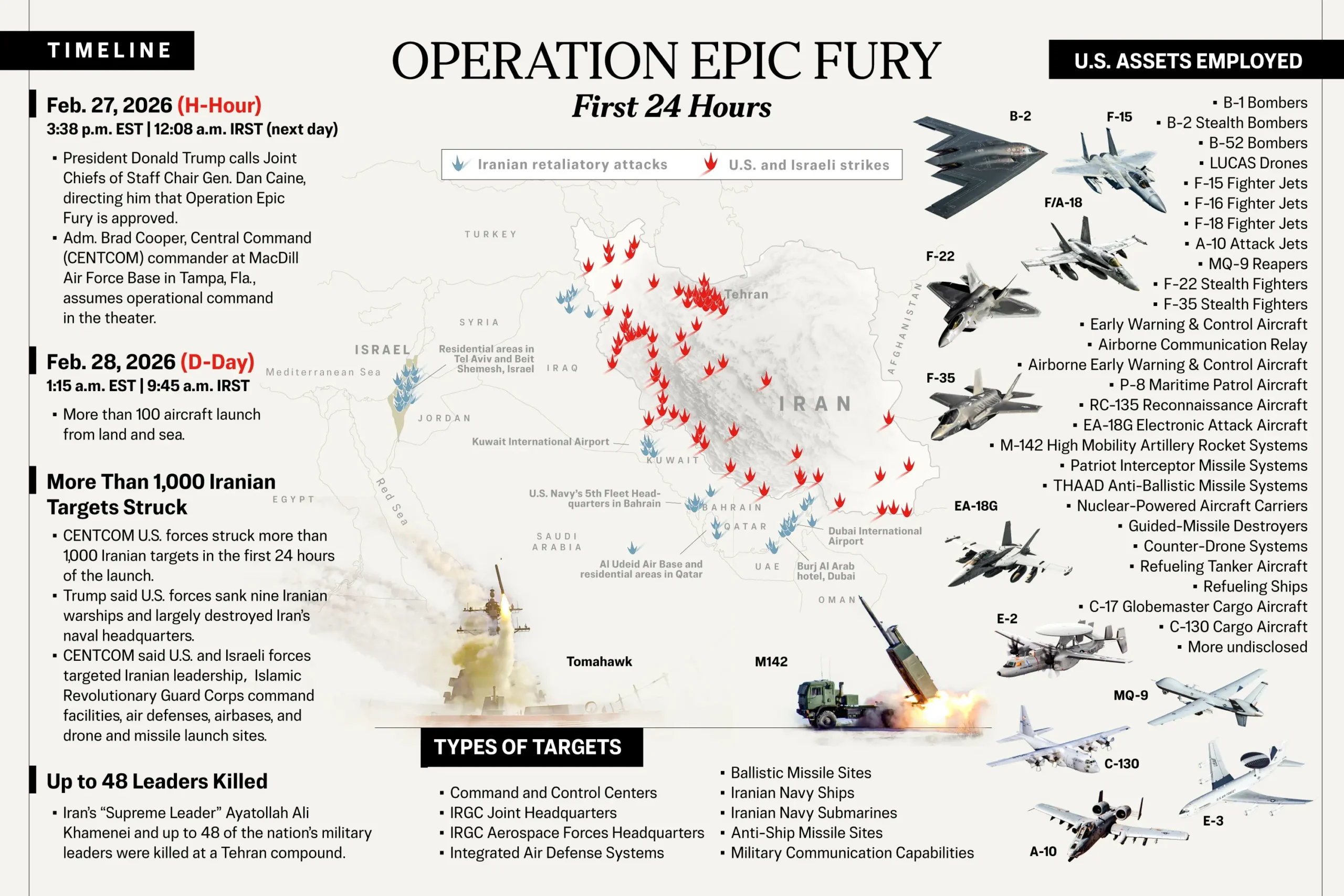
Illustration by The Epoch Times, Public Domain, Shutterstock
Planning for a large-scale U.S. strike against Iran had existed within the Pentagon for decades, dating back to 1980. However, the plan moved toward execution in December 2025 after President Donald Trump met with Israeli Prime Minister Benjamin Netanyahu in Washington and instructed military leaders to prepare a decisive military option if Tehran refused to halt its uranium enrichment program.
Following that directive, U.S. military planners began positioning assets across the region.
Joint Chiefs of Staff Chairman Gen. Dan Caine later described the preparation process during remarks to reporters, noting that the Pentagon began “setting the force and setting the theater” while repositioning military resources during the weeks leading up to the operation. According to reporting citing comments he told reporters, U.S. forces were moved during the previous 30 days to provide the president with operational options should military action become necessary.
Diplomatic talks collapsed on Feb. 26 when negotiations in Geneva between U.S. envoys and Iranian officials ended without an agreement. The American delegation included special envoy Steve Witkoff and Jared Kushner, who met with Iranian Foreign Minister Abbas Araghchi before leaving the talks without concessions from Tehran.
The following day, Trump issued the final authorization while traveling aboard Air Force One en route to Corpus Christi, Texas, where he was scheduled to appear at campaign events for Republican primary candidates.
Caine said the precise moment the Pentagon received the final order occurred at 3:38 p.m. Eastern time on Feb. 27.
“The president directed, and I quote: ‘Operation Epic Fury is approved. No aborts. Good luck,’” Caine said.
Once the directive was received, command centers across the U.S. military network began activating the operational plan. Adm. Brad Cooper, commander of U.S. Central Command at MacDill Air Force Base in Tampa, Florida, assumed operational command of the theater.
At the time of the authorization, it was shortly after midnight in Tehran on Feb. 28. During the hours that followed, military units across the region conducted final preparations.
Caine said air defense batteries were placed on alert while pilots rehearsed their strike missions and crews loaded final weapons. Two U.S. carrier strike groups also moved into launch positions.
“As dawn crept up, across the Central Command area of operations, skies surged to life,” Caine said.
More than 100 aircraft launched in coordinated waves from both land bases and naval platforms, including fighter jets, tankers, airborne early warning aircraft, electronic warfare platforms, bombers dispatched from the United States and unmanned systems.
The strike formation reached Iranian airspace at approximately 1:15 a.m. Eastern time, which corresponded to 9:45 a.m. in Tehran.
According to military officials, the timeline shifted from a nighttime assault to a mid-morning strike following a triggering event carried out by Israeli forces with support from U.S. intelligence assets. That opening strike reportedly killed Iranian leader Ali Khamenei along with up to 48 senior military leaders gathered at a compound in Tehran.
Within the first 24 hours, U.S. and allied forces struck more than 1,000 targets during the initial phase of the offensive, according to a statement announcing the start of the operation from U.S. Central Command.
Caine described the operation as a coordinated multinational effort involving thousands of personnel and extensive military resources.
“The full strength of America’s armed forces came together in a unified purpose against a capable and determined adversary,” he said.
The deployment included hundreds of advanced fighter aircraft from the Air Force and Navy, dozens of aerial refueling tankers, the USS Abraham Lincoln and USS Gerald R. Ford carrier strike groups, and a sustained flow of munitions and fuel supported by intelligence, surveillance and reconnaissance systems.
Military officials said additional forces continued to move into the region after the initial attack began.
Before missiles and aircraft struck their targets, the opening stage of the operation involved cyber and electronic warfare efforts conducted by Space Force, Army and Air Force units. These teams deployed “non-kinetic effects” designed to disrupt Iranian communications networks and degrade air defense systems.
With Iran’s command networks impaired and its air defense coordination disrupted, U.S. and Israeli aircraft quickly established localized air superiority.
The first missiles launched in the operation included Tomahawk cruise missiles fired from U.S. naval vessels operating with the carrier groups in the Arabian Sea and the eastern Mediterranean. According to another Epoch Times report, the cruise missiles opened the assault before waves of fighter aircraft moved against Iranian air defenses and missile launch infrastructure.
Air Force F-15 and F-16 fighters joined stealth F-22 Raptors, carrier-based F/A-18 Hornets, F-35 stealth fighters and EA-18G electronic warfare aircraft during the coordinated strike campaign.
Later phases included B-2 Spirit stealth bombers flying a 17-hour mission from Whiteman Air Force Base in Missouri. The aircraft targeted Iranian ballistic missile facilities using precision-guided 2,000-pound munitions.
Army units also participated using precision strike missiles launched from mobile M142 High Mobility Artillery Rocket Systems positioned at bases in Gulf states. The use of the system in the attack marked the first combat deployment of the short-range ballistic missile platform.
Pentagon officials said the operation also marked the combat debut of a low-cost unmanned combat attack system known as LUCAS, a one-way drone modeled on Iran’s Shahed-136 loitering munition that has been widely used in other conflicts.
Additional aircraft involved in the campaign included MQ-9 Reaper drones equipped with Hellfire missiles, A-10 attack aircraft, E-3 Sentry and E-2 Hawkeye airborne surveillance planes, EA-11A BACN communications relay aircraft and multiple aerial refueling tankers.
At the time of the operation, approximately 2,400 U.S. troops were stationed in Syria and Iraq, including forces operating from Erbil in northern Iraq. Around 2,000 of those personnel are members of the Iowa National Guard scheduled to be relieved by units from the 10th Mountain Division.
Some National Guard units had already begun returning to the United States before the attack began, though their current deployment status remains uncertain.
U.S. bases across the region, including installations in Iraq, have continued to face periodic missile and drone attacks from Iranian forces and affiliated militias.
Trump and Defense Secretary Pete Hegseth have not ruled out deploying ground forces if the conflict escalates, although military leaders have indicated that such a step is not currently planned.
Two Marine Expeditionary Units, each containing roughly 2,500 troops, remain deployed at sea but are currently positioned outside the Middle East. Marines aboard the USS Iwo Jima are operating in the Caribbean while those aboard the USS Tripoli are deployed in the western Pacific.
If ground forces were eventually required, analysts say initial deployments would likely come from rapid-response formations such as the 82nd Airborne Division and XVIII Airborne Corps at Fort Bragg, North Carolina, or the 101st Airborne Division based at Fort Campbell, Kentucky.
Other units capable of rapid deployment include the Fourth Infantry Division at Fort Carson, Colorado, and additional elements of the 10th Mountain Division currently training at Fort Polk, Louisiana.
Despite those options, Caine said during the March 2 briefing that while the possibility of “boots on the ground” remains available to planners, it is not currently the preferred course of action.
Instead, he said the next phase of the operation will focus on expanding air operations.
After Iranian defenses are degraded, Caine said the plan “allows aerial forces to mass for the big wave that is coming.”
Featured Photo: Official White House photograph shows US President Donald Trump, US Secretary of State Marco Rubio and White House Chief of Staff Susie Wiles monitoring activity related to Operation Epic Fury against Iran from an unnamed location © The White House