


Have you ever wondered how countries borrow money from the World Bank? It is actually quite interesting. The World Bank helps nations build roads, schools, hospitals, and much more. But each country borrows differently and for different reasons. Here is a simple guide to World Bank loans country wise.
What is the World Bank?
The World Bank was founded in 1944. Its primary purpose was to assist countries in their post-World War II recovery. Today, it focusses on poverty reduction and assisting countries in achieving safe and sustainable growth.
Key points:
• Offers loans, grants, and credits.
• supports programs in health, education, and infrastructure.
• Provides advice and counsel to governments.
• helps countries during catastrophes and emergencies.
The World Bank functions as a large financial aid provider for countries in need of assistance in their growth.
How the World Bank Gives Loans
The World Bank has two major loan programs:
1. International Bank for Reconstruction and Development (IBRD)
• Developed for middle-income and creditworthy low-income countries.
• Loans are at near-market rates and are typically repaid in 15 to 30 years.
• Used for major projects such as highways, energy plants, and civic improvements.
2. International Development Association (IDA)
· Designed for the world's poorest countries.
· Offers loans with very cheap or zero interest, as well as grants.
· Supports schools, hospitals, water supply, and social programmes.
Middle-income countries mostly use the IBRD, but the poorest countries rely on IDA to fund critical projects.
Top Borrowing Countries for 2025
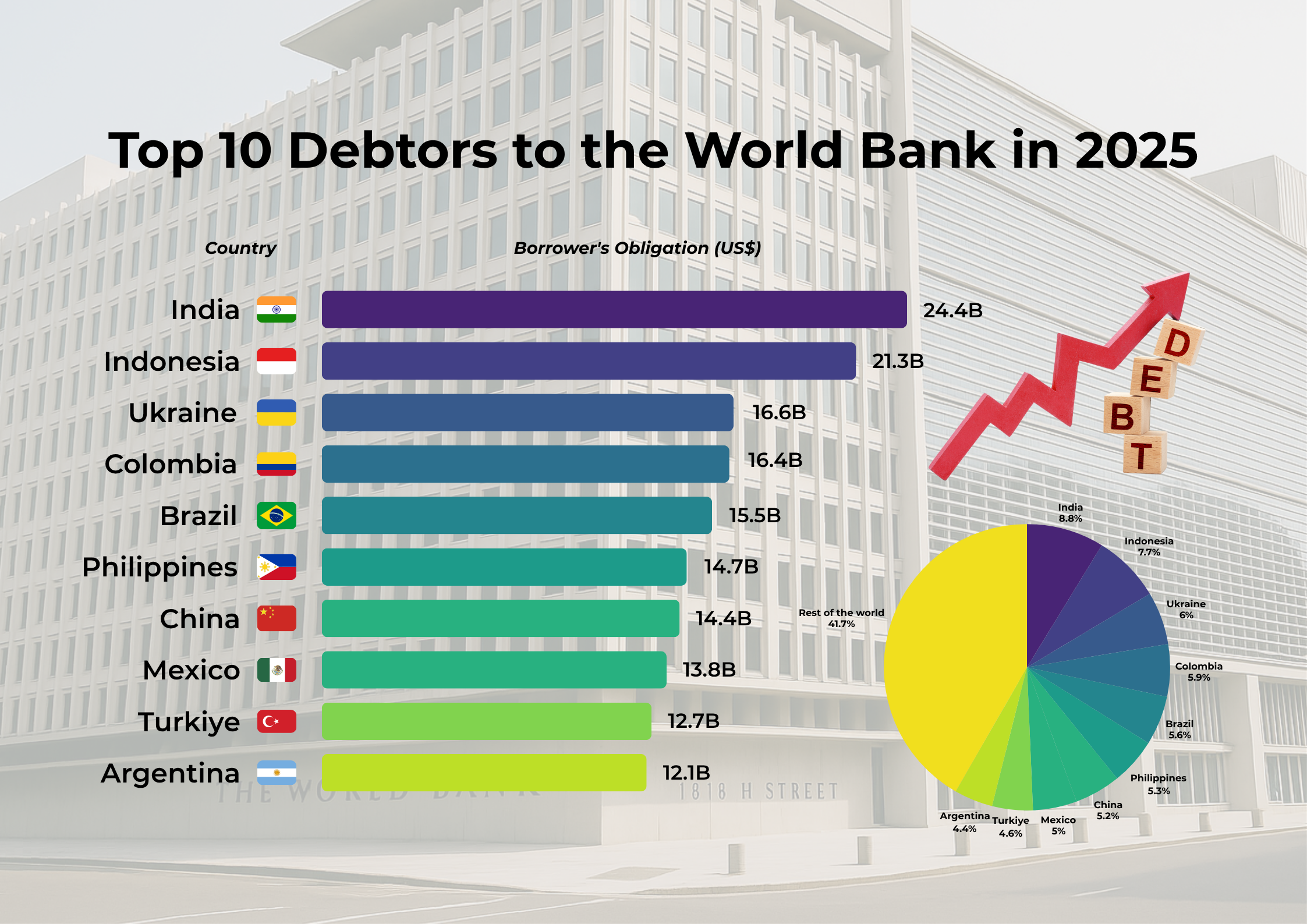
Countries borrow strategically Loans enable them to expand, improve services, and plan for the future Here are the top borrowers for World Bank loans by country in 2025:
· India: The largest borrower supports energy, rural development, education, and infrastructure
· Indonesia: Loans finance transportation, education, emergency preparedness, and environmental projects
· Ukraine: Borrowed significantly to rebuild and recover following hostilities
· Colombia: Loans are used to support rural development, social activities, and civic upgrades
· Brazil: Supports healthcare, urban development, and Amazon conservation
· Philippines: Loans support catastrophe preparation, social welfare, and infrastructure projects.
· China: Concentrate on rural development, pollution control, and poverty reduction.
· Mexico: Supports water management, energy initiatives, and social services.
· Turkey: Supports urban development, agricultural, and social projects.
· Argentina: Helps to stabilise the economy and relieve poverty during inflation
Tip: These ten countries account for more than half of all World Bank loans globally.
Why Countries Borrow?
Borrowing is more than simply money. It is about constructing a stronger future. Countries lend to:
· Build roads, bridges, and railroads.
· Improve schools, hospitals, and public services.
· Provide clean water and power.
· Protect the environment.
· Plan for catastrophes and calamities
Even powerful economies borrow money to fund initiatives without depleting their own resources.
How the World Bank Helps
· Provides money that countries would not have otherwise.
· Provides advice and help for large projects.
· Promotes growth and long-term planning.
· Helps governments manage debt properly to avoid difficulties.
The World Bank operates as a financial coach, providing all of the necessary tools for success.
Quick Summary
· Lending is organised into the IBRD and IDA.
· Top borrowers are India, Indonesia, and Ukraine
· Loans support infrastructure, social initiatives, and environmental projects
· Borrowing is strategic and allows countries to plan for the future
· The top ten borrowers are responsible for more than half of all loans.
Conclusion
The World Bank's loans are about more than money They are tools for growth, stability, and progress Countries such as India, Indonesia, and Ukraine show how borrowing may lead to a stronger economy, better services, and a more secure future Understanding World Bank loans by country reveals how money goes throughout the world and how the World Bank promotes global development.
Borrowing does not suggest weakness. It is a good option to build better nations for the future.